
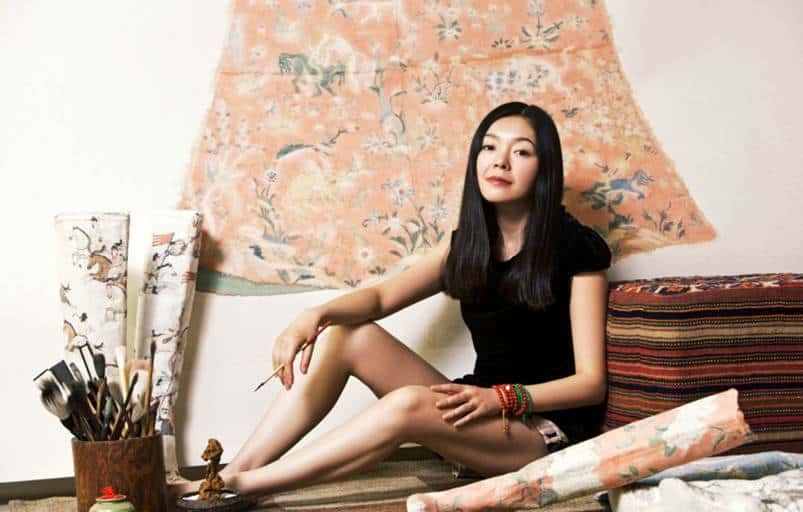
Peng Wei is a contemporary Chinese artist known for combining traditional ink painting with contemporary subject matter and sculptural form. Born in Sichuan in 1974, she builds on the conventions of Chinese painting while pushing them onto surfaces and formats that change how the work is read, including bodies, fragments, and other non-traditional supports.
| Born | 1974, Sichuan, China |
|---|---|
| Field | Contemporary art, ink painting |
| Education | BA in Fine Art, Nankai University, 1997; MPhil in Aesthetics, 2000 |
| Family | Daughter of the artist Peng Xiancheng |
| Editorial work | Editor at Yishu art magazine, 2000–2006 |
| Known for | Works that place Chinese painting traditions in dialogue with sculpture and the body |
What kind of artist is Peng Wei?
Peng Wei works at the edge of painting, where brush, ink, paper, and form no longer stay within the flat rectangle. Her practice is rooted in Chinese painting traditions, but she often transfers those traditions onto sculptural or bodily surfaces, creating an immediate tension between an old visual language and a contemporary physical object. That shift matters because it changes ink painting from a framed image into something spatial and almost performative.
Her work belongs to a broader generation of Chinese artists who have revisited classical materials without treating them as fixed heritage. Instead of quoting tradition as decoration, she tests how it behaves when placed in unfamiliar contexts. The result is work that can feel precise, restrained, and quietly unsettling at the same time.
How did her background shape her work?
Peng Wei studied Fine Art at Nankai University, then completed an MPhil in Aesthetics. That combination matters: one side of her education grounded her in making, while the other gave her a framework for thinking about images, symbols, and the status of artistic tradition. She also worked as an editor for Yishu, a contemporary art magazine, from 2000 to 2006, which would have kept her close to critical debates around Chinese and international art.
She is also the daughter of Peng Xiancheng, which places her within an artistic family and suggests early access to drawing, painting, and professional artistic culture. That background does not determine the work, but it helps explain the confidence with which she handles inherited forms. Her practice does not appear as a break from tradition so much as an argument carried out from within it.
Why does her use of ink matter?
Ink painting in China carries a heavy history. It is associated with scholarship, discipline, and the refinement of line and brushwork, and it has often been treated as a medium with strict visual and cultural codes. Peng Wei uses those codes without flattening them. By bringing ink painting into contact with unconventional formats, she exposes how much meaning the medium still carries, even when separated from its usual landscape, figure, or scroll conventions.
This is why her work is often discussed in relation to contemporary Chinese painting rather than simply “mixed media.” The important point is not novelty for its own sake, but the pressure created when a classical material meets a modern object. In her hands, ink is not nostalgic. It becomes a way to test memory, authority, and the continuing life of tradition.
Where has her work been seen?
Peng Wei was included among 25 artists in Contemporary Art from China: Visual Expression Through Ink and Paper, an exhibition that helped frame newer Chinese art through materials rather than through genre alone. That kind of exhibition context places her in a conversation about how ink and paper can operate in contemporary art without being reduced to either craft or revivalism.
Her visibility in such a survey reflects the wider interest in artists who work with traditional media while refusing to stay inside historical categories. For readers encountering her through a specific work, the key thing to notice is the way surface, support, and subject are never neutral. In Peng Wei’s art, the material choices carry the meaning.
Frequently Asked Questions
Is Peng Wei mainly a painter?
Yes, but only in a broad sense. Her work is grounded in Chinese painting, especially ink-based traditions, yet it often moves beyond the flat painted surface. The important part of her practice is the way painting behaves when it is placed in dialogue with sculpture and bodily form.
What makes her work contemporary rather than traditional?
She uses traditional materials and techniques without trying to preserve them unchanged. The contemporary aspect comes from the objects, contexts, and conceptual questions she brings to them. That includes the decision to place ink painting on forms that are not meant to function like a conventional scroll or hanging painting.
Why is her education relevant?
Her training in both fine art and aesthetics suggests a practice shaped by making and by critical thought. That combination helps explain why her work feels controlled and intellectually deliberate. It also fits an artist who is working with a medium as culturally loaded as Chinese ink painting.