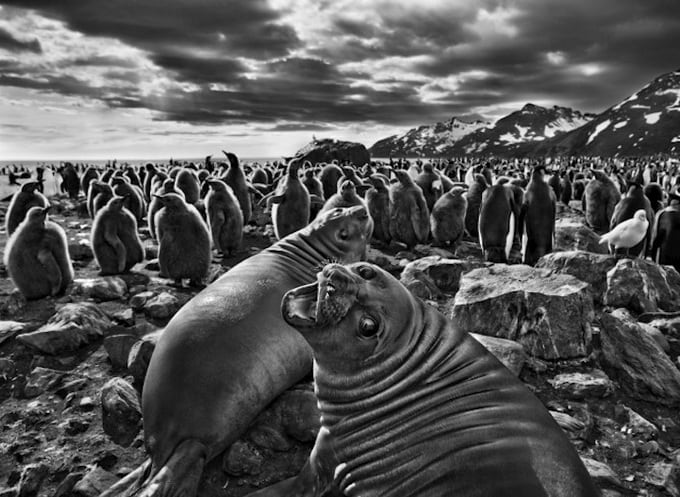
Sebastião Salgado is a Brazilian documentary photographer known for large-scale black-and-white photo essays about labour, migration, conflict, and the natural world. His work combines rigorous field reporting with a highly controlled visual style, turning social documentary photography into something that often reads as both witness and epic narrative.
- Born in Aimorés, Brazil, in 1944; trained first in economics before turning to photography.
- Built major long-form projects such as Workers, Migrations, and Genesis.
- Works almost entirely in black and white, using tonal range, scale, and repetition as core devices.
- Moves between photojournalism and fine-art exhibition practice, often showing images as large prints in carefully sequenced series.
Why Salgado matters
Salgado helped define a late-20th-century model of documentary photography built around long-term immersion. Rather than publishing isolated news images, he returns to the same subject for years, often across continents, to assemble bodies of work that track systems: industrial labour, displacement, famine, extraction, and ecological change. That method gives his pictures a structural force. The subject is not just a person or event but the conditions that shape many lives.
His influence also lies in how he handled form. The use of black and white is not nostalgic in his work; it strips away distraction and pushes attention toward gesture, texture, light, and mass. In exhibition, the photographs often appear as large, luminous prints that make faces, bodies, tools, and landscapes feel physically near. That visual authority has made him one of the most recognisable documentary photographers of his generation.
How did he work?
Salgado began his career after studying economics and working in development-related roles, which gave him early exposure to international inequality. He learned photography in the 1970s and quickly moved into reportorial work for agencies and magazines before pursuing independent projects. That path matters because it shaped his approach: he photographs as a field researcher as much as a picture-maker, spending long periods with miners, farmers, refugees, factory workers, and indigenous communities.
His process depends on extended travel, patient observation, and a tight edit. He often photographs in sequences that allow one image to answer another: a crowd against a horizon, a close view of hands, a portrait, then a wider environmental frame. This rhythm gives his books and exhibitions a strong tempo. Even when the subject is urgent or chaotic, the presentation tends to be measured and composed.
What does his photography look like in practice?
Many Salgado images rely on dramatic tonal contrast, dense shadows, and bright highlights. He frequently photographs in conditions where weather, dust, smoke, water, or strong sun become part of the visual structure. In Workers, bodies bent over machinery or climbing rough terrain are rendered almost sculpturally. In Migrations, lines of people moving through camps and borders create repeated forms across the frame. In Genesis, landscapes and wildlife are arranged with an almost monumental clarity.
The scale of his prints is important. Small reproductions can flatten the work into familiar reportage, but large prints reveal fine gradations in skin, fabric, mud, metal, and stone. His images often balance empathy with distance: they ask for close attention, yet they also keep the subject within a broad social or geographic frame. That tension is central to his style and to the debates around it.
Why has Salgado been debated?
Salgado has attracted admiration and criticism in equal measure. Supporters value the seriousness of his long-term engagement and his ability to make structural violence visible. Critics have questioned whether the beauty of his images can aestheticise suffering, especially when famine, war, or displacement are rendered with monumental compositional care. That debate has followed documentary photography for decades, but Salgado sits near its centre because his style is so distinctive and so polished.
He has also been criticised for the distance between photographer and subject that can come with large, internationally circulated projects. At the same time, his later environmental work expanded the scope of his practice beyond human crisis alone, linking social documentary photography to land restoration and ecological repair. The result is a career that is both admired and argued over, which is usually a sign of lasting cultural force.
Frequently Asked Questions
Is Sebastião Salgado a photojournalist or an արվեստ photographer?
He began in photojournalism and documentary reporting, but his mature work also belongs to the world of gallery photography and exhibition making. The same image can function as evidence in a journalistic context and as part of a formally composed series in a museum. That dual position is one reason his work remains influential.
Why are most of his photographs black and white?
Black and white gives his pictures a strong graphic structure and removes the informational noise of colour. It also allows him to emphasise light, shadow, texture, and form, which are central to his compositions. The choice helps unify projects that span many countries and different kinds of subjects.
What are his best-known projects?
His major series include Workers, which focuses on manual labour; Migrations, which records displaced and mobile populations; and Genesis, which turns toward wild landscapes, animals, and remote communities. These projects show the range of his interests while keeping a consistent visual language. Each one is built from long-term fieldwork rather than quick assignment photography.
Articles mentioning Sebastião Salgado