
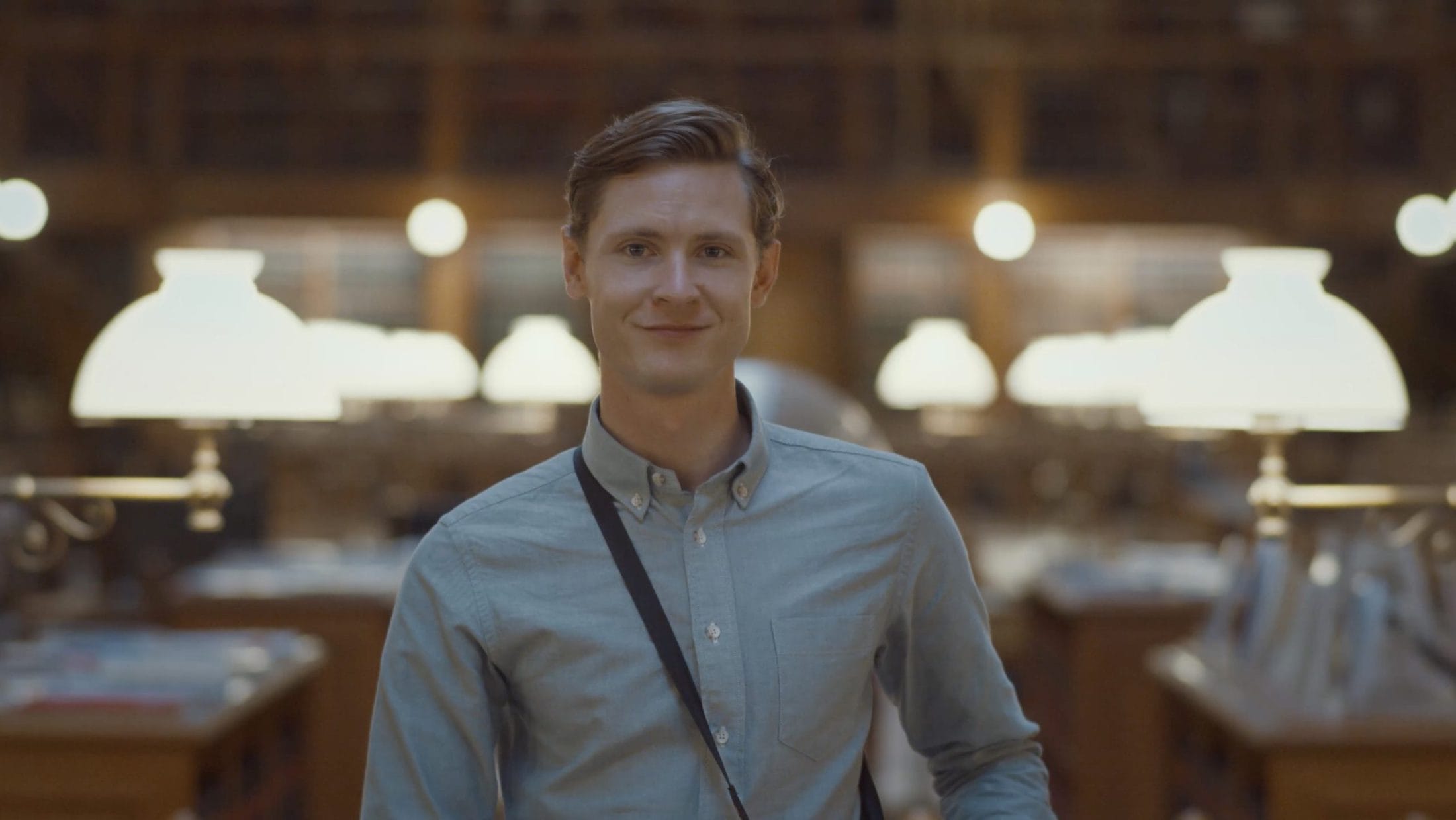
Thibaud Poirier is a French architectural and urban photographer known for images of libraries, places of worship, and other civic interiors. Born and raised in Paris, he has spent much of his life moving between cities such as Buenos Aires, Houston, Montreal, and Tokyo, and that experience shapes his eye for built space. He works as a self-taught photographer and often uses night photography to bring out structure, atmosphere, and scale.
- French photographer based in Paris
- Focuses on architecture, interiors, and urban environments
- Self-taught, with work informed by lived experience in multiple cities
- Night photography is a recurring part of his practice
- Has photographed libraries, modernist religious buildings, and other public spaces
What kind of photographer is he?
Poirier works in architectural photography, but his pictures are less about documenting buildings as objects and more about showing how spaces feel when they are empty, quiet, or lit at unusual hours. He pays close attention to symmetry, material surfaces, and the way light pulls out volume from concrete, glass, stone, and wood. In that sense, his work sits between documentary photography and visual interpretation.
His subject matter often includes interiors that are difficult to photograph well: large reading rooms, chapels, sanctuaries, corridors, and atriums. These are spaces built for movement, reverence, study, or pause, and his images tend to flatten distractions so the underlying design reads clearly. The result is precise rather than ornate.
How did his style develop?
Poirier’s background in several cities matters because it gave him repeated contact with different kinds of urban fabric. Paris, Buenos Aires, Houston, Montreal, and Tokyo each offer different ideas of density, scale, and public space, and those contrasts show up in his eye for composition. Instead of treating architecture as a single style, he approaches it as a changing set of habits, materials, and spatial solutions.
Being self-taught also shaped the work. Without a formal school system setting his methods, he built his practice around looking, patience, and repetition. That often shows in the clarity of his framing and his preference for controlled conditions, especially when working after dark or in low light.
Why does night photography matter in his work?
Night photography gives Poirier’s images a specific mood, but it is also a technical way of revealing architecture. At night, artificial light isolates certain parts of a building while leaving others in shadow, which can sharpen lines and simplify complex interiors. The effect is often calm, almost reverential, and it suits spaces that are already designed for contemplation.
It also helps him control visual noise. Crowds, street clutter, and incidental movement disappear, leaving light, structure, and proportion to carry the image. In a library or a modernist church, that can make a building look more legible than it does in daylight.
What does his work look like in practice?
In practice, Poirier’s photographs often feature central perspectives, strong geometry, and balanced symmetry. He tends to work with broad compositions that let a viewer read the whole room, then linger on details such as ribs, columns, shelving, glazing, or the junction between old and new materials. The images are usually crisp and restrained rather than dramatic in a theatrical sense.
Because he focuses on interiors and urban spaces, his subjects often carry traces of use: worn seating, stacked books, illuminated altars, polished floors, and the quiet infrastructure of public life. He does not strip away those signs. Instead, he uses them to show how architecture is inhabited and how design shapes behavior.
Frequently Asked Questions
Is Thibaud Poirier an architectural photographer?
Yes, but his practice is broader than pure documentation. He photographs architecture, interiors, and urban environments, often with attention to mood and atmosphere rather than catalogue-style completeness. Libraries and religious spaces are recurring subjects because they offer strong geometry and distinctive light.
What makes his images recognizable?
His images often use symmetry, clean framing, and low or artificial light to emphasize structure. He tends to photograph spaces when they are quiet, which allows materials and spatial order to stand out. The work usually feels calm and carefully composed rather than busy or spontaneous.
Where is he based?
Poirier is based in Paris, where he was born and raised. His work has been shaped by time spent in several other cities, but Paris remains his home base. He also takes freelance commissions locally and abroad.