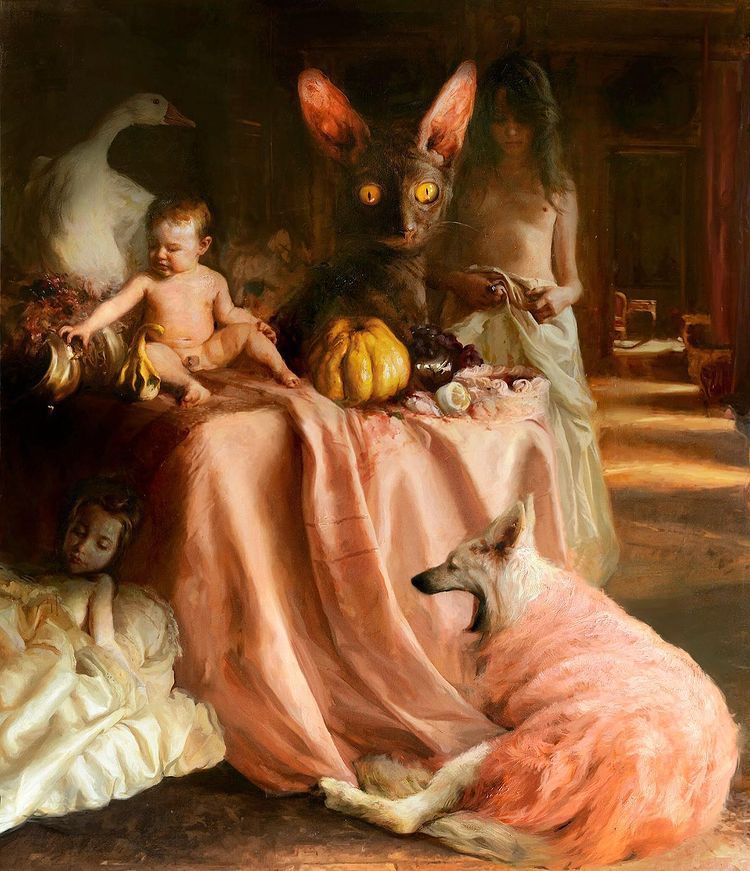
Baroque is a style of art, architecture, music, and writing that emerged in Rome around 1600 and spread across much of Europe, using movement, contrast, ornament, and dramatic scale to create intensity and emotional force. It was shaped by courts, churches, and powerful patrons who wanted images and spaces that could persuade, impress, and overwhelm.
- Baroque began in early 17th-century Rome and spread through Catholic and Protestant Europe in different forms.
- It favors motion, strong light and dark contrast, rich ornament, and scenes that feel immediate or theatrical.
- In painting and sculpture, figures often twist, lean, or break across boundaries to create energy.
- In architecture, it uses curves, columns, domes, gilding, and layered space to control how a viewer moves through a building.
- The term now also describes later revivals and any work that borrows its dramatic, ornate visual language.
What Baroque means in practice
Baroque work rarely aims for calm balance. It prefers diagonals over straight lines, suspended moments over static poses, and dense surfaces over plain ones. A Baroque painting may use a single beam of light to isolate a face or hand. A Baroque church may lead the eye toward an altar with sweeping walls, painted ceilings, marble, gilt bronze, and concealed windows that make the interior feel alive.
That theatrical quality was not accidental. Artists and architects used the style to produce clarity and persuasion as much as beauty. The viewer should understand the scene quickly, but also feel its force. In this sense Baroque is both highly crafted and highly directed: every curve, shadow, and decorative detail serves an emotional effect.
Where did the Baroque come from?
Baroque took shape in Rome in the early 17th century, in the wake of the Counter-Reformation. The Catholic Church used art and architecture to reinforce doctrine and inspire devotion, while monarchs and aristocrats used the same language of grandeur to present authority. From Italy, the style moved into Spain, France, the Low Countries, Austria, Germany, and parts of Eastern Europe, where local traditions changed its appearance.
The style did not look identical everywhere. Italian Baroque often feels theatrical and forceful; Dutch Baroque painting can be more intimate and domestic; French Baroque architecture often appears more controlled and symmetrical. Even with these differences, the shared vocabulary remains clear: depth, motion, ornament, and a strong sense that art should act on the viewer.
What does Baroque look like?
In painting, Baroque artists often used chiaroscuro, the strong contrast between light and dark, to model forms and direct attention. Caravaggio made figures emerge from darkness as if lit by a stage lamp. Rubens filled canvases with muscular bodies, swirling drapery, and crowded movement. In sculpture, Gian Lorenzo Bernini turned marble into something that seems to breathe, cry, or shift under pressure.
In architecture and decorative arts, Baroque often relies on expensive materials and skilled surface work: stucco, marble, gilding, carved wood, fresco, bronze, and complex joinery. Interiors may feel layered and immersive rather than openly structural. Even when the plan is orderly, the details push outward, curve, or erupt into ornament. The result is a built environment that feels staged rather than merely constructed.
Why Baroque still matters
Baroque matters because it helped define how Western visual culture uses spectacle. Many later styles borrowed from it, including Rococo, Neoclassicism in reaction against it, and 19th- and 20th-century revivals that used “baroque” to mean lavish, elaborate, or overly ornate. The word has also moved beyond the historical period and now describes any work that feels richly decorated, highly expressive, or intensely layered.
For contemporary artists and designers, Baroque remains useful as a reference point for composition and atmosphere. A photographer might use hard highlights and deep shadow to create a Baroque mood. A fashion image might borrow its pose, drapery, and sense of tableau. A watch engraver or product designer might echo Baroque ornament in the density of a surface, where repeated motifs and fine carving turn an object into a display of skill.
Frequently Asked Questions
Is Baroque the same as Baroque style?
Yes. “Baroque style” is simply a descriptive phrase for the same historical and visual category. In practice, the shorter form is usually used for the broader movement, while “Baroque style” can point to a specific object, image, or revival that uses its language.
How is Baroque different from Renaissance art?
Renaissance art tends to emphasize proportion, balance, and rational space. Baroque pushes toward movement, theatrical contrast, and emotional immediacy. Where Renaissance compositions often feel stable and centered, Baroque compositions usually feel as if something is happening right now.
Why do people still call something Baroque today?
The word has survived because it names a recognizable visual effect: ornate, dramatic, and highly worked. Modern use can describe historic pastiche, but it can also describe any object or image with dense detail and a strong sense of performance. That is why the term appears in art, fashion, photography, and design far beyond the 17th century.
Articles mentioning Baroque