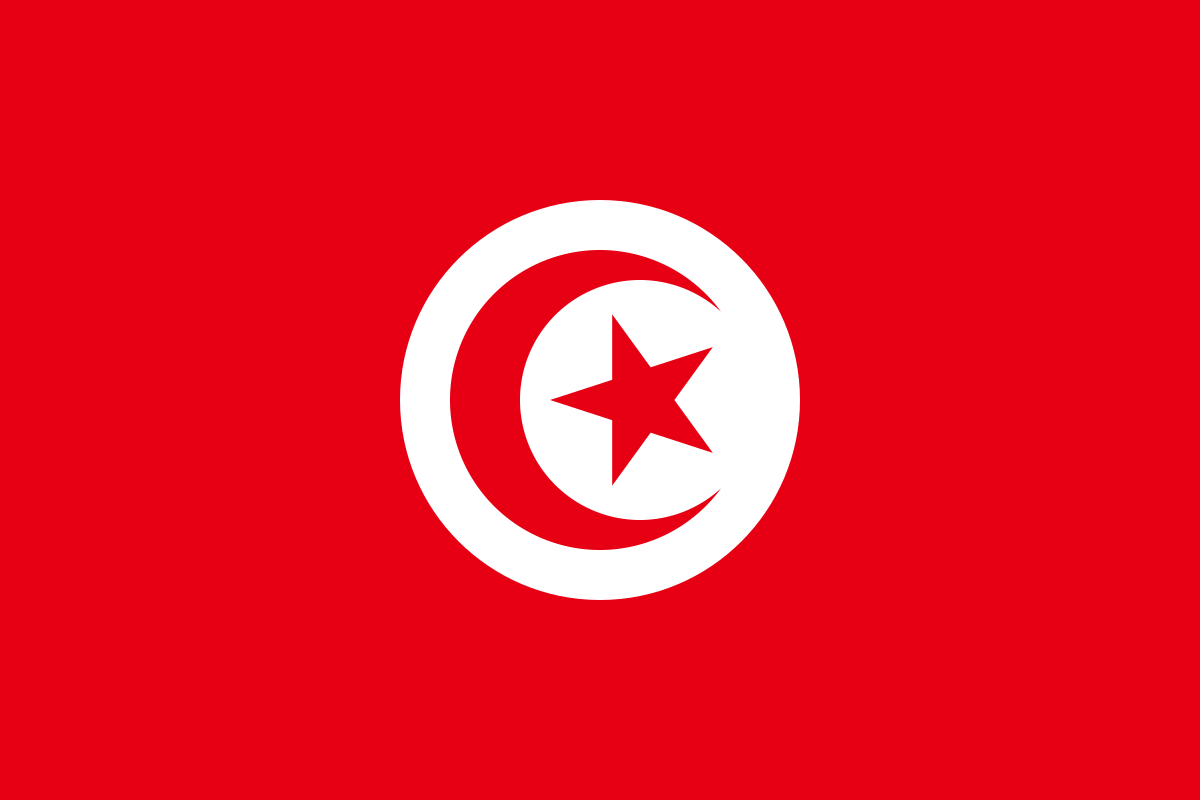
Tunisia is a North African country on the Mediterranean coast, bordered by Algeria to the west and Libya to the southeast. It is the smallest country in the Maghreb, with a long history shaped by Punic, Roman, Arab, Ottoman, and French influence. Its capital, Tunis, sits in the northeast and gives the country its name.
| Fact | Detail |
|---|---|
| Official name | Republic of Tunisia |
| Region | North Africa, Maghreb |
| Capital | Tunis |
| Borders | Algeria, Libya, Mediterranean Sea |
| Area | About 165,000 square kilometres |
| Population | Just under 10.7 million |
Where Tunisia sits and why that matters
Tunisia occupies a narrow stretch of land between the sea and the Sahara. That position made it a crossroads for trade, migration, and empire, and it still shapes daily life. Coastal cities such as Tunis, Sfax, and Sousse look toward the Mediterranean, while the south opens into desert landscapes and oasis towns.
Its location also helps explain its visual character. Tunisian streets often combine French colonial planning, Islamic architecture, and practical modern building, while older medinas preserve dense alleyways, tiled courtyards, and carved doors. For photographers and designers, the country offers a strong contrast between public facades and intimate interior spaces.
What is Tunisia known for culturally?
Tunisia is known for a culture that blends Arab, Amazigh, Mediterranean, and European influences. That mix appears in language, food, craft, and architecture. Arabic is the main language, French remains widely used in administration and education, and traditional forms of dress and domestic design continue alongside modern urban life.
The country has a strong craft tradition, especially in ceramics, weaving, metalwork, and leather. In places such as the medina of Tunis or the pottery town of Nabeul, making remains visible rather than hidden: shopfronts display hand-painted tiles, hammered brass, embroidered textiles, and woven mats. These objects matter not just as souvenirs but as evidence of long-running workshop systems and local skill.
How did Tunisia become a modern state?
Tunisia became independent from France in 1956 after decades as a French protectorate. Before that, it had passed through a long sequence of rulers and colonial powers, including the Carthaginian state in antiquity, Roman rule, Islamic dynasties, and Ottoman administration. Each period left traces in ruins, street plans, religious buildings, and place names.
Modern Tunisia emerged as a republic under Habib Bourguiba, whose government pushed secular reform, education, and state-led modernization. Later political changes, including the 2011 revolution, made Tunisia a central reference point in debates about democracy in the Arab world. That political history matters because it affects how public space, protest, and image-making are read there.
Why Tunisia appears in visual culture
Tunisia often appears in photography and design because it compresses many visual registers into a small area. A single project can move from Roman ruins to whitewashed seaside towns, from market stalls to desert roads, and from new apartment blocks to carefully preserved medina houses. The country’s light, color, and street texture make it especially legible to image-makers.
It also serves as a useful setting for work about everyday urban life. A photographer looking for an “honest spirit” in a city often finds it in the ordinary details: laundry lines, shop shutters, scooter traffic, worn stone steps, and the repeated patterns of tiled thresholds or shaded arcades. Tunisia’s built environment makes those details easy to notice because older structures still sit close to active daily use.
Frequently Asked Questions
Is Tunisia part of North Africa or the Middle East?
Tunisia is geographically part of North Africa and culturally part of the Arab world, so it is often discussed in both regional frames. The term Maghreb is also used for Tunisia and its western neighbors. In practice, the country sits at the meeting point of African, Mediterranean, and Arab histories.
What language is spoken in Tunisia?
Arabic is the official language, and Tunisian Arabic is widely spoken in daily life. French is also common, especially in business, higher education, and formal writing. Amazigh languages have a smaller presence and connect to the region’s deeper pre-Arab history.
What does Tunisia look like physically?
Tunisia has a Mediterranean north with fertile plains, olive groves, and coastal cities, then becomes drier toward the south. The Sahara reaches into the country, so the landscape shifts from urban streets and farmland to salt lakes, desert plateaus, and oasis settlements. That range gives the country a striking visual variety within a relatively small area.