
The United Arab Emirates is a federation of seven emirates on the southeastern edge of the Arabian Peninsula, along the Persian Gulf. It emerged in 1971 from a set of British-protected sheikhdoms and is governed as a constitutional monarchy, with each emirate ruled by a hereditary emir. Abu Dhabi is the capital and Dubai is the best-known commercial centre.
Stories from United Arab Emirates
19 stories



About United Arab Emirates
| Type | Federal state |
|---|---|
| Region | Arabian Peninsula, Persian Gulf |
| Founded | 1971 |
| Capital | Abu Dhabi |
| Largest city | Dubai |
| Constituent emirates | Abu Dhabi, Dubai, Sharjah, Ajman, Umm Al Quwain, Ras Al Khaimah, Fujairah |
Read the full overviewHow the federation works, Why the UAE matters in architecture and design, What it looks like on the ground, What visitors and residents encounter
How the federation works
The UAE is not a unitary state. Power is divided between the federal government and the individual emirates, which keep substantial control over local affairs, land, and economic policy. The Supreme Council, made up of the seven rulers, chooses the president and vice president from among its members. In practice, Abu Dhabi and Dubai set much of the country’s political and economic direction.
This structure matters for how cities are built, how property is sold, and how major projects are approved. A tower in Dubai, a museum in Abu Dhabi, or a development on reclaimed coastland may sit within one national framework but move through local systems of regulation, patronage, and investment.
Why the UAE matters in architecture and design
The UAE has become one of the most visible construction landscapes in the world. Oil wealth, global trade, aviation, tourism, and finance have helped produce a rapid build-out of infrastructure, skyscrapers, resorts, cultural institutions, and master-planned districts. Dubai in particular has been used as a testing ground for ambitious real estate and urban branding.
That built environment often relies on imported materials, international design firms, and large-scale engineering. Glass curtain walls, steel frames, precast concrete, desalination systems, climate-controlled interiors, and artificial landforms all play a part. The result is a landscape where architecture is inseparable from logistics, capital, and environmental control.
What it looks like on the ground
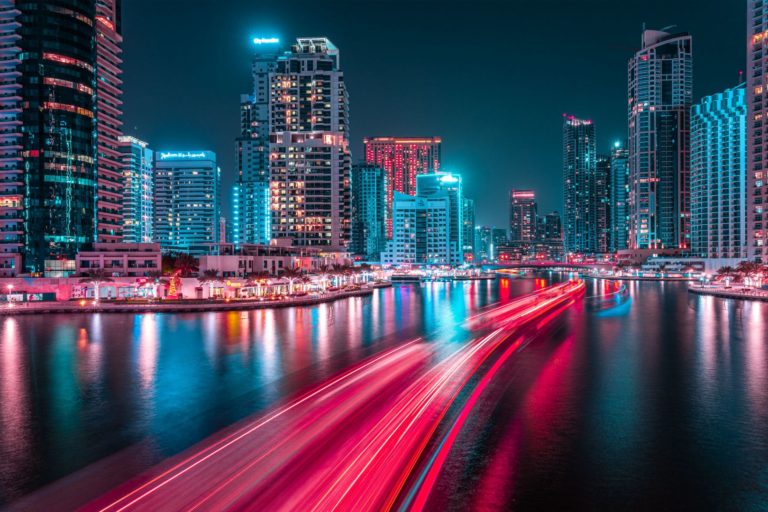
The UAE combines hypermodern districts with older urban fabrics and open desert. In Dubai and Abu Dhabi, airport terminals, museum precincts, highway interchanges, and waterfront towers stand beside low-rise neighborhoods, souqs, and industrial zones. Inland and on the coast, the desert remains a defining material condition, shaping heat management, shading, water use, and the color and texture of buildings.
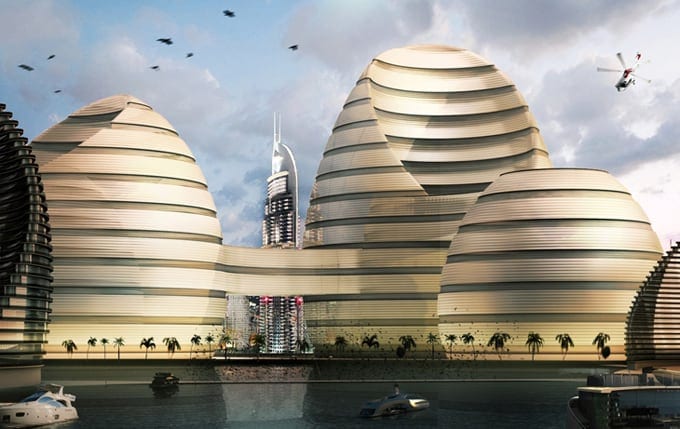
Its cities are also marked by strong visual contrasts: reflective towers rising from sand-colored ground, planted islands edged by breakwaters, and vast roads crossing empty expanses. Many projects aim to create a sense of spectacle at a very large scale, whether through height, engineered coastlines, or carefully controlled public realms.
What visitors and residents encounter
For residents, the UAE is a place of high mobility and sharp social stratification, with a large expatriate workforce supporting construction, hospitality, retail, and domestic labor. For visitors, it often appears as a set of highly curated experiences: airports, malls, museums, resorts, and observation decks. Those experiences are part of the country’s economic model and its image-making strategy.
That image can obscure the older coastal trading history of the region, the political bargain that formed the federation, and the environmental cost of maintaining dense urban life in a hot desert climate. At the same time, the UAE remains a major site for contemporary architecture, design patronage, and experimental urban development, which is why it appears so often in discussions of scale, monumentality, and transformation.
Frequently Asked Questions
Is the UAE a country or a city?
The UAE is a country made up of seven emirates. Abu Dhabi is the capital, while Dubai is its largest and best-known city. The federation gives each emirate a ruler and a degree of autonomy.
Why does the UAE appear so often in architecture coverage?
It has become a major client for global architecture firms and a site for very large development projects. The combination of state wealth, fast growth, and a strong appetite for landmark buildings has produced museums, towers, airports, and resort complexes that attract international attention. Many of these projects also push technical limits in climate control, construction, and coastal engineering.
Is Dubai the same as the UAE?
No. Dubai is one of the seven emirates within the UAE. It has its own ruler and government, but it also forms part of the federal state. Much of the country’s international profile comes through Dubai, which can make the distinction easy to miss.
}’} json code block to=final icator 不中反ైన conversion error? No۔ 0json to=final स्ता roundtrip ುವುದು 重庆时时彩彩 to=final 微信的天天中彩票 জ্জಾ ుకున్నారు મુદ્દો to=final രംഗത്ത് ుంది เติมเงินไทยฟรี]})