
Abu Dhabi is the capital of the United Arab Emirates (UAE) and the largest of the country’s seven emirates. Located on an island in the Persian Gulf, it serves as the political, economic, and cultural center of the UAE. Known for its modern skyline, luxurious lifestyle, ambitious architecture, and deep-rooted traditions, Abu Dhabi has transformed from a small fishing and pearling settlement into one of the world’s wealthiest cities thanks to its vast oil reserves and strategic development.
Stories from Abu Dhabi
10 stories


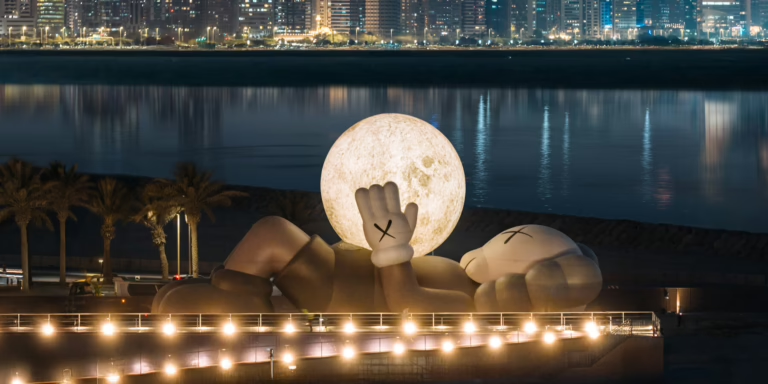


About Abu Dhabi
Today, Abu Dhabi is recognized as a global hub for business, finance, tourism, and culture, attracting millions of visitors each year with its blend of futuristic landmarks and preserved Arabian heritage.
Read the full overviewHistory, Geography, Economy, Government
History
For centuries, the region around Abu Dhabi was inhabited by Bedouin tribes who relied on fishing, pearl diving, camel herding, and trade for survival. The city itself was founded in 1761 after members of the Bani Yas tribe discovered a freshwater spring on the island, making permanent settlement possible.
The ruling Al Nahyan family established Abu Dhabi as their seat of power, and the city gradually grew as a regional trading center. During the 19th and early 20th centuries, pearling became the area’s primary economic activity, but the industry declined following the introduction of cultured pearls.
A dramatic turning point came in 1958, when commercial oil was discovered. Oil exports began in 1962, generating enormous wealth that fueled rapid modernization. Roads, schools, hospitals, airports, and residential districts were constructed within just a few decades.
When the United Arab Emirates was formed in 1971, Abu Dhabi became the nation’s capital, with Sheikh Zayed bin Sultan Al Nahyan serving as the country’s first president. Often referred to as the “Father of the Nation,” Sheikh Zayed played a crucial role in uniting the emirates and guiding the country’s development.
Geography
Abu Dhabi lies along the southeastern coast of the Persian Gulf and covers approximately 67,340 square kilometers (26,000 square miles), making it the largest emirate in the UAE. Despite the city’s island setting, numerous bridges connect it to the mainland.
The emirate’s landscape consists primarily of:
- Coastal islands
- Sandy deserts
- Salt flats (sabkhas)
- Mangrove forests
- Inland oases
One of its most famous natural landmarks is the Liwa Oasis, located on the edge of the vast Empty Quarter (Rub’ al Khali), the world’s largest continuous sand desert.
Economy
Abu Dhabi possesses approximately 90% of the UAE’s oil reserves, making petroleum the backbone of its economy. The emirate is home to the headquarters of the Abu Dhabi National Oil Company (ADNOC), one of the world’s largest energy producers.
In recent decades, Abu Dhabi has actively diversified its economy by investing in:
- Renewable energy
- Artificial intelligence
- Aerospace
- Financial services
- Tourism
- Manufacturing
- Technology
- Logistics
Major investment funds such as the Abu Dhabi Investment Authority manage hundreds of billions of dollars in assets worldwide, making Abu Dhabi one of the most influential financial centers in the Middle East.
Government
As the capital of the UAE, Abu Dhabi hosts the country’s federal government institutions, presidential palace, ministries, embassies, and diplomatic missions.
The emirate is ruled by the Al Nahyan family, whose members have governed the region for over 250 years. The ruler of Abu Dhabi traditionally serves as the President of the United Arab Emirates.
Culture
Despite its rapid modernization, Abu Dhabi has preserved many aspects of Emirati culture. Traditional customs remain important, including hospitality, falconry, camel racing, Arabic coffee ceremonies, and Islamic architecture.
The city also hosts international cultural institutions and festivals, reflecting its goal of becoming a global center for arts and education.
Notable museums include:
- Louvre Abu Dhabi
- Qasr Al Watan
- Qasr Al Hosn
Architecture
Abu Dhabi combines traditional Islamic design with contemporary engineering. Among its most recognizable landmarks is the magnificent Sheikh Zayed Grand Mosque, one of the world’s largest mosques. Constructed from white marble, it features 82 domes, over 1,000 columns, intricate floral mosaics, and one of the largest hand-knotted carpets ever made.
Other iconic buildings include:
- Etihad Towers
- Emirates Palace Mandarin Oriental
- Aldar Headquarters
- Capital Gate, famous for its dramatic leaning design
Tourism
Abu Dhabi has become one of the Middle East’s leading tourist destinations, offering luxury resorts, pristine beaches, desert adventures, shopping, museums, and world-class entertainment.
Popular attractions include:
- Ferrari World Abu Dhabi
- Yas Marina Circuit, home of the Formula One Abu Dhabi Grand Prix
- Warner Bros. World Abu Dhabi
- SeaWorld Abu Dhabi
- Saadiyat Island
- Corniche Road
Visitors can also experience desert safaris, dune bashing, camel riding, and traditional Bedouin camps outside the city.
Climate
Abu Dhabi has a hot desert climate characterized by extremely hot summers and mild winters.
- Summer temperatures frequently exceed 40°C (104°F).
- Winter temperatures generally range between 18–28°C (64–82°F).
- Rainfall is scarce, averaging less than 100 mm (4 inches) annually.
- Sunshine is abundant throughout the year.
Transportation
Abu Dhabi is served by Zayed International Airport (formerly Abu Dhabi International Airport), one of the busiest airports in the Middle East.
The city has an extensive road network, public buses, taxis, and growing cycling infrastructure. Long-term transportation plans include expanded rail connections through the UAE’s national rail system.
Education and Innovation
Abu Dhabi has invested heavily in higher education and research. Institutions such as New York University Abu Dhabi and Khalifa University have helped establish the emirate as a regional center for science, engineering, and innovation.
The city is also home to Masdar City, an ambitious sustainable urban development focused on renewable energy, clean technologies, and low-carbon living.
Interesting Facts
- Abu Dhabi covers about 87% of the UAE’s total land area.
- The emirate contains more than 200 natural islands.
- It possesses some of the world’s largest proven oil reserves.
- The Sheikh Zayed Grand Mosque can accommodate over 40,000 worshippers.
- The Louvre Abu Dhabi is the first universal museum in the Arab world.
- Yas Island hosts one of the world’s fastest roller coasters at Ferrari World.
- Abu Dhabi consistently ranks among the safest major cities in the world according to several international safety indexes.

Today, Abu Dhabi stands as a symbol of the United Arab Emirates’ remarkable transformation, balancing rapid economic growth, cutting-edge architecture, cultural preservation, and ambitious sustainability initiatives. From its origins as a modest oasis settlement, it has become one of the Middle East’s most influential capitals and a major global destination for business, tourism, and culture.