
Vincent Leroy is a French artist and designer known for large-scale kinetic installations that use reflective materials, suspended forms, light, and movement to alter how a space is perceived. Born in 1968 in Avranches, France, he works in Paris and creates environments that shift between sculpture, architecture, and optical experiment.
Vincent Leroy’s work on FreeYork
All 6 stories Vincent Leroy’s “Eccentric Lenses” Melds Nature and Optics in Bali’s Munduk Hills
 Vincent Leroy’s Kinetic Sculptures Transform Munduk’s Landscape with Eccentric Lenses
 Kinetic Harmony: Vincent Leroy Transforms Beijing’s Plaza into a Vibrant Chromatic Skyscape
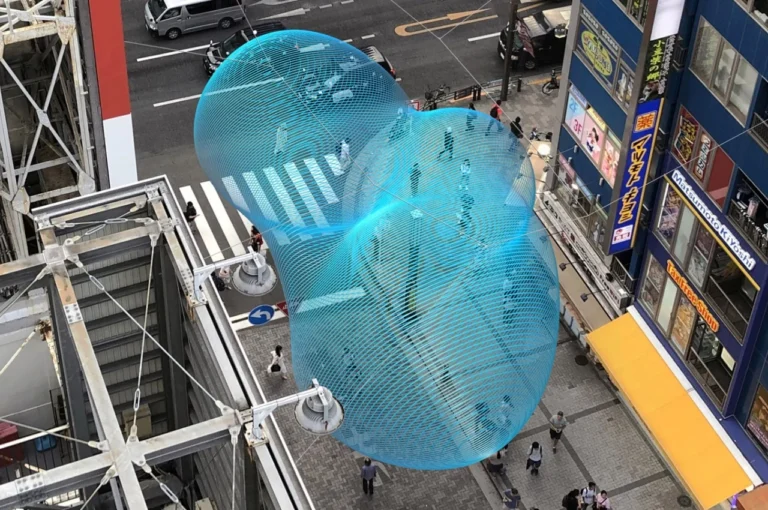 Vincent Leroy’s “Metacloud” Art Installation: A Cloud That Looms Over Our Lives
 Vincent Leroy’s Mesmeric Installation is a Dimensional Experience With Suspended Structures
About Vincent Leroy
- He is best known for immersive installations rather than conventional gallery objects.
- His work often uses mirrored surfaces, lightweight structures, and controlled motion.
- Viewer experience matters as much as form: the work changes as people move through it.
- His installations often sit at the boundary between public art, design, and contemporary sculpture.
What does Vincent Leroy make?
Leroy makes spatial works that depend on reflection, suspension, and movement. Rather than building a single fixed form, he arranges surfaces and volumes so that light bounces, fragments, and multiplies across the installation. Materials such as polished metal, mirrored film, translucent panels, cables, and lightweight framing elements are central to this effect.
The result is usually not a static sculpture to be viewed from one side. His works are built to be entered, circled, or passed beneath, so the image changes with position, angle, and ambient light. That makes the viewer part of the work’s operating system.
Where did his practice come from?
Leroy emerged from the French design and art scene, where experimentation with materials and environment has long blurred the line between decorative object and architectural intervention. His background reflects that overlap: the work is careful about fabrication, but it aims at perception rather than utility.
His practice belongs to a broader lineage of installation art that treats space as a medium. What distinguishes it is the emphasis on shimmer, instability, and optical distortion. Instead of presenting a single image, the work keeps reconfiguring itself through movement, reflection, and the surrounding environment.
Why does his work matter?
Vincent Leroy matters because his installations show how contemporary art can use simple industrial materials to produce complex bodily and visual experiences. A sheet of mirror film, a suspended volume, or a moving reflective plane can turn an ordinary room into a shifting field of light and depth.
That interest in perception gives his work a clear place in visual culture. It speaks to the way display, architecture, and spectacle now overlap in museums, public spaces, and branded environments. His pieces are often memorable because they are understood less as objects than as situations.
How are his installations built?
His work depends on fabrication choices that support lightness and precision. Suspended elements must be carefully balanced; reflective surfaces need to be finished to avoid unwanted visual noise; and mechanical movement, when present, has to remain quiet and controlled. The engineering is usually hidden so that the effect feels effortless.
In practice, that means the installation is composed as much through spatial choreography as through material assembly. A viewer may first notice a visual illusion, but the illusion is produced by very concrete means: frame, tension, suspension, surface treatment, and the calibration of light in the room.
Questions
Is Vincent Leroy mainly an artist or a designer?
He works across both fields, and that crossover is part of his identity. His projects use the formal language of design, but they function as immersive artworks rather than products. The distinction is less important than the way he shapes experience through materials and space.
What materials appear most often in his work?
Reflective and lightweight materials appear frequently, especially mirror-like surfaces, metal, translucent panels, and suspension systems. These materials matter because they catch and redirect light while keeping the structure visually open. The physical hardware is usually integral, even when it is meant to recede.
Why do his installations feel so immersive?
They immerse because they change with movement and light instead of remaining fixed. The eye keeps searching for a stable image, but the environment keeps shifting as reflections and forms move. That instability makes the work feel active rather than merely displayed.
