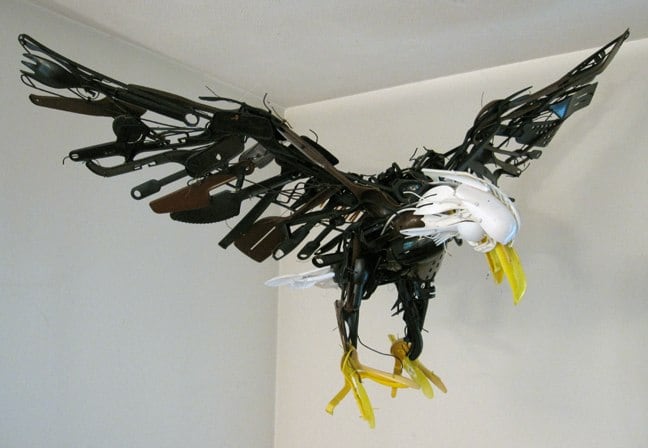
Sayaka Ganz is a Japanese sculptor known for making dynamic animal forms from discarded plastic utensils, tools, and household objects. Born in Yokohama and raised in Japan, Brazil, and Hong Kong, she brings together a cross-cultural background and a strong Japanese sensibility in sculptures that seem to move, leap, or turn midair.
- She works primarily as a sculptor and welder.
- Her best-known pieces use reclaimed plastic and other found materials.
- Her forms often describe birds, fish, horses, and other animals in motion.
- She studied at Indiana University Bloomington, where she tested ceramics, printmaking, and other media before settling on sculpture.
- Her work sits between craft, recycling, and contemporary installation.
How did Sayaka Ganz become a sculptor?
Ganz was born in Yokohama and spent her childhood in several countries, including Brazil and Hong Kong. That movement between places shaped her eye for difference, but she has said that Japanese influence remains central to how she thinks about line, rhythm, and form. After moving to the United States, she studied at Indiana University Bloomington and explored multiple media before finding that sculpture gave her the most direct way to work.
Welding became essential to that practice. It allowed her to build large armatures and attach many small parts securely, which matters in works made from hundreds or thousands of individual pieces. The process is labor-intensive: she sorts, cleans, and assembles found materials by hand before welding or fastening them into a single structure.
What does her work look like in practice?
Ganz is best known for sculptures made from discarded plastic forks, spoons, knives, chopsticks, brushes, and other everyday objects. She arranges these materials in layered bands that follow the curve of a body, feather, fin, or mane. From a distance, the work reads as fluid and organic; up close, the individual objects remain visible and insist on their former life as waste.
That tension between aggregate and whole is central to the work. A horse may seem to charge forward, while a fish appears to ripple through air, built from hundreds of bright fragments that catch light differently. The result often feels animated, but the motion comes from structure and placement rather than mechanics.
Why does Sayaka Ganz matter?
Ganz matters because she gives discarded material a second life without disguising what it is. Her sculptures do not hide their source objects; instead, they rely on the public recognition of those things to create surprise. A spoon or fork becomes part of a wing, spine, or tail, and that shift changes how the object is understood.
Her work also sits within a broader conversation about sustainability and making. It shows how reuse can be formal, not just ethical. The sculptures are not simple demonstrations of recycling; they are carefully designed studies in movement, surface, and construction. That makes them relevant to viewers interested in material process as much as finished image.
How is her style rooted in material and technique?
Ganz’s method depends on repetition, sorting, and manual assembly. She chooses objects for shape, color, and flexibility, then welds or secures them into dense surfaces that can bend around an underlying frame. The process takes patience and close attention, because a small change in angle can alter the way a wing or muscle reads at scale.
The visual effect comes from accumulation. Each element contributes a slight change in line or sheen, so the finished sculpture behaves almost like a brushstroke made three-dimensional. That is part of why her animals feel vivid rather than merely decorative: the making remains visible in the surface.
Frequently Asked Questions
What materials does Sayaka Ganz use?
She most often uses reclaimed plastic utensils and other discarded household items, though her practice can include a range of found materials. The choice of material is not incidental; the objects are selected for their shape, color, and ability to build layered forms. Welding and assembly turn them into durable sculptures.
Is her work considered environmental art?
It can be read that way, because it reuses waste and draws attention to disposable plastic. Still, the work is not only an environmental statement. It is also concerned with anatomy, motion, and the visual energy created by many small parts joined into one form.
Why are her sculptures usually animals?
Animals give her a way to explore gesture, movement, and instinct through shape. Birds, horses, fish, and dogs all offer strong silhouettes and flowing anatomy that suit her layered construction. The subject matter also lets the material do expressive work, since feathers, fur, and scales can be suggested through repeated fragments.
Articles mentioning Sayaka Ganz