
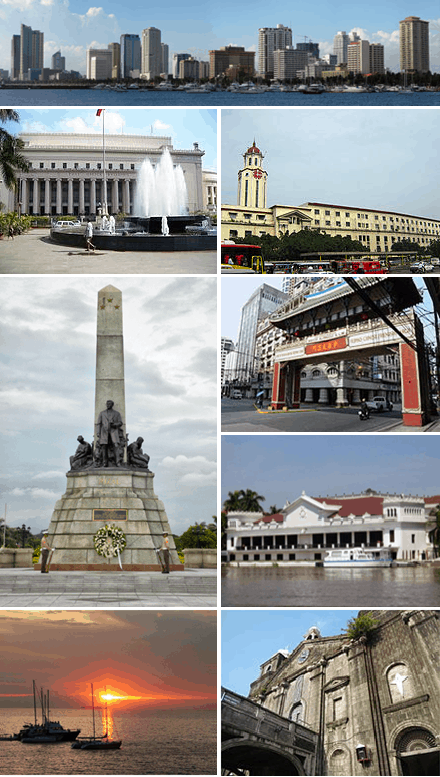
Manila is the capital city of the Philippines and the core historic city within the larger Metro Manila region. It sits on the eastern shore of Manila Bay and has long served as a political, commercial, and cultural center for the country. The name can also appear as Manilla in older usage, though the modern standard is Manila.
- Capital city of the Philippines.
- Part of Metro Manila, the country’s national capital region.
- Located on Manila Bay, with a dense urban fabric shaped by ports, trade, and administration.
- Known as a reference point for Filipino culture, publishing, sport, and design.
Where Manila came from
Manila began as a settlement at the mouth of the Pasig River, where river traffic met bay trade. Its position made it valuable to indigenous rulers, then to Spanish colonial власти after the 16th century, when the city was reorganized around fortifications, churches, government buildings, and the port. That colonial layering still affects the city’s streets, districts, and built form.
Over time, Manila became one node in a much larger metropolitan system. The city proper is only one of sixteen cities in Metro Manila, but its name often stands in for the whole capital region in speech, news, and international references. That overlap matters because many institutions, studios, schools, and archives cited as “Manila” are actually spread across the wider metropolis.
What does Manila look like in practice?
Manila is dense, hot, and heavily urbanized. Older districts such as Intramuros preserve the logic of colonial walls, plazas, and stone churches, while surrounding areas hold narrow streets, roadside commerce, apartment blocks, markets, and transport interchanges. The city’s everyday visual culture is shaped by signage, metal shutters, concrete facades, jeepneys, and flood-prone streets, alongside pockets of formal civic architecture and heritage restoration.
That mix gives Manila a layered appearance rather than a single skyline. Its public spaces often combine improvisation and repair: tarpaulin graphics, hand-painted lettering, patched paving, and structures adapted for trade or family life. In design and photography, Manila often appears as a city of contrast, where Spanish-era remnants, American-period planning, postwar rebuilding, and contemporary high-density growth all sit close together.
Why Manila matters to design and visual culture
Manila matters because it is one of Southeast Asia’s major centers of image-making, publishing, architecture, education, and commercial design. Books, magazines, campaign graphics, product photography, and student work from the Philippines often pass through or reference Manila because that is where major schools, studios, agencies, and clients are concentrated. The city also shapes aesthetic choices through material scarcity, humidity, heavy traffic, and frequent repair, all of which influence how objects are printed, built, carried, and maintained.
For artists and architects, Manila is often both subject and setting. Its streets offer dense visual material: informal typography, layered advertisements, religious imagery, family-run shops, and domestic additions to buildings. At the same time, the city serves as a production base for more polished work in architecture, editorial design, and fashion, where local conditions and global references meet.
How the city is understood today
Manila is often used in international media as shorthand for the Philippines, but that simplification can hide the city’s actual scale and complexity. The City of Manila is distinct from Quezon City, Makati, Pasay, and the other nearby jurisdictions that make up Metro Manila. Its borders matter because culture, governance, and infrastructure are split across multiple city governments rather than handled by one unified authority.
The result is a place that functions through overlap. People move between districts for work, school, worship, shopping, and transit, and many of the country’s most visible cultural products are made in that wider network. Manila remains the historical and symbolic center of that system, even when the work associated with it spreads across the metropolis.
Frequently Asked Questions
Is Manila the same as Metro Manila?
No. Manila is one city, while Metro Manila is the larger national capital region made up of sixteen cities and one municipality. The city of Manila is only one part of that urban area, though it remains the historic and symbolic center.
Why is Manila important in the Philippines?
Manila is the country’s capital and a major center for government, trade, education, and culture. It has also been a long-running crossroads for colonial rule, migration, and commerce, which shaped its built environment and public life. Many Philippine institutions and creative industries still cluster there or identify with it.
What makes Manila visually distinctive?
Manila is marked by density, congestion, and visible layering. Colonial landmarks, concrete apartment blocks, roadside commerce, hand-painted signs, and improvised repairs often sit side by side. That mix gives the city a vivid, uneven surface that many photographers, architects, and artists find compelling.