
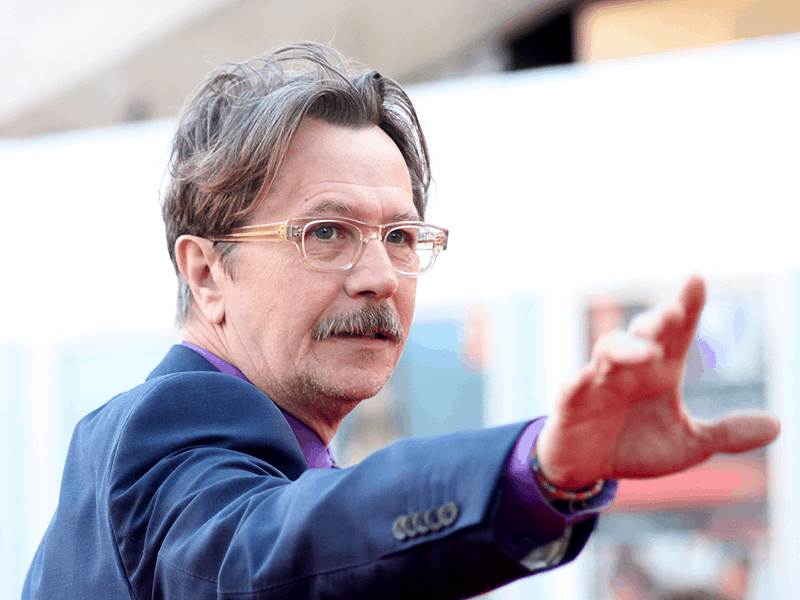
Gary Oldman is an English screen and stage actor, filmmaker, and musician known for his wide range of character work and his ability to vanish into roles through voice, posture, and heavily altered appearance. Born in London in 1958, he moved from British theatre and independent film into major American productions, where he became one of the most adaptable actors of his generation.
| Born | 21 March 1958, London, England |
|---|---|
| Fields | Acting, filmmaking, music |
| Best known for | Transformative screen performances across drama, thriller, and genre films |
| Notable collaborators | Christopher Nolan, Oliver Stone, Ridley Scott, Quentin Tarantino, Francis Ford Coppola, Robert Zemeckis |
What made Gary Oldman distinctive?
Oldman built his reputation on transformation rather than star image. He often alters his voice, carriage, hair, and facial expression so thoroughly that a role can feel physically re-engineered. That approach helped him move between historical dramas, crime films, superhero franchises, and prestige cinema without being trapped in one screen persona.
He is also known for playing unstable or morally compromised characters with precision. Rather than treating intensity as a general mood, he adjusts it through small technical choices: a sudden change in pacing, a brittle laugh, a flat refusal to blink, or a controlled collapse into fatigue. Those details give even large, stylized performances a grounded, handmade quality.
How did he come to prominence?
Oldman began in British theatre, where stage discipline shaped the clarity of his physical work. His early screen roles in the 1980s, especially in British films and in rebellious, confrontational characters, established him as an actor willing to take risks. He soon attracted directors who wanted performers capable of combining technical control with emotional volatility.
His move into Hollywood did not flatten that style. Instead, major filmmakers used him in very different ways: as a ruthless villain, a weary cop, a political operator, a detective, or a voice inside large-scale genre filmmaking. Across those shifts, the common feature was his commitment to specificity. He rarely plays a character as a generic type when a more idiosyncratic version is available.
What does his work look like in practice?
In practice, an Oldman performance often begins with construction. Costume, accent, and posture are not decorative additions; they are the framework of the character. In Dracula, The Fifth Element, Sid and Nancy, JFK, and Tinker Tailor Soldier Spy, the body itself becomes a major part of the design. He can seem theatrical without losing realism, a difficult balance that depends on exact control of gesture and timing.
That method also suits filmmakers who work with strong visual design. Christopher Nolan, for example, used Oldman in films where the actor had to anchor exposition, emotional continuity, or moral ambiguity while the production around him operated at a large scale. The result is often a performance that feels built to fit an architecture of image, sound, and editing rather than simply delivered in front of it.
Why does he matter?
Oldman matters because he helped define a kind of modern screen acting that prizes transformation over recognizability. In an industry that often rewards consistency of brand, he showed that an actor could have a long career by changing shape repeatedly and still remain legible to audiences. That made him useful in both art cinema and studio filmmaking.
He also widened the idea of what a supporting or ensemble player could do in a blockbuster context. His roles often carry narrative weight even when they are not the visual center of a film. That balance between presence and disappearance has made him a frequent reference point for actors who want to build character through technique rather than charisma alone.
Frequently Asked Questions
Is Gary Oldman mainly a character actor or a leading actor?
He is best understood as an actor who has done both, often in the same career phase. He can carry a film, but he is especially associated with roles that require alteration, ambiguity, or strong authorial control from the director. His strength lies less in a fixed leading-man image than in adaptability.
Why do people talk about his transformations so much?
Because the changes are not superficial. Oldman often reshapes a role through accent, rhythm, costume, and body language in ways that make the character feel newly built. The transformation is part of the performance method, not a gimmick layered on top of it.
Has he worked outside acting?
Yes. Oldman has also worked as a filmmaker and musician, which fits a career built around craft and control. Those projects are less publicly central than his acting, but they reinforce the sense that he approaches performance as one part of a larger creative practice.