
Bogotá is Colombia’s capital city and largest urban center, a high-altitude metropolis on the Andean plateau that also serves as an independent capital district. It sits in the country’s center, governs its own administrative territory, and functions as the main political, cultural, and economic hub of Colombia. Formerly called Santafé de Bogotá from 1991 to 2000, it is usually known simply as Bogotá.
Stories from Bogotá
9 stories


About Bogotá
- Capital of Colombia and its most populous city.
- Located on the Bogotá savanna in the Andes at roughly 2,600 metres above sea level.
- Operates as a capital district separate from the surrounding department of Cundinamarca.
- Known for dense public life, major museums, universities, and a strong contemporary art and design scene.
- Its urban landscape mixes colonial-era centers, modernist planning, large-scale infrastructure, and informal street culture.
Read the full overviewWhy Bogotá matters, What does Bogotá look like in practice?, How did Bogotá develop?, What kinds of design and public space are associated with Bogotá?
Why Bogotá matters
Bogotá matters because it concentrates national institutions and much of Colombia’s cultural production. Decisions about architecture, public space, transport, education, and art often radiate from the city outward. As the country’s largest market for publishing, design, and contemporary art, it has also become a reference point for Latin American urban culture.
The city’s scale and altitude shape daily life. Cool temperatures, strong sunlight, and abrupt changes in weather affect how streets, facades, and public spaces are used and maintained. Bogotá’s civic identity is tied to these conditions: plazas, parks, cycle routes, and bus corridors are not background features but part of how the city works.
What does Bogotá look like in practice?
Bogotá’s built environment shifts sharply from district to district. In the historic center, narrow streets, stone paving, and colonial structures sit near museums and government buildings. Elsewhere, broad avenues, dense apartment blocks, industrial sites, and newer towers create a more modern skyline. The city also holds extensive informal growth on its edges, where self-built housing and improvised infrastructure tell another part of its history.
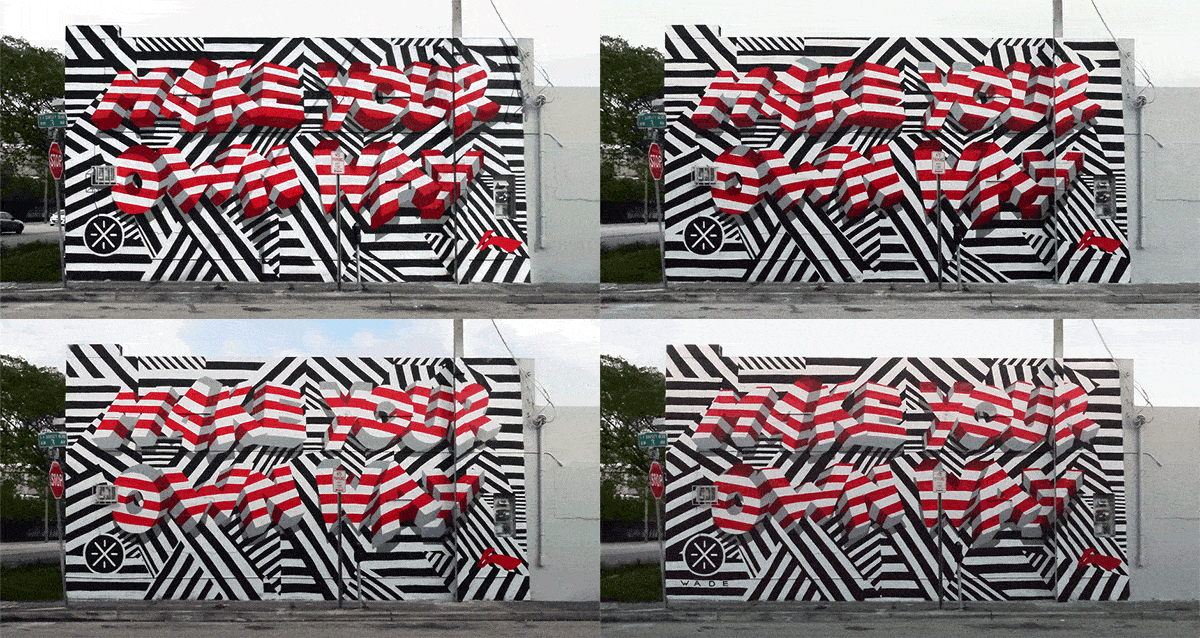
For designers and artists, Bogotá offers a strong street-level culture. Walls carry murals, storefronts use handmade signs, and public squares serve as stages for protest, performance, and informal trade. That visible mixture of official and unofficial making is one reason the city appears so often in discussions of urban design and visual culture.
How did Bogotá develop?
Bogotá began as a colonial Spanish settlement over an earlier Muisca territory. Its role as a seat of government deepened after independence, and in the nineteenth and twentieth centuries it grew from a regional capital into the center of a rapidly urbanizing nation. Migration from across Colombia accelerated its expansion, especially during periods of political violence and rural displacement.
That growth left the city with layered planning traditions. Colonial grids, republican civic buildings, modernist infrastructure, and recent large-scale redevelopment projects coexist and sometimes clash. The city’s history is therefore visible not only in archives and monuments but in the way roads, neighborhoods, and public institutions were built, repaired, and repurposed over time.
What kinds of design and public space are associated with Bogotá?
Bogotá is often discussed through its public-space projects, civic architecture, and street art. Squares, school campuses, transport corridors, and parks have been redesigned as part of broader efforts to improve access and movement across the city. Many of these projects use restrained materials such as brick, concrete, steel, and planted surfaces, but their significance lies less in style than in how they organize social life.
The city is also a major site for graphic and mural practices. Large-scale wall painting, paste-up work, and temporary interventions appear across neighborhoods, especially in areas where commercial frontage and public visibility overlap. This makes Bogotá relevant to anyone studying how urban surfaces carry political messages, local identity, and visual experimentation.
Frequently Asked Questions
Is Bogotá the same as Bogota?
Yes. “Bogotá” is the standard Spanish spelling with the accent mark, while “Bogota” is a common anglicized or unaccented form. Both refer to the same city.
Why is Bogotá important in Colombian culture?
Bogotá concentrates national museums, universities, publishers, galleries, and government institutions. It also sets trends in architecture, public policy, and visual culture, so work made there often gains national visibility quickly. For that reason, the city is frequently used as a reference point for modern Colombian life.
What is distinctive about Bogotá as a place?
Its altitude shapes climate, movement, and even building use. The city combines colonial streets, modern infrastructure, informal settlements, and highly active public space, which creates a dense and sometimes contradictory urban fabric. That combination gives Bogotá a strong presence in discussions of design and urbanism.