
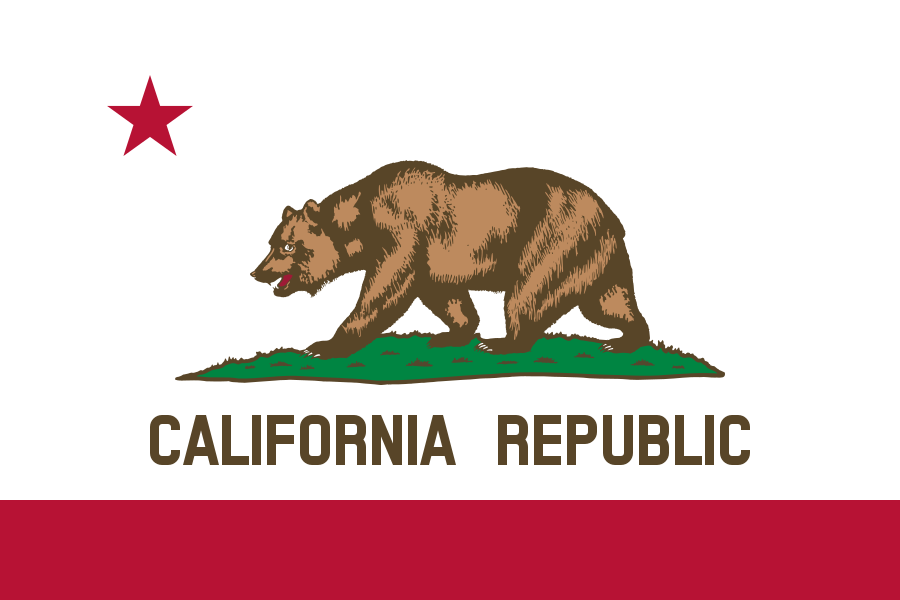
California is a U.S. state on the Pacific coast, stretching from the Oregon border to Mexico and from the Sierra Nevada to the Pacific Ocean. Its size, climate, and economic weight make it one of the most visible places in American visual culture, with major centers in Los Angeles, the Bay Area, San Diego, and Sacramento. It is known for a dense mix of film, architecture, technology, agriculture, and design experimentation that has shaped styles far beyond the state itself.
- Location: West Coast of the United States, between Oregon and Mexico
- Capital: Sacramento
- Largest city: Los Angeles
- Landscape: Coastal plains, valleys, deserts, mountains, and a long Pacific shoreline
- Design importance: A major center for architecture, film, product design, and technology
Why California matters
California matters because it concentrates population, capital, and image-making in one place. The state is home to major studios, design firms, universities, museums, and technology companies, so it regularly produces objects, buildings, and media that circulate globally. A house in the hills above Los Angeles, a Silicon Valley device, or a museum in Los Angeles can quickly become a reference point for international design conversation.
Its cultural influence also comes from scale. California is large enough to contain several distinct regions with different climates and economies, from foggy coastlines to inland deserts and agricultural valleys. That variety has encouraged many forms of building and making: mid-century modern houses adapted to warm weather, roadside Googie architecture, experimental sustainable homes, and large-format museum projects built for car travel and wide sites.
What does California look like in practice?
California design often reflects sun, distance, and mobility. Builders use overhangs, patios, glass walls, terraces, and low rooflines to manage light and heat while opening interiors to views. In the mid-20th century, this produced a recognizable domestic style: clean lines, indoor-outdoor living, and materials such as wood, steel, and concrete used with a restrained palette. In commercial architecture, the same conditions encouraged bold signage, futuristic curves, and dramatic canopies meant to catch the eye from a moving car.
The state’s material culture also shows a strong split between high-tech and handmade traditions. Northern California helped foster countercultural self-build housing, small-scale fabrication, and early personal-computing culture. Southern California developed large studios, entertainment sets, car culture, and flashy commercial architecture. Both regions reward forms that read quickly at a distance: silhouettes, glowing surfaces, deep shadow lines, and buildings that look engineered for photography as much as occupation.
How did California become so influential?
California’s rise began with a combination of geography, extraction, migration, and infrastructure. Gold rush wealth, rail connections, fertile farmland, military spending, and later aerospace and computing investment all fed rapid growth. That growth attracted makers, engineers, artists, and entrepreneurs who treated the state as a place to test new systems. The result was not a single style, but a habit of reinvention. California repeatedly turns new industries into visible forms, from movie palaces to suburban tracts, lab equipment to electric vehicles.
Migration matters too. California has absorbed influences from Latin America, Asia, the American South, the Midwest, and the East Coast, then remade them in local conditions. That is one reason the state’s built environment feels hybrid rather than fixed. A Los Angeles house might combine modernist planning, Spanish Revival traces, and drought-conscious landscaping. A Bay Area tech office might mix industrial shells, collaborative interiors, and polished digital branding. The state’s influence comes from how often these hybrids become models elsewhere.
California in art, architecture, and technology
FreeYork articles often use California as a setting for projects that join narrative, design, and technical ambition. In Los Angeles, museum architecture frequently aims to be iconic at city scale, with sweeping roofs, large spans, and sculptural massing that frame collections as public events. In the hills and coastal suburbs, residential projects often respond to slope, sun, and privacy through terraces, long sightlines, and environmentally tuned envelopes.
California also sits at the center of the personal-computing story. The state’s garages, campuses, and small workshops helped launch a culture of prototyping that still defines product design today. That history connects to contemporary work in electric vehicles, smart-home systems, and software-driven interiors. In California, technology is often presented as a lifestyle object: smooth, clean, quiet, and meant to disappear into domestic space.
Frequently Asked Questions
Why is California so often associated with design and innovation?
California combines wealth, scale, and a strong culture of experimentation. Film studios, universities, startups, and architecture firms all sit within the same state, so ideas move quickly between industries. The climate also shapes design choices, encouraging open plans, outdoor rooms, and bright, image-friendly surfaces.
Is California one style or many?
It is many styles. Northern and Southern California differ in climate, settlement patterns, and industries, so their buildings and objects often look different. The state’s visual identity comes less from uniformity than from the repeated translation of new ideas into local form.
What makes California architecture recognizable?
California architecture often emphasizes light, views, and indoor-outdoor flow. Common features include flat or low-pitched roofs, deep eaves, glass walls, terraces, and careful responses to heat and sun. In more flamboyant examples, especially roadside and commercial buildings, curves, neon, and futuristic detailing make the structure visible from a car.
At a glance
- Address
- United States
- Coordinates
- 37, -120
Articles mentioning California


