
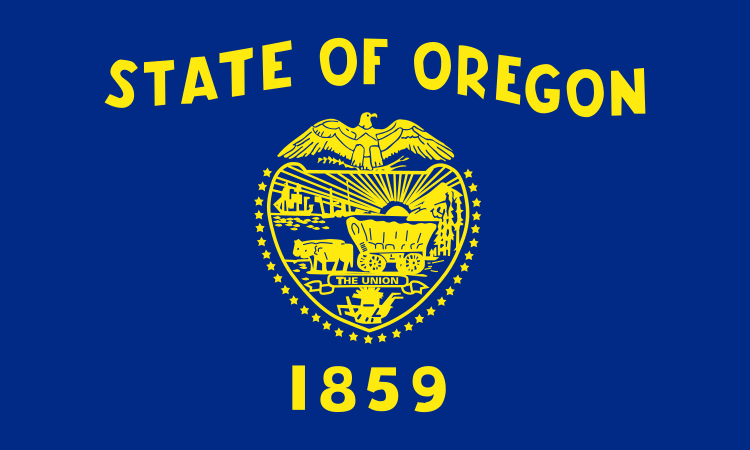
Oregon is a state in the Pacific Northwest of the United States, on the Pacific coast between Washington and California. Its landscape ranges from wet coastal forests and the Cascade Range to high desert, river valleys, and volcanic country in the east. The state sits at the meeting point of Indigenous homelands, maritime trade routes, timber extraction, farming, and a long West Coast design culture.
- Oregon combines a rainy coast, mountain spine, fertile valleys, and arid interior, so its visual identity changes sharply from region to region.
- Its modern history is tied to Indigenous nations, the fur trade, overland settlement, statehood in 1859, and the growth of timber, rail, and port economies.
- Oregon design often draws on natural materials such as cedar, glass, basalt, fir, and concrete.
- The state has become associated with landscape photography, craft production, outdoor recreation, and a strong craft and contemporary architecture scene.
Where is Oregon, and what makes it distinct?
Oregon stretches from the Pacific Ocean to the Idaho border, with the Columbia River forming much of its northern edge and the Snake River marking part of the eastern boundary. This geography gives the state an unusually varied set of environments: temperate rainforest on the coast, volcanic peaks in the Cascades, irrigated farmland in the Willamette Valley, and dry sagebrush country in the east. That variety matters in visual culture because it changes what can be built, grown, photographed, or made with local materials.
In practice, Oregon often appears in work that uses landscape as more than backdrop. Photographers, architects, and craft makers tend to respond to the state’s broad skies, deep greens, driftwood tones, basalt rock, and weathered timber. The state’s terrain also shapes everyday making: cedar siding, glass walls, exposed wood framing, and concrete volumes all reflect a preference for materials that can sit comfortably against forest, rain, and open land.
How did Oregon become a state?
Long before European settlement, Oregon was home to many Indigenous nations, including the Chinook, Nez Perce, Klamath, Coos, and others whose lands and lifeways were tied to rivers, fish runs, cedar forests, and seasonal movement. Fur traders and explorers arrived in the early nineteenth century, followed by missionaries and settlers traveling along the Oregon Trail. In 1843, settlers formed an autonomous government in Oregon Country, and the territory later entered the Union as a state in 1859.
That history still shapes the state’s public landscape. River corridors, ports, rail lines, and timber towns reflect the economies that grew during settlement and industrial expansion. At the same time, contemporary Oregon is marked by efforts to recognize Indigenous sovereignty and by ongoing debates over land use, conservation, forestry, and growth. Those tensions often surface in the state’s architecture and visual projects, where natural abundance sits beside the legacy of extraction.
What does Oregon look like in design and visual culture?
Oregon’s design language often favors restraint, texture, and close attention to place. Homes and studios commonly use wood cladding, large panes of glass, low profiles, and views that frame trees, hills, or distant ridgelines. In the high desert and eastern part of the state, buildings may shift toward stronger shadows, heavier masonry, and more enclosed forms that answer to harsher sun and wider temperature swings. The result is not one “Oregon style” but several regional responses to climate and landscape.
The state also has a strong association with craft and handmade production. Timber has long supported furniture, framing, and milling; glass and ceramics have found fertile ground in studio practice; and Portland in particular has been a hub for illustration, tattooing, baking, and independent publishing. Oregon’s visual identity therefore comes from both nature and labor: the forest provides the material, while the workshop, kitchen, studio, and camera translate it into finished form.
Why does Oregon matter in contemporary culture?
Oregon matters because it offers a clear example of how geography shapes aesthetics. A cedar-and-glass house in the hills, a photograph of a burned-out barn, a landscape image of the high desert, or a cake decorated with a logging axe all use the state as a visual cue, but they do so through material choices rather than slogan. Oregon signals a relationship to weather, industry, and outdoor space that artists and designers continue to mine for meaning.
It also matters as a place where urban and rural influences collide. Portland has become known for a dense creative culture, while much of the state remains defined by agriculture, timber, and remote land. That split produces a useful tension in design: polished interiors set against rugged terrain, craft objects shaped by a region that still feels physically large, and images that balance ecological beauty with the marks of use and change.
Frequently Asked Questions
Is Oregon part of the Pacific Northwest?
Yes. Oregon is one of the core states of the Pacific Northwest, along with Washington and, in broader usage, parts of Idaho and British Columbia. The term points to both geography and a shared cultural field shaped by rain, forests, mountains, coastal trade, and outdoor life.
What materials are strongly associated with Oregon?
Cedar, fir, basalt, stone, glass, and concrete appear often in Oregon architecture and design. Timber has deep economic and cultural roots in the state, while glass and wood are common in contemporary homes, studios, and furniture. The material palette usually reflects a wish to stay visually aligned with the surrounding landscape.
Why does Oregon come up so often in art and photography?
Oregon offers dramatic and varied scenery within a single state, from ocean cliffs and forested rain to dry basins and volcanic peaks. That range gives artists a strong visual shorthand for solitude, scale, weather, and wilderness. It also has a built reputation for independent craft and outdoor culture, which makes it useful in both documentary and stylized work.
At a glance
- Address
- United States
- Coordinates
- -44, 59.5
Articles mentioning Oregon


