
Catalonia is an autonomous community in northeastern Spain with its own institutions, distinct language traditions, and a strong regional identity. It includes the provinces of Barcelona, Girona, Lleida, and Tarragona, with Barcelona as its capital and largest city. The region has long been a centre of trade, industry, publishing, architecture, and visual culture, which is why it appears so often in discussions of design and contemporary image-making.
Stories from Catalonia
2 stories
About Catalonia
- Type: Autonomous community of Spain
- Capital: Barcelona
- Provinces: Barcelona, Girona, Lleida, Tarragona
- Area: 32,114 km²
- Population: About 7.5 million
- Notable languages: Catalan and Spanish
Read the full overviewWhat makes Catalonia distinct?, Why does Catalonia matter in visual culture?, How is Catalonia seen on the ground?, What should a reader notice first?
What makes Catalonia distinct?
Catalonia is not a country, but it is not a generic administrative region either. It has a parliament, a government, and a history of autonomy that stretches back through medieval institutions, early modern trade networks, and modern political struggles. Its public life often runs through two languages, Catalan and Spanish, and that bilingual setting shapes signage, publishing, education, and the visual tone of the region.
The region’s geography also matters. It stretches from the Pyrenees to a long Mediterranean coastline, so its built environment includes mountain towns, agricultural plains, industrial suburbs, and dense coastal cities. That range produces different visual registers: Romanesque churches in the north, modernist housing blocks in Barcelona, fishing ports, logistics landscapes, and tourist-heavy seaside towns.
Why does Catalonia matter in visual culture?
Catalonia has been one of Spain’s most visible centres of architecture, graphic design, photography, and editorial production. Barcelona, in particular, became a laboratory for modern urban form through the work of Antoni Gaudí and later generations of architects and designers who shaped everything from exhibition graphics to street furniture. The city also hosts major museums, art schools, and publishing houses, which helps sustain a dense culture of image-making.
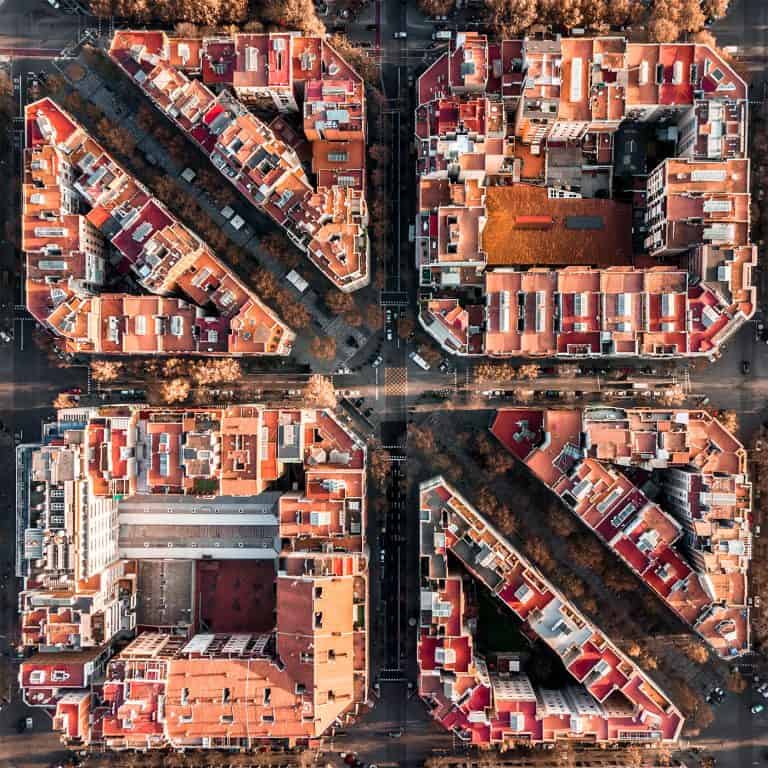
For photographers, Catalonia offers a compact but varied stage. Aerial work over Barcelona can show the city’s Eixample grid, the serrated line of the Serra de Collserola, and the pressure between planned urban blocks and irregular historic districts. Outside the capital, the region offers a different visual field: terraced vineyards, industrial estates, monastery complexes, and Roman ruins that sit close to contemporary infrastructure.
How is Catalonia seen on the ground?
In practice, Catalonia often appears through material contrasts. Stone churches and monastery cloisters sit near concrete apartment blocks; traditional markets operate beside glass-fronted cultural buildings; small workshops survive next to globally connected manufacturing and tech sectors. The region’s design culture reflects that mix, combining craft traditions, modernist ornament, and industrial production.
Public space is especially important. Catalan cities tend to use plazas, boulevards, and waterfronts as social stages, which gives street photography and urban studies a strong footing here. Even when a project focuses on one building or one neighbourhood, it usually carries traces of wider regional conditions: migration, tourism, language policy, political debate, and the long afterlife of industrialisation.
What should a reader notice first?
Start with the relationship between Barcelona and the rest of the region. Barcelona dominates Catalonia economically and culturally, but it does not exhaust it. Girona has a different urban scale, Lleida a more inland and agricultural profile, and Tarragona a landscape shaped by Roman history, port activity, and industry. Those differences keep Catalonia from becoming a single visual stereotype.
It also helps to notice how often Catalonia is framed through movement and perspective. That can mean aerial views of Barcelona, but it can also mean railway corridors, highways, harbor edges, and processional streets used for festivals and political demonstrations. The region is defined not only by monuments, but by the ways people move through space and claim it.
Frequently Asked Questions
Is Catalonia a country?
No. Catalonia is an autonomous community within Spain, with its own government and parliament but not sovereign statehood. It is often described as a nationality within Spain because of its distinct historical and cultural identity. That status is central to many political debates about autonomy and independence.
What language is used in Catalonia?
Catalan and Spanish are both official languages in Catalonia. Catalan appears in schools, signage, public administration, literature, and everyday conversation, especially alongside Spanish in urban areas. The bilingual environment is a major part of the region’s visual identity, from street names to publishing design.
Why is Barcelona so closely associated with Catalonia?
Barcelona is the capital, largest city, and economic centre of Catalonia, so it often stands in for the region as a whole. It concentrates architecture, tourism, media, museums, and design institutions, which gives it disproportionate visibility. At the same time, treating Barcelona as the whole of Catalonia misses the region’s inland, coastal, and provincial variety.