
Che Guevara was an Argentine Marxist revolutionary, physician, writer, guerrilla commander, diplomat, and military theorist whose image became one of the most reproduced political symbols of the 20th century. Born Ernesto Guevara in 1928, he rose to prominence during the Cuban Revolution and later died in Bolivia in 1967. His life combined armed struggle, state politics, and public mythmaking, and the tension between those roles still shapes how he is remembered.
Stories from Che Guevara
3 stories

About Che Guevara
- Best known as a leading figure in the Cuban Revolution and a theorist of guerrilla warfare.
- Trained as a doctor before turning to revolutionary politics.
- Associated with anti-imperialist politics, left-wing internationalism, and armed struggle in Latin America.
- His photograph by Alberto Korda became a globally circulated emblem on posters, T-shirts, and protest graphics.
- His reputation remains divisive: admired by supporters of revolution, condemned by critics of political violence.
Read the full overviewWho was Che Guevara?, Why does his image matter so much?, What did he actually believe and do?, How is Che Guevara used in visual culture?
Who was Che Guevara?
Guevara came of age in Argentina and studied medicine in Buenos Aires before travel through South America pushed him toward radical politics. He saw poverty, labor exploitation, and political repression across the region, and those experiences informed his belief that Latin American inequality could not be solved by reform alone. After meeting Fidel Castro in Mexico in the mid-1950s, he joined the expedition that returned to Cuba and helped overthrow Fulgencio Batista in 1959.
In post-revolutionary Cuba, Guevara held senior posts in government, including roles in the central bank and the ministry of industry. He also represented Cuba abroad as a diplomat and public spokesman. Even then, he remained more than an administrator: he wrote manuals on guerrilla struggle, argued for “new socialist” ethics, and promoted the idea that revolutionary discipline had to remake both institutions and individual behavior.
Why does his image matter so much?
Few political figures have been turned into such a durable graphic sign. Alberto Korda’s 1960 photograph, usually called Guerrillero Heroico, shows Guevara staring past the camera in a beret with a star. The image was cropped, reproduced, posterized, and simplified until it became detached from its original context. In print and design, it functions almost like a logo: stark, high-contrast, easy to recognize at a glance, and adaptable to countless surfaces.
That visual afterlife matters because it changed Guevara from a historical actor into a portable icon. The face appears on protest banners, album covers, fashion goods, student posters, and commercial merchandise, often carrying meanings far removed from Cuban revolutionary politics. Designers and illustrators continue to reuse it because the image balances severity and charisma, making it useful for both rebellion and irony.
What did he actually believe and do?
Guevara argued that anti-colonial struggle should be international, not confined to one nation. He supported armed insurgency as a means of breaking authoritarian and capitalist systems, and he believed a committed revolutionary vanguard could create the conditions for broader popular change. His writings, especially on guerrilla warfare, became influential among leftist movements in Latin America, Africa, and elsewhere.
His record also includes coercion and violence. As a revolutionary official, he supported executions of regime loyalists after the Cuban Revolution, and later attempts to export revolution failed in the Congo and Bolivia. That combination of idealism, discipline, and armed struggle is central to his historical significance. He is remembered not as a purely symbolic figure but as a person whose politics produced real institutions, real campaigns, and real deaths.
How is Che Guevara used in visual culture?
In visual culture, Guevara’s face often stands in for rebellion itself, even when the surrounding context is commercial or detached from politics. Screen printers, poster artists, and editorial illustrators use the image because its silhouette is instantly legible and its emotional charge is already built in. It works especially well in two-color printing, stencil form, halftone reproduction, and other techniques that flatten detail into graphic impact.
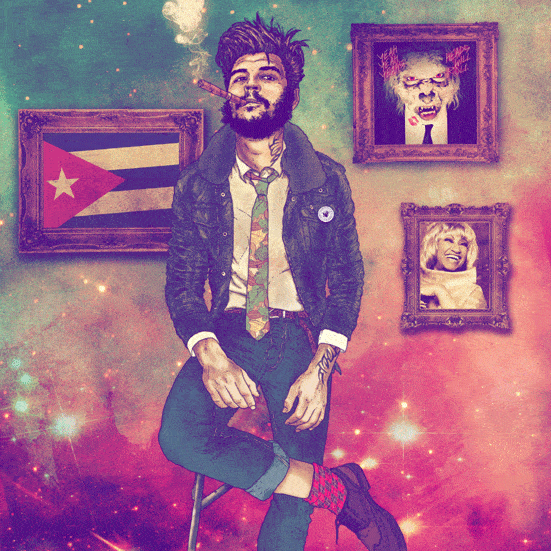
That usability has made him a recurring subject in satire, homage, and critique. Artists reframe the portrait to question hero worship, expose political branding, or place Guevara inside contemporary consumer culture. The result is a rare case in which a revolutionary image became both a mass-market motif and a subject of constant visual argument.
Frequently Asked Questions
Was Che Guevara a doctor or a soldier?
He was trained as a doctor, and he qualified as a physician before becoming a full-time revolutionary. Medicine shaped his early thinking, but he abandoned clinical practice in favor of political struggle. Later accounts of his life often stress that transition because it shows how quickly his career moved from healing to warfare.
Why is the Korda photograph so famous?
The portrait became famous because it isolates an intense expression and strips away background detail. That simplicity made it easy to reproduce across posters, newspapers, shirts, and digital graphics. Its power comes from both the image itself and the way it was circulated outside its original moment.
Is Che Guevara admired or criticized today?
Both, often in equal measure. Supporters see him as a symbol of anti-imperialism and commitment; critics point to authoritarian politics, armed struggle, and executions. His name still triggers debate because it belongs to both revolutionary history and mass culture.