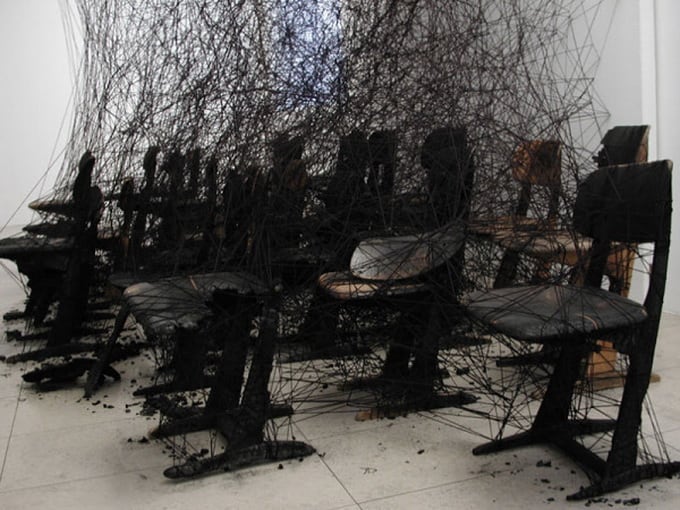
Chiharu Shiota is a Japanese installation artist known for filling rooms with dense webs of thread, found objects, and suspended everyday items to make immersive works about memory, loss, and the trace of human presence. Born in Osaka in 1972, she has lived and worked in Berlin since 1996.
| Born | 1972, Osaka, Japan |
|---|---|
| Based in | Berlin, Germany |
| Field | Installation art, drawing in space, textile-based environments |
| Training | Seika University, Kyoto; further study in Germany |
| Known for | Large-scale thread installations using wool, yarn, metal frames, shoes, beds, keys, dresses, and other found objects |
What makes Shiota’s work distinctive?
Shiota builds installations that behave like drawings made in three dimensions. She stretches black or red thread across walls, ceilings, and floors until the gallery becomes a mesh of lines that can feel like a nervous system, a storm, or a trapped memory. Into those fields she places objects with strong personal charge: keys, chairs, suitcases, dresses, boats, or beds. The objects matter less as symbols than as carriers of use, absence, and lived time.
The physical effect is immediate. The work often blocks direct passage through a room, so movement becomes part of looking. The threads cast shadows and create layers that make space seem both dense and empty at once. This tension between enclosure and exposure is central to her practice, and it gives the installations their emotional force.
Where did her practice come from?
Shiota studied in Kyoto and later in Germany, where she encountered performance, installation, and the language of contemporary European art more directly. Her move to Berlin in the mid-1990s placed her in a city with its own fractured history, and that atmosphere of displacement shaped the way she works with absence and reconstruction. Rather than making static sculpture, she began using the room itself as material.
Her work also draws on Japanese and international traditions of ephemeral making, where structure can be temporary and meaning comes from process as much as from finished form. Thread gives her a way to build an image slowly, line by line, while keeping the final work fragile. Even when the installations are monumental, they often look as though they could loosen or dissolve.
How are her installations made?
Shiota’s installations require substantial manual labour. Assistants and installers typically anchor thread to existing architecture or to custom-built frames, then weave it across the space in a planned but physically demanding process. The thread may be knotted, wrapped, or pulled into taut lines, with the density adjusted to create areas of opacity and passage. The result can resemble a drawn field, a cage, or a net laid over the architecture.
Found objects are chosen for their ordinary familiarity and their ability to trigger association. A bed may suggest rest, illness, or intimacy; keys can suggest access, memory, or ownership; shoes can imply a body that is no longer present. Shiota often uses these objects in suspension or isolation, which turns them into evidence rather than decoration. The materials are simple, but the arrangement depends on precise placement and strong control of scale.
Why does Chiharu Shiota matter?
Shiota has become one of the most recognisable installation artists working today because she has made a highly specific visual language that is immediately legible but not simplistic. The thread installations are striking from a distance, yet they reward close looking through their detail and through the emotional pressure created by repetition, emptiness, and accumulation. Her work reaches audiences that may not usually follow installation art because it is both theatrical and psychologically direct.
She also expanded the way textile materials can function in contemporary art. Thread is usually associated with domestic labour, weaving, or repair, but Shiota uses it to build large architectural environments that carry grief, silence, and memory. That shift has helped place textile-based installation at the centre of contemporary visual culture rather than at its margins.
Frequently Asked Questions
Is Chiharu Shiota a sculptor or an installation artist?
She is best described as an installation artist, though her work borrows from sculpture, drawing, and performance. The room is not a container for the artwork; it is part of the work itself. Her installations are built in place and are often impossible to separate from the architecture they inhabit.
Why does she use so much thread?
Thread lets Shiota create volume without solid mass, so she can make spaces that feel both present and unstable. It also carries associations with connection, labour, repair, and entanglement. Those meanings support the emotional themes that recur in her work, especially memory and absence.
Are the objects in her installations important?
Yes, but not as standalone sculptures. Shiota usually uses ordinary objects because they arrive already loaded with use and personal history. A single object placed inside a field of thread can change the reading of an entire room and make the installation feel intimate rather than abstract.
Articles mentioning Chiharu Shiota