
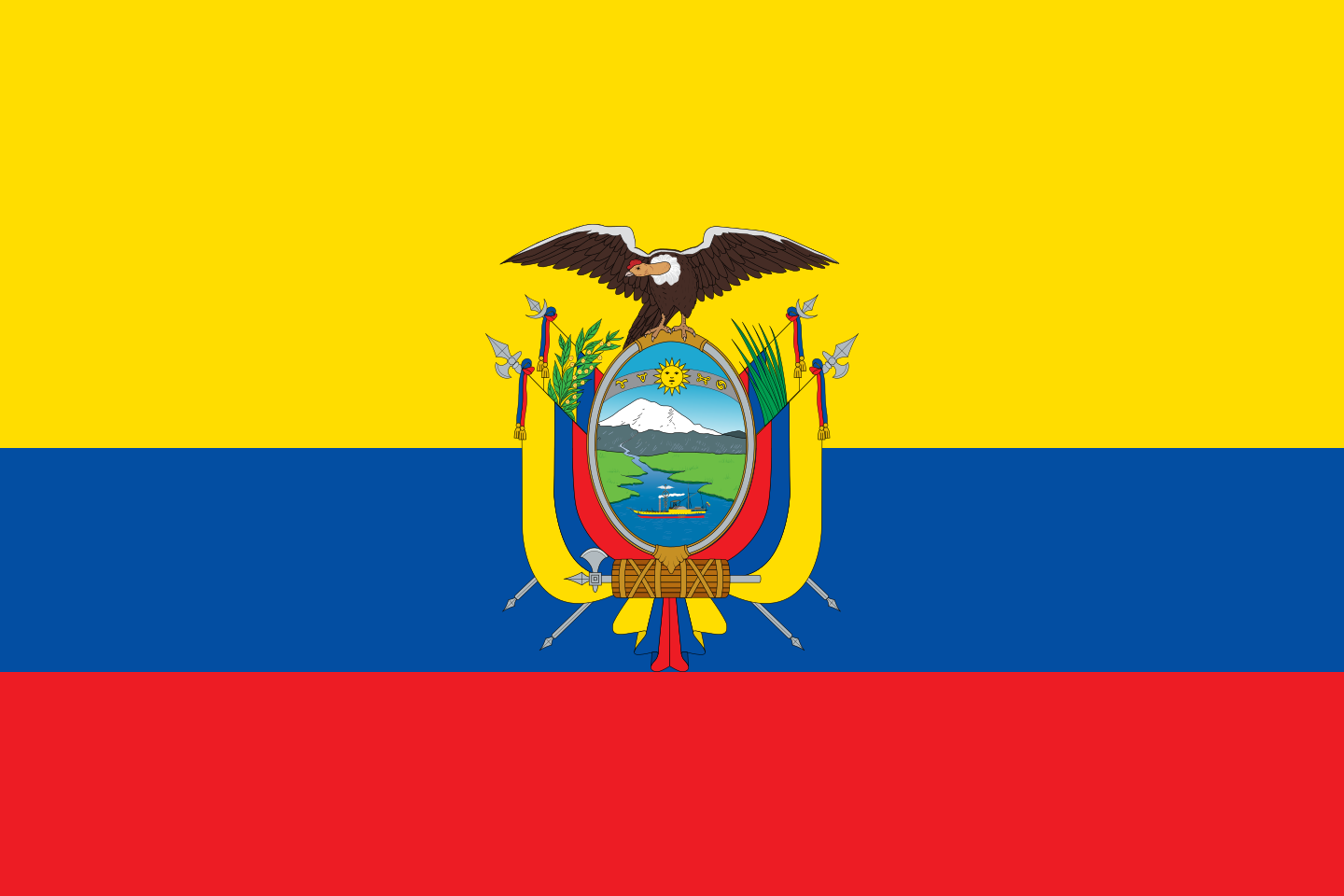
Ecuador is a country on South America’s west coast, bordered by Colombia, Peru, and the Pacific Ocean, with the Galápagos Islands lying about 1,000 kilometres offshore. Its name comes from the equator, which crosses the country near Quito. For FreeYork readers, Ecuador matters as a place where architecture, craft, and design are shaped by a tight fit between climate, geography, and local materials.
- Capital: Quito
- Region: northwestern South America
- Neighbouring countries: Colombia and Peru
- Coastline: Pacific Ocean
- Notable territory: the Galápagos Islands
Where is Ecuador, and what makes it distinct?
Ecuador sits on the northwestern shoulder of South America, straddling the equatorial line that gives the country its name. That position produces a sharp range of environments in a compact territory: Andean highlands, Pacific lowlands, Amazonian forest, and volcanic islands. Few countries compress so many climates and elevations into such a small area, and that variety shapes everything from agriculture to building practice.
The country is politically a republic with a long history of shifting between central control and local autonomy. Quito, the capital, sits high in the Andes, while Guayaquil anchors coastal trade and industry. That geographic split between mountain and coast is not just administrative; it appears in regional building traditions, foodways, and the different visual cultures that circulate through the country.
Why does Ecuador matter in design and architecture?
Ecuador has become a recurring reference point in contemporary design because its built environment often responds directly to climate and available materials. In the Andes and on the Pacific side, architects and builders work with timber, bamboo, earth, stone, and brick in ways that reflect local labor and local conditions rather than imported finish systems. This gives many Ecuadorian projects a practical clarity: structure is visible, materials are legible, and construction methods often stay close to the landscape that supplies them.
The country is also associated with a strong tradition of vernacular building. Bahareque, for example, is a method that uses a lightweight woven or framed structure filled and coated with earth-based material. In Ecuador, such methods are not only historical; they still inform contemporary work that seeks lower embodied energy, better thermal performance, and closer ties to regional craft knowledge. That continuity makes Ecuador important to readers tracking sustainable design that is not merely aesthetic but materially grounded.
What does Ecuador look like on the ground?
In practice, Ecuador looks uneven and highly local. Quito’s urban fabric combines colonial-era stone and plaster buildings with modern interventions in concrete, steel, and glass. On the coast and in forest regions, buildings often open more directly to air movement, shade, and rainfall. In rural areas, construction can still depend on timber frames, cane, thatch, and earth finishes, shaped by what can be carried, harvested, and maintained locally.
The Galápagos add another layer to the country’s visual identity. Because of their ecological sensitivity, the islands have influenced how Ecuador is discussed in relation to conservation, tourism, and low-impact building. For designers and architects, Ecuador often appears as a place where the demands of climate adaptation, biodiversity, and resource limits are visible at once rather than abstract.
How has Ecuador appeared in FreeYork coverage?
FreeYork articles use Ecuador as a setting for projects that connect design to place. Quito-based studios have been noted for community-centred approaches, and projects such as Casa 6-3 in the Chocó cloud forest show how minimal forms can sit inside dense ecological settings. Other coverage highlights how local techniques and resources, including bahareque and timber, continue to shape contemporary work rather than serving only as heritage references.
Ecuador has also appeared in stories about institutions and public debate, including criticism and redesign around museum proposals. That matters because it shows the country not simply as a scenic backdrop, but as a place where design is contested in public, where government, civic groups, and practitioners negotiate what new buildings should do and how they should look.
Frequently Asked Questions
Is Ecuador a small country?
Ecuador is relatively small by South American standards, especially compared with Brazil, Argentina, or Peru. Its size does not mean simplicity, though. The country spans coastal, highland, Amazonian, and island environments, which makes it unusually varied for its area.
What is Ecuador best known for?
Ecuador is known for the equator, the Andes, the Galápagos Islands, and a high level of ecological diversity. In design and architecture, it is also known for work that uses local materials and climate-responsive methods. Bahareque, timber construction, and earth-based finishes are part of that reputation.
Why do designers and architects mention Ecuador so often?
Designers mention Ecuador because it offers strong examples of place-based making. The country’s regions demand different solutions, which makes material choice and construction method especially visible. That makes Ecuador useful as a reference for projects that aim to be local, durable, and environmentally responsive.
At a glance
- Address
- Ecuador
- Coordinates
- -0.15, -77.5
Articles mentioning Ecuador


