
Iris van Herpen is a Dutch fashion designer known for sculptural garments that combine couture handwork with digital fabrication, 3D printing, laser cutting, and unusual materials. Since launching her label in 2007, she has built a reputation for treating clothing as a hybrid of dress, object, and moving image.
Stories from Iris van Herpen
6 stories



About Iris van Herpen
- She works at the edge of fashion, sculpture, and technology.
- Her collections often begin with natural forms, anatomy, architecture, or motion.
- She uses materials such as resin, silicone, metal mesh, organza, and 3D-printed polymers.
- Her pieces are typically made through close collaboration with ateliers, engineers, architects, and material specialists.
- Her work helped make advanced fabrication part of high fashion rather than a separate experimental field.
Read the full overviewWhat makes her work distinctive?, Where did her approach come from?, How are her garments made?, Why does Iris van Herpen matter?
What makes her work distinctive?
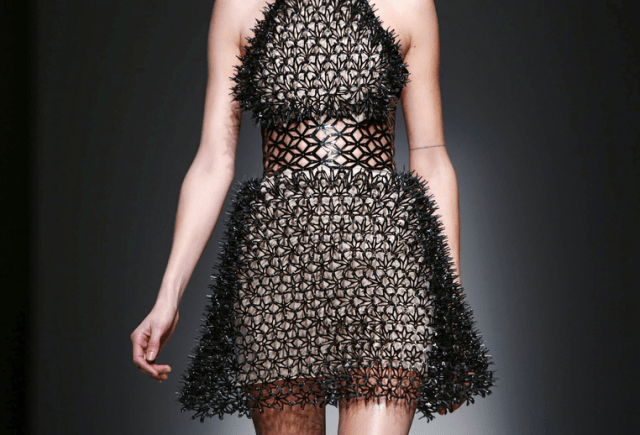
Van Herpen’s clothes are usually built around a tension between fragility and structure. A single look may combine hand-pleated fabric, molded plastic, stitched embroidery, and a rigid printed shell, all shaped to move on the body rather than sit like static sculpture. The result is often visually intricate but technically disciplined, with seams, joints, and surfaces carefully engineered.
She is especially known for turning fabrication methods into part of the design language. A 3D-printed bodice is not a gimmick in her work; it is a way to create surfaces that can mimic bones, shells, smoke, or water. That approach changed how many people in fashion think about what a garment can be made from and how it can be formed.
Where did her approach come from?
Van Herpen trained in the Netherlands and began her own label after working with Alexander McQueen and in smaller design settings. Her early collections already showed an interest in movement, anatomy, and material experimentation, but the scale and complexity of the work grew as digital tools became more accessible. She became one of the designers most closely associated with the rise of 3D printing in fashion during the 2010s.
Her references often come from science and the natural world: water currents, fossil forms, magnetic fields, aerial photography, microscopic structures, and the geometry of skeletons. These are not used as decorative themes alone. They shape pattern cutting, surface treatment, and the choice of fabrication method, so the source material becomes part of the garment’s construction.
How are her garments made?
Her studio typically combines couture handcraft with digital workflows. A design may begin as a sketch or a digital model, then pass through 3D modeling, prototype printing, laser cutting, or thermoforming before being finished by hand. Embroidery, bonding, pleating, and sculpting remain important, but they are often applied to materials that would not be common in traditional couture.
Materials matter in a direct way in her work. She has used transparent polymers, featherweight fabrics, silicone, metal elements, and reinforced textiles to create clothing that can hold volume without looking heavy. Because many pieces are fragile, limited, or custom-built, they are often shown as runway garments, museum works, or editorial objects rather than everyday fashion.
Why does Iris van Herpen matter?
Van Herpen helped expand the visual and technical vocabulary of contemporary fashion. She demonstrated that digital manufacturing could serve high-level design rather than simply mass production, and that new tools could produce garments with the precision and atmosphere of art objects. Her work also widened public ideas of couture by proving that invention in fashion can come from software, engineering, and material research as much as from draping or tailoring.
Her influence is visible in museums, on runways, and in the broader culture of fashion imaging. Designers, costume makers, and material researchers continue to borrow from the sense of engineered delicacy that her work popularized: surfaces that look organic but are made through exact processes, and garments that seem to hover between fashion and future object.
Frequently Asked Questions
Is Iris van Herpen considered haute couture?
Yes. Her work is widely associated with haute couture because of its labor intensity, custom construction, and emphasis on craftsmanship. Even when she uses digital tools, the pieces are usually finished and assembled through highly skilled manual work.
Does she actually use 3D printing in clothing?
Yes, and that is one of the reasons her name is so closely tied to fashion technology. She has used 3D printing for wearable structures, decorative elements, and rigid components that would be difficult to make through sewing alone. In many garments, printed parts are combined with softer fabrics so the result still moves with the body.
Are her designs meant for everyday wear?
Usually not. Many pieces are runway looks, commissioned works, or museum-level garments that require time, fitting, and careful handling. Some ideas from her practice filter into more wearable fashion, but the core of her output is experimental and highly specialized.