
John the Baptist was a first-century Jewish preacher who called people to repentance and baptised them in water, most famously in the River Jordan. He appears in the Canonical gospels and the Qur’an, and Christian tradition treats him as the forerunner of Jesus. His public role centred on a baptismal movement rather than a settled teaching office, which gave his ministry a stark, ritual form.
| Essential fact | Details |
|---|---|
| Period | Early first century CE, in Roman-period Judea |
| Core practice | Baptism in water as a sign of repentance and preparation |
| Main setting | The Jordan River and surrounding wilderness areas |
| Sources | Canonical gospels, the Qur’an, later Christian tradition |
| Historical importance | Linked to the origins of Christian baptism and the ministry of Jesus |
What John the Baptist did
John preached a message of moral urgency. People came to him confessing sins and underwent baptism, a washing rite that marked a turning point in their lives. The gospels present him as a prophetic voice in the wilderness, dressed simply and living ascetically, which reinforced the severity of his message.
His preaching was not abstract theology. It was public, bodily, and immediate: gather at the river, confess, be washed, and prepare for judgment. That combination of sermon and rite made John unusual among religious figures remembered primarily through texts. His movement depended on performance, place, and repeated ritual action.
Where did the Baptist movement come from?
John emerged in a Jewish world already familiar with purification baths, repentance, and apocalyptic expectation. Scholars have often compared his practice to the Essenes, a semi-ascetic Jewish group sometimes associated with ritual washing and a strict moral code. That comparison is suggestive, but direct evidence for a formal link does not survive.
What can be said with more confidence is that John worked within a broader landscape of Jewish renewal movements. His baptism gave water a decisive symbolic role: not just cleansing, but preparation for a coming divine intervention. That is one reason his figure remains important in the study of late Second Temple Judaism and the beginnings of Christianity.
How is John the Baptist shown in practice?
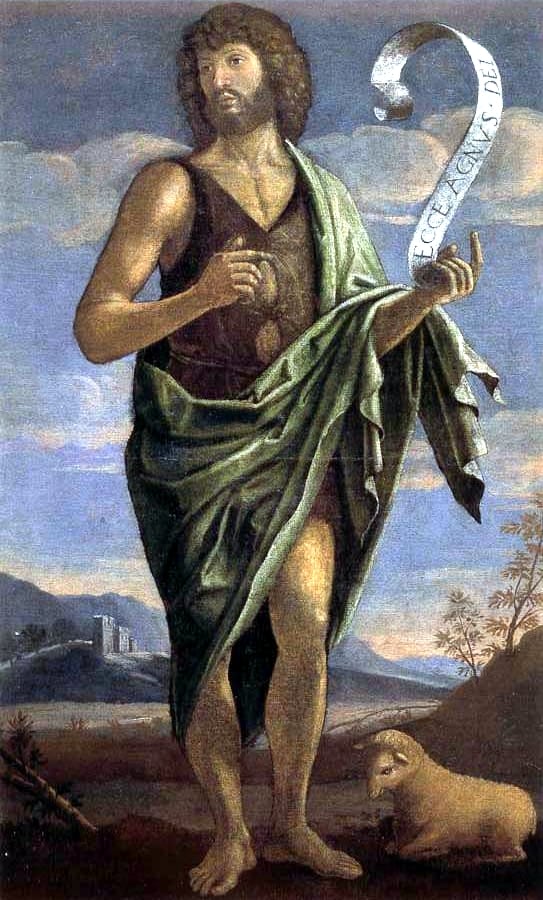
In art and devotional culture, John usually appears as a thin, rough-clothed ascetic carrying a staff or pointing toward Christ. A lamb often accompanies him as a symbol of Jesus, the “Lamb of God” in Christian theology. Scenes of baptism in the Jordan show him standing in the water, hand raised over Jesus, compressing his whole significance into a single act.
That visual formula mattered because it made John legible at a glance. He is not normally shown as a founder of a sect, but as a witness and preparer. In painting, sculpture, stained glass, and manuscript illumination, his appearance signals moral intensity, the nearness of transformation, and the bridge between Hebrew prophecy and Christian narrative.
Why does he matter?
John the Baptist matters because he stands at a threshold. The gospels place him just before Jesus, so his ministry frames the start of the Christian story. Baptism, as later Christian communities practised it, drew its authority partly from John’s rite, even though the meanings of baptism changed over time.
He also matters beyond Christianity. The Qur’an recognises Yahya, identified with John, as a righteous prophet, which places him in a wider Abrahamic frame. That cross-traditional presence has kept him visible in theology, liturgy, literature, and art for centuries. Few biblical figures are remembered so clearly for both a message and a method.
Frequently Asked Questions
Was John the Baptist a disciple of Jesus?
No. The gospels present John as an older prophetic figure whose ministry began before Jesus’. He baptised Jesus and then fades from the narrative, which suggests distinction rather than discipleship. Christian tradition remembers him as Jesus’ forerunner, not as one of his followers.
Did John the Baptist found a religion?
Not in the usual sense. He led a baptismal movement and preached repentance, but the surviving evidence does not show a separate, lasting institution founded by him. His influence came through the impact of his ritual practice on early Christianity and on later interpretations of prophecy.
Is there historical evidence for John outside scripture?
There is limited external evidence, and most of what is known comes from the gospels and related religious texts. That does not make him a purely fictional figure; it means historians must work with sparse sources and compare them carefully. The broad outline of a baptising preacher in Judea is widely considered plausible, even where details remain uncertain.
Articles mentioning John the Baptist

