
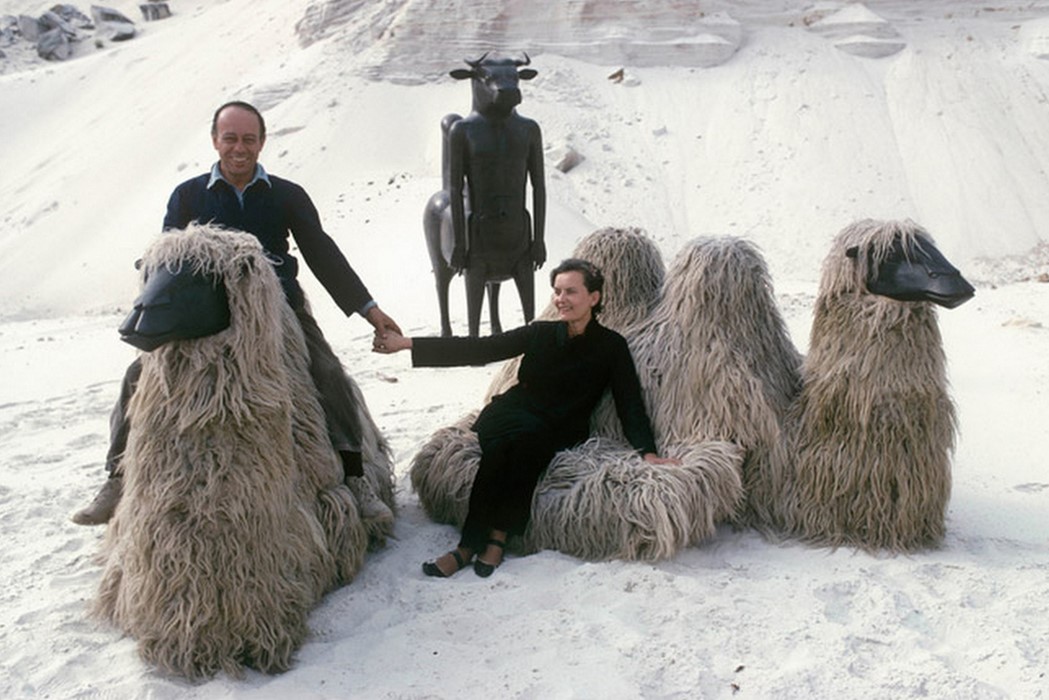
Les Lalanne were a French artist duo made up of the married sculptors François-Xavier Lalanne and Claude Lalanne, known for turning animals, plants, and ordinary furnishings into surreal objects with a highly crafted finish. Their work sits between sculpture, design, and decorative art, and it often takes the form of tables, chairs, cabinets, mirrors, and garden pieces that look alive. They became especially associated with bronze, plaster, copper, and later patinated metal surfaces that gave their forms a tactile, hand-worked presence.
- Who they were: François-Xavier Lalanne, born in 1927, and Claude Lalanne, born in 1924, worked independently and together, but their names are now usually grouped as one artistic partnership.
- What they made: Functional objects shaped as owls, sheep, birds, leaves, crocodiles, and other natural forms.
- How they worked: They used sculpture methods such as modelling, casting, chasing, gilding, and patination, often applying them to furniture-scale objects.
- Why they matter: They helped erase the line between usable furniture and collectible sculpture.
Where did Les Lalanne come from?
François-Xavier Lalanne grew up in Agen, studied in Paris, and moved among the postwar avant-garde, where sculpture could be playful without losing seriousness. Claude Lalanne, trained as a sculptor and metalworker, brought a precise sense of surface and botanical form to the partnership. They worked in France for most of their careers, and their circle included artists, designers, and collectors who were interested in craft as much as in art-historical prestige.
Their partnership formed in a moment when French design was opening to new ideas about luxury and the handmade object. Rather than treating decoration as a secondary layer, they made ornament structural. A cabinet could become a rhinoceros, a mirror could bloom like a leaf, and a seat could take the shape of an animal body. That approach made their work legible both to gallery audiences and to clients who wanted unusual, highly finished interiors.
What does their work look like in practice?
Les Lalanne are best known for objects that borrow directly from the natural world. François-Xavier often produced larger sculptural pieces with a whimsical, sometimes theatrical tone: sheep that functioned as seats, birds used as tables, and animal forms adapted into furniture or architectural elements. Claude Lalanne often focused on plants, leaves, and branches, making mirrors, screens, and jewellery that preserve the look of veins, stems, and petals in metal.
Their pieces usually depend on careful fabrication. A form begins in modelling or direct observation, then moves into mould-making and casting, followed by finishing work that sharpens texture and depth. Bronze allowed François-Xavier to combine durability with mass and detail; Claude often worked copper and other metals into thin, organic surfaces that felt lifted from a garden and fixed in time. The result is not cute craft. It is deliberate illusion, built through exact making.
Why do collectors and museums care?
Les Lalanne matter because they made furniture and sculpture behave like each other without flattening either category. Their work appeals to collectors of design, decorative arts, and contemporary sculpture at once. That crossover has made them influential in interiors, fashion, and luxury branding, where their animal forms and botanical surfaces still read as witty, elegant, and unmistakable.
Museums and galleries also value them because their work captures a particular French attitude toward craftsmanship: technically exact, visually luxurious, and willing to be funny. Their objects are not purely functional, but neither are they mere fantasies. They are made things, grounded in metalworking and sculpture, that carry the memory of use. A sheep can be a seat, a leaf can become a mirror, and a cabinet can behave like a living creature.
How did they influence design and decorative art?
Les Lalanne helped normalize a hybrid mode that designers still borrow today: the object that is both practical and sculptural. Their influence shows up in furniture with exaggerated forms, in interiors that treat fixtures as animals or plants, and in luxury collections that rely on craftsmanship as a visible part of value. They also helped push postwar French design toward a more imaginative, less doctrinaire use of materials.
Their legacy is strongest where making is visible. Casting seams, hammered surfaces, and patina are not hidden; they are part of the appeal. In a visual culture often divided between high art and decorative usefulness, the Lalannes offered a third category: objects that are meant to be used, looked at, and remembered for how they were made.
Frequently Asked Questions
Were Les Lalanne one artist or two?
They were two artists: François-Xavier Lalanne and Claude Lalanne. The name “Les Lalanne” is used for the couple because their careers became closely associated, and they often appear together in discussions of sculpture and design. Their individual practices differed, especially in subject matter and surface treatment.
What materials did they use?
They worked mainly in bronze, copper, and other metals, often combining sculpture techniques with the finishing methods of decorative art. Casting, patination, chasing, and modelling were central to their process. Those materials let them make furniture-scale forms that stayed crisp, durable, and richly textured.
Are their works functional or purely sculptural?
Many pieces are both. A Lalanne sheep might serve as a seat, a bird might become a table, and a leaf might function as a mirror or screen. Even when a work is usable, it usually insists on being read first as sculpture.
Articles mentioning Les Lalanne
