
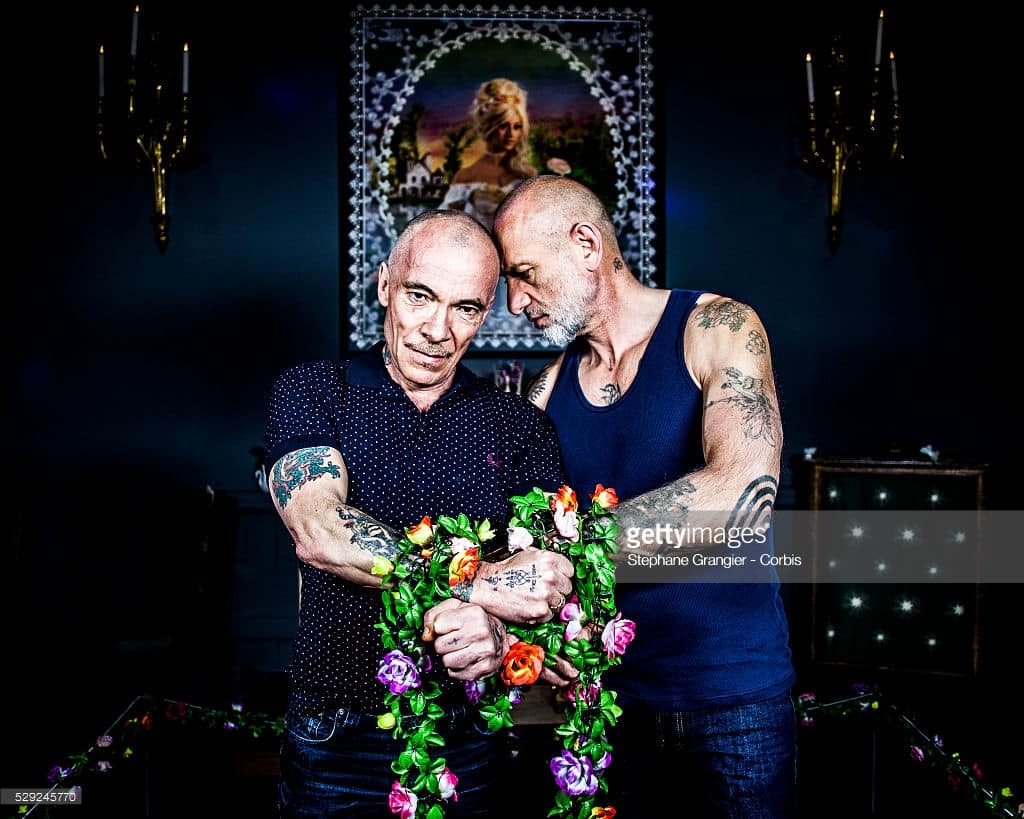
Pierre et Gilles are a French artist duo made up of Pierre Commoy and Gilles Blanchard, known for elaborate staged photographs that combine fashion, painting, set design, and devotional imagery. Their pictures are carefully built objects: the pair photograph a scene, then retouch it by hand until the final image looks both glossy and handmade.
- French duo: Pierre Commoy and Gilles Blanchard
- Known for staged photographic portraits and tableaux
- Build their own sets, costumes, and props
- Hand-retouch each image to intensify colour and detail
- Draw on pop culture, religion, camp, and celebrity imagery
How do Pierre et Gilles make their images?
Their process starts with construction. Pierre et Gilles design a scene, often in their studio, with painted backdrops, sculpted props, theatrical lighting, and costumes made for a specific subject. They photograph the sitter or model in that environment, then continue working on the print with paint and retouching until the surface reads like a hybrid of photograph and icon.
This method gives their work its distinctive finish. The image remains recognisably photographic, but the handwork softens edges, deepens colours, and pushes the result toward fantasy. The final object is less a documentary image than a constructed picture, closer to a modern altarpiece or pageant scene than a casual portrait.
Where did their style come from?
Pierre et Gilles emerged in France in the 1970s and 1980s, when photography was increasingly treated as an art form rather than a purely mechanical record. They absorbed influences from advertising, magazine photography, queer club culture, Catholic imagery, and the polished excess of pop art. Their partnership also matters: the work grew from a shared studio practice, with one artist handling photography and the other painting and retouching, though the finished pieces are signed as a joint vision.
Their subjects often borrow from familiar visual codes: saints, sailors, film stars, pop singers, wrestlers, mythological figures, and anonymous youths. That mix of the sacred, the commercial, and the erotic became a signature. Instead of separating high and low culture, they place them in the same frame and make the clash feel deliberate and ornate.
Why does Pierre et Gilles matter?
They helped define a form of photographic portraiture that behaves like collage, theatre, and devotional painting at once. Their images challenged the idea that photography had to be neutral, immediate, or strictly truthful. By making every part of the picture—background, costume, pose, paint, and print—feel composed, they showed how photography can be built as carefully as sculpture or stage design.
Their work also had a strong influence on fashion, music imagery, and contemporary portraiture. The saturated colour, obvious artifice, and unapologetic sentiment became a visual language of their own. Many later photographers and image-makers borrowed their taste for stylisation, queer glamour, and the fusion of sacred and pop references.
What do their works look like in practice?
A typical Pierre et Gilles image shows a single figure or small group posed frontally in a dreamlike set. The background may be painted, glittering, or filled with symbolic objects. Surfaces are smooth and luminous, colours are saturated almost to excess, and faces are often idealised rather than naturalistic. The result can feel tender, humorous, solemn, or kitsch, sometimes all at once.
Even when the subject is contemporary, the finished work often resembles a shrine, a poster, or a religious panel. That visual ambiguity is central to their appeal. The images invite close looking because the eye keeps moving between the photographic base and the visible evidence of handwork.
Frequently Asked Questions
Are Pierre et Gilles photographers or painters?
They are both, and the label changes depending on which part of the process is being described. The work begins as a photograph, but painting and retouching are not finishing touches; they are essential to the final image. Their practice sits between photography, painting, and installation.
Why are their images often described as camp?
Their pictures use exaggeration, glamour, theatricality, and emotional intensity in ways that align with camp aesthetics. They do not hide artifice; they foreground it. That openness lets them mix beauty, sincerity, irony, and excess without trying to resolve the tension.
What subjects recur in their work?
Recurring subjects include celebrities, sailors, saints, and androgynous or idealised figures. They often return to religious imagery and popular culture because both supply instantly legible symbols. Their best-known works turn those symbols into polished portraits that feel both contemporary and old-fashioned.