
Robert Longo is an American artist known for large-scale charcoal drawings, films, sculpture, and prints that turn mass culture into stark, theatrical images. He came to prominence in the 1980s with the Men in the Cities drawings, in which sharply dressed figures twist, fall, and recoil against blank space, and he has since built a career around forceful images of power, violence, and public spectacle.
Robert Longo on FreeYork
How did Robert Longo become known?
Longo emerged from the New York art scene of the late 1970s and early 1980s, alongside artists interested in appropriation, media images, and the visual codes of advertising and cinema. He studied at Buffalo State College and spent formative time in Europe before settling into an art world centered on downtown Manhattan, where artists were reacting to television, magazines, corporate imagery, and the political mood of the period.
The Men in the Cities series made his name because it combined polish with collapse. Longo photographed friends in business clothes as they were jerked into extreme poses, then translated those poses into oversized drawings that erased context and intensified gesture. The result looked both glamorous and violent, as if a boardroom, dance floor, and emergency room had been collapsed into a single image.
What does his work look like?
Longo’s best-known works are made in dense black charcoal on white paper, often at a monumental scale. He uses high contrast, sharp edges, and a near-photographic finish to make bodies, objects, and scenes seem suspended in a split second of crisis. The drawings often isolate a single figure or object against a blank ground, which removes distraction and pushes attention toward posture, friction, and shadow.
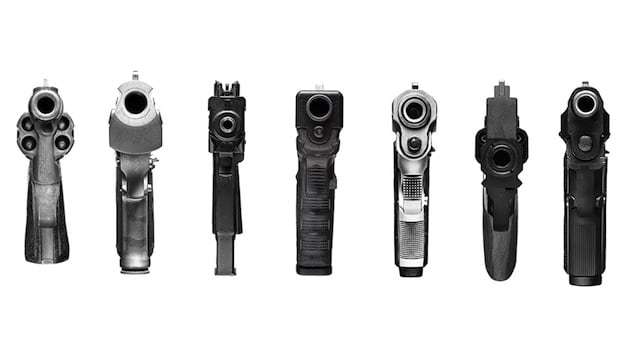
His subjects have shifted over time from urban bodies to guns, waves, animals, and buildings. In series such as Bodyhammer, firearms appear as crisp, frontal forms, rendered with the cool precision of a forensic image and the drama of an advertising photograph. In other works, storm clouds, crashing surf, or animal heads fill the frame with a similar sense of threat and scale.
Why does Robert Longo matter in contemporary art?
Longo matters because he showed that drawing could work at the same visual volume as film and photography. He did not treat charcoal as an old-fashioned medium. Instead, he used it to produce images that looked immediate, mediated, and modern, drawing on newspaper photography, cinema, and publicity images while keeping the physical labor of hand-making visible in the surface.
He also helped define a broader shift in postwar American art toward images that register social pressure rather than private feeling. His figures do not simply express emotion; they seem acted on by systems, whether fashion, corporate culture, or violence. That tension between style and stress is central to his place in the Pictures Generation and to the lasting impact of his work.
How are his drawings made?
Longo’s process usually begins with photography or film reference. He stages or collects source images, then translates them into charcoal drawings through a highly controlled method of layering, erasing, and refining. The scale matters: the large sheets let him build surfaces that can hold both minute detail and sweeping movement.
Although the images look mechanically exact, they depend on handwork. Charcoal allows a range from velvety blacks to thin gray dust, and Longo uses that range to model metal, fabric, skin, and smoke. The drawings can feel smooth from a distance and physically rough up close, where the grain of the paper and the pressure of the hand remain visible.
Questions
Is Robert Longo mainly a painter or a draftsman?
He is best known as a draftsman, especially for charcoal drawings, but his practice is broader than that label suggests. Longo has also made sculpture, films, photographs, prints, and installations. The drawing work remains central because it carries the clearest version of his visual language.
What is Bodyhammer?
Bodyhammer is a series of drawings centered on firearms, presented with the same severe clarity Longo brings to bodies and buildings. The title points to the collision between the human body and mechanical force. The images are not casual depictions of guns; they are composed to make weapons feel monumental, clinical, and charged at once.
Why are his figures often shown in extreme poses?
The poses create a sense of impact before any narrative begins. Longo uses twisting bodies to suggest pressure, panic, performance, and loss of control, which gives the drawings their tension. The body becomes a site where social and psychological forces appear in visible form.