
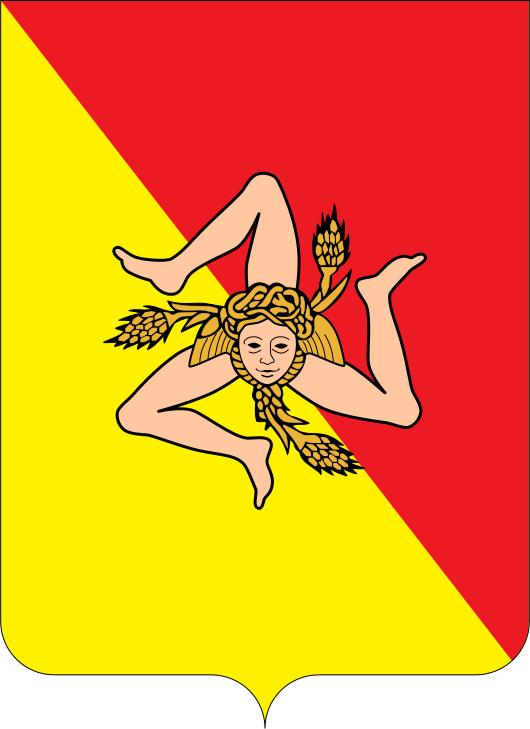
Sicily is the largest island in the Mediterranean Sea and an autonomous region of Italy, set between the tip of the Italian peninsula and the North African coast. Its position has made it a crossroads for trade, conquest, migration, and making, and that layered history still shapes its architecture, food, craft traditions, and visual culture.
- Largest island in the Mediterranean, separated from mainland Italy by the Strait of Messina.
- An autonomous region of Italy, officially the Regione Siciliana.
- Shaped by Greek, Roman, Arab, Norman, Spanish, and modern Italian rule.
- Known for baroque cities, volcanic landscapes, ceramics, textiles, and strong regional craft traditions.
- Frequently appears in photography, film, and design because of its light, terrain, and dense historical surfaces.
Why does Sicily matter?
Sicily matters because it condenses Mediterranean history into a single place. Greeks built temples there, Arabs altered irrigation and agriculture, Normans fused Latin, Byzantine, and Islamic forms, and later rulers left churches, palaces, street plans, and decorative systems that still remain visible. Few places in Europe show so many successive cultures in such direct physical contact.
That density gives Sicily unusual importance for visual culture. A single street can hold volcanic stone, tiled facades, wrought iron, baroque ornament, and food markets full of color and pattern. Photographers and designers return to the island for exactly that reason: it offers strong light, hard shadows, weathered surfaces, and a built environment where craft and history stay close together.
What does Sicily look like on the ground?
Sicily is not visually uniform. The east is dominated by Mount Etna and cities such as Catania and Syracuse, where lava stone, pale limestone, and baroque rebuilding shape the streets. The west includes Palermo, Trapani, and smaller inland towns with Arab-Norman traces, market culture, and older masonry forms. Coastal settlements bring in fishing harbors, tiled domes, and buildings designed for intense sun and salt air.
In practice, the island’s appearance comes from material adaptation. Builders have used local stone, plaster, terracotta, timber, and ceramic tile; artisans have made majolica surfaces, carved balconies, and decorative metalwork; and domestic interiors often combine utilitarian objects with vivid color. The result is not a single style but a repeating logic: make use of what the island offers, then turn it into something durable and expressive.
How did Sicily get this layered character?
Sicily’s strategic location made it a prize for empires moving through the Mediterranean. Ancient Greek colonies established temples and theaters; the Romans treated the island as an agricultural base; Arab rule introduced new crops, water systems, and vocabulary; Norman rulers preserved and recombined existing traditions rather than replacing them outright. Later Spanish and Italian periods added more baroque and civic architecture.
That sequence matters because it left visible overlap instead of clean breaks. A cathedral might contain Islamic decorative logic under a Christian program. A town square may sit beside older defensive walls, while later facades rest on much older foundations. For makers and historians, Sicily is valuable precisely because the island records cultural exchange in stone, tile, and street form.
How is Sicily used in art, photography, and design?
Sicily functions as both subject and source. Artists and photographers use it for its texture, light, and social life, but the island also supplies motifs that travel far beyond it: citrus groves, nets, ceramics, black lava stone, processional imagery, and baroque balconies. These elements often appear in branding, interiors, publishing, and travel imagery when an image needs to suggest warmth, memory, or Mediterranean abundance.
That visual appeal can flatten the place into a postcard if handled carelessly. The stronger work keeps the material reality in view: hard summer light, rural labor, dense urban markets, and the weight of migration and economic change. Sicily’s influence in visual culture is strongest when its surfaces are treated as evidence of lived history, not as decorative backdrop.
Frequently Asked Questions
Is Sicily part of Italy?
Yes. Sicily is an autonomous region of Italy, with its own regional government and a distinct cultural identity. It remains fully within the Italian state while retaining a special administrative status.
Why is Sicily so important in Mediterranean history?
Its location makes it a hinge between Europe, North Africa, and the eastern Mediterranean. That position brought repeated conquest, trade, and settlement, which left the island with a rare concentration of architectural and cultural layers.
What makes Sicilian architecture and design distinctive?
Sicilian architecture often combines local stone, bright plaster, decorative tile, and forms inherited from Greek, Arab, Norman, and Baroque traditions. In design terms, it tends to be tactile, sun-worn, and highly responsive to climate and material availability.