
The Lord of the Rings is an epic high fantasy novel by J. R. R. Tolkien, written as a sequel to The Hobbit and expanded into a far larger mythology of war, landscape, language, and power. Published in three volumes between 1954 and 1955, it follows Frodo Baggins and the struggle to destroy a ruling ring that can dominate all life in Middle-earth. The book became one of the most influential fantasy works ever written and a major source for illustration, film design, games, miniatures, and fan-made objects.
Stories from The Lord of the Rings
10 stories


About The Lord of the Rings
- It is a novel, not a series in the original publication sense, though it is often grouped as three volumes.
- Tolkien built it from invented languages, maps, genealogies, and a detailed secondary world.
- Its imagery has shaped fantasy illustration, costume, prosthetics, prop making, and worldbuilding.
- The book’s visual identity is tied to rings, crowns, swords, script, heraldry, and ruined architecture.
Read the full overviewHow the book was made, Why does The Lord of the Rings matter?, What does it look like in practice?, How has it been adapted?
How the book was made
Tolkien started with the world of The Hobbit, then pushed the material into a darker and more complex narrative. He wrote in stages over many years, revising the story while also developing the languages and histories that support it. That layered process matters because the novel does not read like a simple adventure tale; it feels built from archives, songs, maps, and fragments of older legend.
That method also explains why so many later makers treat the book as a design system. The text offers usable forms: armour, cloaks, runes, crowns, banners, ruined towers, and ring motifs. Artists and filmmakers have repeatedly had to translate those written details into physical things, from lettering and book covers to prosthetic ears, chain mail, and weathered set dressing.
Why does The Lord of the Rings matter?
The novel matters because it helped define modern fantasy fiction. Tolkien did not just invent a story; he established a model for secondary worlds that feel historically deep, materially specific, and linguistically coherent. Later fantasy writers borrowed that model, sometimes directly and sometimes in reaction against it.
Its influence reaches far beyond literature. Costume designers, miniature builders, concept artists, prop makers, and game studios keep returning to its visual language because it gives them strong cues about material culture: ironwork, leatherwork, weaving, calligraphy, stone carving, and battered travel gear. Even when a project is not adapting the novel, it often borrows the same atmosphere of weathered nobility and handmade detail.
What does it look like in practice?
The book’s influence is easiest to see in the objects and images attached to it. The One Ring is a plain gold band with an inscription in Tengwar, the invented script that gives the object its authority and menace. That combination of simple form and dense meaning has made the ring one of the most recognisable props in modern fantasy.
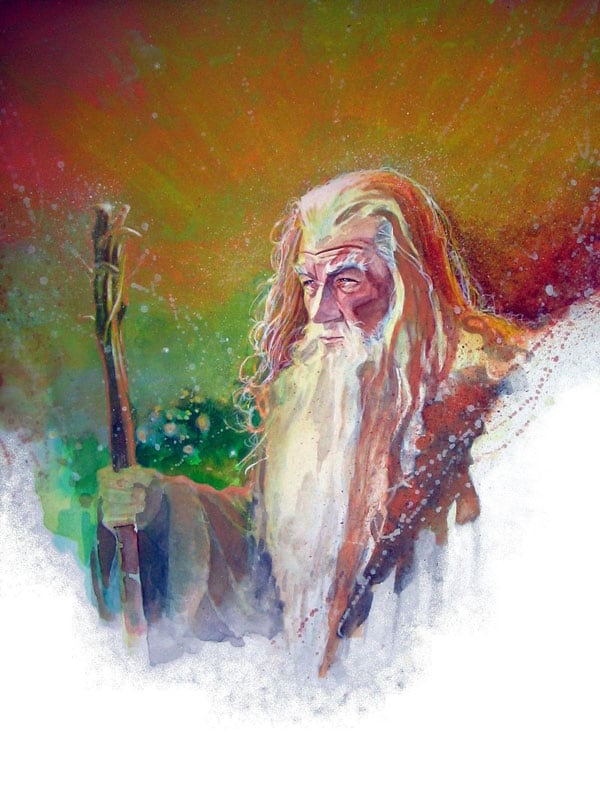
Elsewhere, the visual vocabulary is more varied: Elvish armour tends toward elegance and surface pattern; Mordor suggests blackened metal, ash, and brutal geometry; the Shire uses wood, cloth, and domestic craft; Rohan leans on horse culture, braid, and carved timber. These differences are why the novel keeps inspiring artists working in oil paint, watercolor, sculpture, digital modelling, LEGO, and production design. The story is inseparable from the materials that express it.
How has it been adapted?
The most influential adaptations are Peter Jackson’s films, which converted Tolkien’s written world into a physical cinema language of scale models, prosthetics, miniatures, matte painting, and digital effects. Wētā Workshop became especially important in that process, building armour, weapons, creature suits, and practical props that grounded the fantasy in real fabrication. Those films in turn fixed many visual expectations for later audiences.
Adaptation also continues in smaller formats. Collectors build large LEGO versions of sets and ships, artists paint scenes from the books, and craftspeople make replicas of swords, maps, and rings. Each version has to decide how much weight to give to Tolkien’s text versus the cinematic image that now surrounds it. That tension keeps the work active in design culture rather than frozen as a single canon.
Frequently Asked Questions
Is The Lord of the Rings a trilogy?
It is commonly sold as a trilogy, but Tolkien intended it as one novel divided into three volumes for publication. The three parts are The Fellowship of the Ring, The Two Towers, and The Return of the King. The division is practical rather than structural in the way a modern trilogy usually is.
Why do designers keep returning to it?
It offers a rich set of repeatable visual problems: how to design an ancient ring, a haunted tower, an imperial fortress, or a believable nonhuman costume. Tolkien’s world is specific enough to guide craft, but open enough to allow different interpretations. That makes it unusually useful to illustrators, model makers, and production designers.
What is Middle-earth?
Middle-earth is the fictional setting of the novel and Tolkien’s wider legendarium. It is not a distant planet in the science-fiction sense, but a mythic version of our world in an imagined earlier age. Its geography, peoples, and languages are built to feel historical rather than purely invented.