
J. R. R. Tolkien was an English writer, poet, philologist, and Oxford professor whose invented languages and mythic fiction reshaped modern fantasy. He is best known for The Hobbit, The Lord of the Rings, and the posthumously published The Silmarillion. His work draws on Old English, Norse legend, medieval romance, and the discipline of language study, which gave his fiction an unusual density of history, geography, and naming.
Stories from J. R. R. Tolkien
8 stories





About J. R. R. Tolkien
- Best known for building a secondary world called Middle-earth, with its own languages, peoples, and chronology.
- His scholarship in Old and Middle English strongly shaped his writing style and subject matter.
- His fiction helped establish high fantasy as a major literary form in the 20th century.
- His invented scripts, place-names, and genealogies matter as much as plot in many of his texts.
- His influence reaches literature, illustration, film adaptation, games, and fan cultures.
Read the full overviewWhat made Tolkien different?, Where did his ideas come from?, How does Tolkien’s world-building work in practice?, Why does Tolkien still matter?
What made Tolkien different?
Tolkien did not simply write fantasy adventures. He built stories from language outward, treating words, sounds, and etymology as the starting point for entire cultures. As a philologist, he studied how languages change over time, and that habit appears in his fiction as ancient songs, old chronicles, regional dialects, and names that feel inherited rather than invented.
This method gave his work a textured materiality. A sword has a history, a hill has an older name, and a kingdom can be read through the sound of its language. That depth made Middle-earth feel less like a stage set and more like a reconstructed past.
Where did his ideas come from?
Tolkien’s imagination drew on Anglo-Saxon poetry, Finnish epic, medieval romance, Christian theology, and the landscape of industrial and rural England. He disliked modern mechanised life and often contrasted it with older forms of craft, farming, and local knowledge. That tension appears repeatedly in his fiction, where forests, rivers, roads, and ruins are never just scenery.
His academic career at Oxford mattered as much as his literary one. He edited texts, taught language history, and wrote scholarly essays long before he became widely famous as a novelist. The patient attention required by scholarship shows up in the care with which he mapped genealogies, invented alphabets, and revised prose over many years.
How does Tolkien’s world-building work in practice?
Middle-earth is organised through layers of writing: songs, annals, maps, heraldry, inscriptions, and translated names. Tolkien often gives a character several names in different languages, which suggests contact between peoples and the passage of time. Even small objects such as rings, cloaks, blades, and books carry symbolic weight because they belong to a wider historical system.
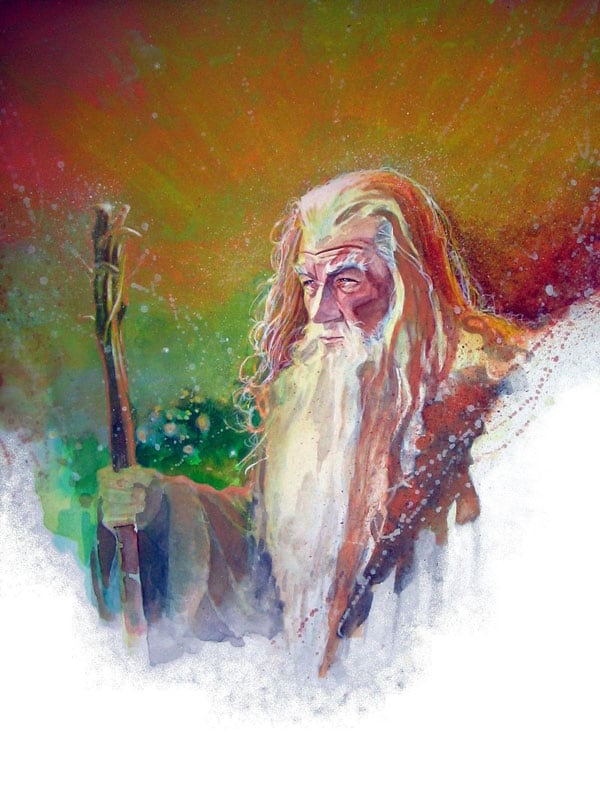
Visually, Tolkien’s world has been interpreted through illustration, typography, costume design, and film production, but the source material already contains a strong visual grammar. Elvish script, crowned halls, armour, ruined fortresses, and deep forests all emerge from a prose style that balances precision with mythic scale. His influence is visible whenever fantasy fiction treats invented detail as a serious craft rather than decoration.
Why does Tolkien still matter?
Tolkien helped define what readers now expect from fantasy: a coherent secondary world, ancient lore, multiple races or peoples, invented languages, and a sense that history predates the main story. Many later writers adopted his methods, whether they followed his model closely or reacted against it. He also changed how publishers, illustrators, and filmmakers approach fantasy settings, pushing them toward consistency and world-specific design.
His legacy is not limited to genre fiction. Scholars continue to study his language work, his handling of myth, his religious imagination, and the politics embedded in his invented worlds. At the same time, his books remain widely read because they combine adventure with careful attention to craft, loss, memory, and the look and sound of old things.
Frequently Asked Questions
Was Tolkien mainly a novelist or a scholar?
He was both, and the two roles overlap throughout his career. Tolkien spent most of his professional life teaching and studying language history at Oxford, and that scholarship directly informed his fiction. His novels became famous, but they grew out of academic habits of close reading, etymology, and textual reconstruction.
Did Tolkien invent entire languages?
Yes, he created several constructed languages, including Quenya and Sindarin, and he treated them as living systems with grammar, sound changes, and historical relationships. He did not make them as isolated codes for a story; he built cultures around them. The languages often came first, and the stories followed.
Why do his books feel so detailed?
Tolkien wrote as if his stories were translations of older records. He filled the texts with songs, maps, family trees, place-names, and references to events outside the main plot. That accumulation of detail creates the sense that the reader has entered a large and old world rather than a single narrative.