
Vanessa Paradis is a French singer, model, and actor whose career began with a teenage pop hit and expanded into fashion campaigns, film roles, and a long-running public image built around Parisian style. She became famous at 14 with Joe le taxi, then turned that early chart success into a durable career across music, screen work, and luxury branding.
Stories from Vanessa Paradis
1 story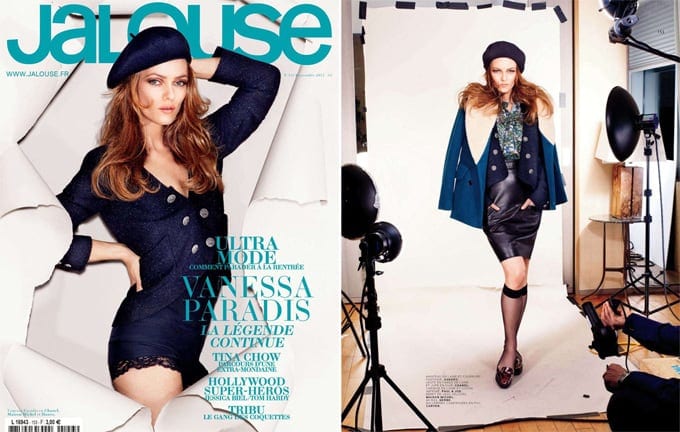
About Vanessa Paradis
| Born | 22 December 1972, Saint-Maur-des-Fossés, France |
|---|---|
| Known for | Music, modelling, film acting |
| Breakthrough | Single Joe le taxi (1987) |
| Major brand association | Chanel spokesmodel since 1991 |
| Family | Sister: Alysson Paradis, actor |
Read the full overviewHow did she become famous?, Why does Chanel matter in her career?, What does Vanessa Paradis look like as a public image?, What makes her more than a pop star?
How did she become famous?
Paradis first reached a mass audience as a child performer. Joe le taxi became a hit well beyond France and gave her a rare profile for a teenager: part pop singer, part media figure, part fashion image. That early fame mattered because it was not built on a single season of novelty. It opened a route into adult work in music and film, while keeping her name recognisable to fashion houses and magazines.
Her public identity quickly moved beyond the single itself. She recorded albums, appeared in French cinema, and became associated with a controlled, elegant presentation rather than tabloid excess. That balance helped make her a lasting figure in French popular culture.
Why does Chanel matter in her career?
Paradis became a Chanel spokesmodel in 1991, a relationship that has shaped how many readers know her. For a fashion house, a spokesmodel is not just a face in an advert; she helps embody the brand’s visual language across campaigns, print images, and promotional films. In Paradis’s case, the fit rested on a combination of youth, restraint, and a distinctly French glamour that echoed Chanel’s own image.
This association also shows how modelling can amplify an artistic career. Her Chanel work reinforced her presence in magazines and fashion editorials, including covers such as Jalouse, where styling, makeup, and pose become part of the message. The result is a career that sits at the meeting point of pop music, celebrity portraiture, and luxury branding.
What does Vanessa Paradis look like as a public image?
Paradis is often presented with a spare, polished look: natural hair, minimal styling, clean silhouettes, and a face that reads well in both soft editorial lighting and formal campaign photography. That visual economy matters. It lets photographers and art directors use her as a marker of chic rather than spectacle, which has been central to her longevity in fashion pages.
In practice, this means she appears less as a heavily transformed celebrity and more as a stable icon whose features and posture carry the image. Her photographs often depend on understatement: a simple jacket, strong lighting, an attentive gaze. For a publication focused on visual culture, that kind of consistency is part of the subject.
What makes her more than a pop star?
Paradis’s career has lasted because it crosses several industries that usually reward different kinds of visibility. Music gave her a public voice, modelling gave her a visual signature, and acting extended that presence into narrative form. Each field supported the others. A magazine cover could recall a hit single; a film role could refresh her image for fashion editors; a luxury campaign could keep her recognisable between records or screen appearances.
She also became part of a wider French cultural export: polished, understated, and easily adaptable to international fashion systems. That combination makes her useful to brands and interesting to editors, because she carries both celebrity recognition and a specific aesthetic code.
Frequently Asked Questions
What was Vanessa Paradis’s breakthrough?
Her breakthrough was the 1987 single Joe le taxi, which made her a star at 14. The song travelled widely and gave her immediate visibility outside the usual limits of child-pop success. It remains the key reference point for her early career.
Is Vanessa Paradis mainly a singer or a model?
Neither label fully captures her career. She is known as a singer, model, and actor, and each role has been significant at different times. The public image around her depends on the combination, not on one discipline alone.
Why is she often discussed in fashion magazines?
Her long association with Chanel made her a familiar figure in fashion media, but the interest goes beyond one contract. She fits an editorial idea of French elegance that works well in photography and advertising. That makes her a recurring subject for covers, campaigns, and style pages.