
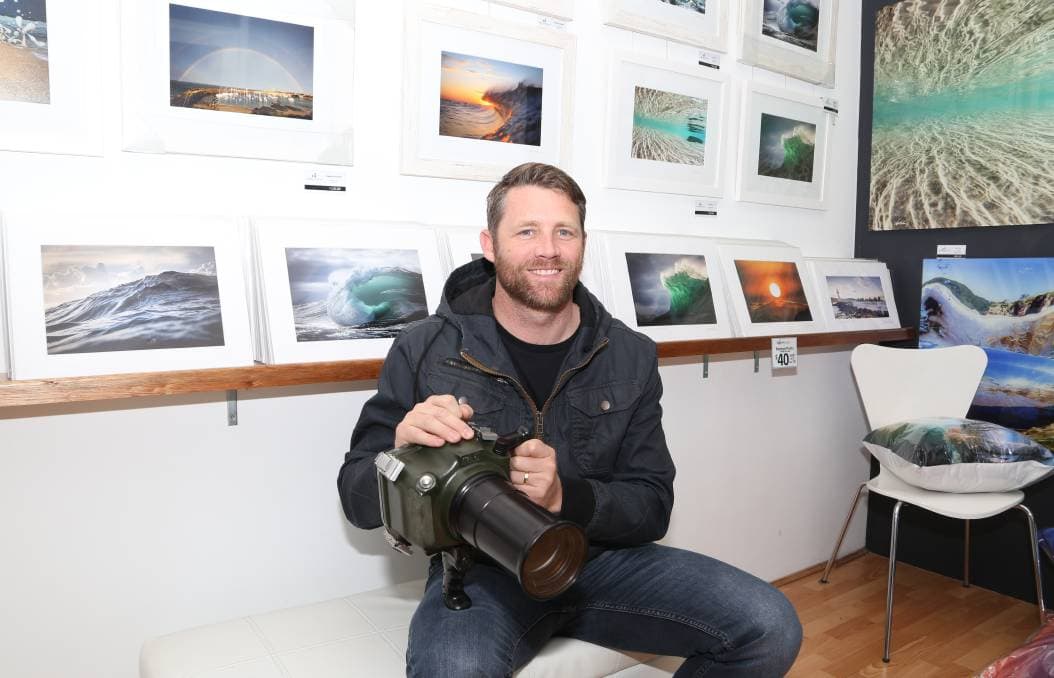
Warren Keelan is an Australian seascape and ocean photographer known for images of breaking waves, underwater light, and the changing surface of the sea. Based on the South Coast of New South Wales, he works close to and often inside the water, using digital photography to turn fleeting conditions into detailed, atmospheric photographs.
| Field | Details |
|---|---|
| Discipline | Seascape and ocean photography |
| Base | South Coast of New South Wales, Australia |
| Main subjects | Waves, surf, sunlight on water, underwater scenes |
| Medium | Digital photography |
| Known for | Images that emphasise movement, texture, and the emotional force of the ocean |
What does Warren Keelan photograph?
Keelan photographs the ocean as a fast-moving, unstable subject rather than a static view. His work focuses on surf conditions, the build and collapse of waves, and the moment when light catches spray, foam, and the translucent body of water itself. Many of his images use a tight frame, which turns a single wave into a graphic form full of texture and motion.
He is interested in the sea as something that is never the same twice. That makes timing central to his practice. A strong photograph might depend on the right swell, the right tide, and a split second when the water, weather, and sun align.
How does he make these images?
Keelan’s practice depends on proximity. He spends long periods beside the ocean and, at times, within it, so he can photograph from a perspective that feels immediate and immersive. That position matters: shooting at water level changes the scale of waves and brings the viewer closer to the force of the sea.
He works digitally, which suits a practice built around fast-changing conditions. Digital capture makes it easier to respond quickly to light and movement, review images on site, and refine a sequence of shots as the conditions shift. In seascape photography, that speed is practical as well as aesthetic, because the scene can change before the camera is put away.
Why do his photographs stand out?
Keelan’s images stand out because they treat waves as subjects with structure, not just spectacle. He often isolates the curl, crest, or collapse of a wave so that the photograph shows both the physical mechanics of water and its visual beauty. The result can feel almost abstract at first glance, but it remains rooted in direct observation.
Light is a major part of that effect. Sunlight passing through water can make the ocean appear luminous, green, blue, or silver, and Keelan uses that natural illumination to shape the mood of each frame. His best-known photographs do not simply record a wave breaking; they show how water behaves, how it reflects light, and how quickly it changes form.
What place does he hold in ocean photography?
Keelan belongs to a tradition of photographers who treat the coast as a working environment and the sea as an active visual language. His images fit within contemporary surf and seascape photography, where technical skill, patience, and physical risk often overlap. The photographer’s position in the water can be as important as the equipment used.
His work matters because it offers a fresh way of looking at a familiar subject. Waves are often photographed as background or scenery; Keelan gives them the attention usually reserved for portraiture or landscape at its grandest scale. That shift makes the ocean feel immediate, specific, and alive.
Frequently Asked Questions
Is Warren Keelan a surf photographer or a fine art photographer?
He works in a space where those categories overlap. His subjects come from surf and coastal environments, but the images are composed and lit with strong attention to form, mood, and surface detail. That gives the work a fine art quality even when the subject is an everyday ocean scene.
What makes shooting waves difficult?
Waves move quickly, change shape without warning, and often break in the wrong place for a frame. The photographer has to judge timing, position, and exposure while working around spray, glare, and the force of the water. In ocean photography, the difficulty is part of the image-making process, not just an obstacle to it.
Why does sunlight matter so much in his work?
Sunlight reveals the structure inside moving water. It can make a wave glow from within, sharpen the edge of foam, or turn a dark surface into a reflective plane. Keelan uses that effect to make the ocean feel dimensional rather than flat.
}
Articles mentioning Warren Keelan

