
Fra.Biancoschock is the public art identity of Italian street artist Biancoshock, known for urban interventions that use surprise, humour, and discomfort to push social commentary into everyday life. The work began in 2004 and ranges from small wall stencils to staged objects and actions placed in streets, doorways, and other public spaces. Rather than making images to be looked at from a distance, Fra.Biancoschock builds situations that interrupt routine and force a reaction.
Fra.Biancoschock on FreeYork
About Fra.Biancoschock
- Best known for urban installations and street-based interventions
- Started working under this name in 2004
- Uses public space as both site and material
- Combines satire, shock, and social criticism
- Often turns ordinary objects or habits into visual traps
What kind of work does Fra.Biancoschock make?
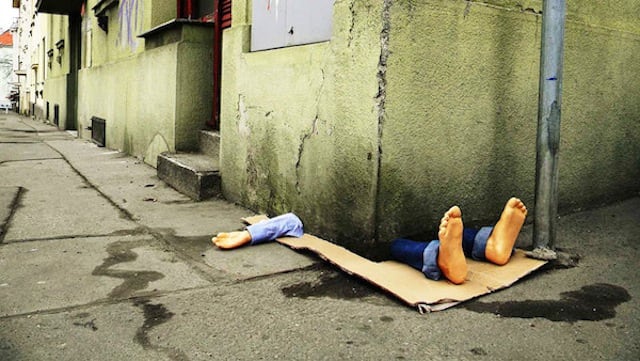
Fra.Biancoschock makes installations that sit directly in the path of daily life. A wall, a bin, a doorway, a bus stop, or a patch of pavement can become the support for a joke, a critique, or a visual prank. The work is often low-tech and temporary, relying on placement, timing, and a sharp sense of context rather than on expensive materials or permanent construction.
That placement matters. A piece may look like a familiar object at first glance, then reveal a twist that exposes social habits, public indifference, consumer culture, or political contradiction. The result is less about formal beauty than about disruption. The work needs the street, the passerby, and the split second before recognition for its effect.
Why does it matter?
Fra.Biancoschock belongs to a strand of contemporary street art that treats the city as an active conversation rather than a backdrop. Instead of decorating public walls, the work tests what public space allows, ignores, or hides. It borrows the speed and accessibility of street art, but it uses them for social critique rather than image-making alone.
The practice matters because it makes people notice what routine usually erases. A joke placed in the wrong corner of a square can expose habits of control, inequality, waste, or boredom more effectively than a poster can. The work also shows how urban art can function as a temporary intervention: quick to appear, quick to vanish, but strong enough to stay in memory and circulate online.
How does the work operate in practice?
Fra.Biancoschock often uses simple fabrication and direct installation methods. Stencils, pasted elements, found objects, painted surfaces, and small built inserts are common tools. The emphasis is on making something that can be installed quickly in public and understood immediately, even if the meaning unfolds over a longer look.
The practice also depends on risk. Public interventions can be removed, ignored, photographed, or misunderstood. That instability is part of the form. Fra.Biancoschock’s work leans into that uncertainty, using the possibility of interruption as part of the artwork itself.
Is Fra.Biancoschock part of a movement?
Fra.Biancoschock is often associated with urban art and activist street art, but the name refers to an individual artist rather than a collective movement. The work shares ground with graffiti, tactical urbanism, and social practice art, especially where art leaves the gallery and enters the street as a public event. The artist’s output is best understood as a sustained practice within that larger field.
That matters because the work blurs categories. It can read as street art, performance, installation, or visual satire depending on the piece. The common thread is a refusal to keep art separate from the physical and social conditions of the city.
Questions
Who is Fra.Biancoschock?
Fra.Biancoschock is the artistic identity used by Biancoshock, an Italian artist working in public space. The name is associated with interventions that use wit, shock, and irony to comment on social life. His practice has been active since 2004.
What materials does Fra.Biancoschock use?
The work often uses ordinary urban materials and simple fabrication: paint, stencils, pasted paper, found objects, and small built additions. The choice of material usually serves the situation rather than a fixed style. Familiar things are rearranged so they read as something unexpected.
Is Fra.Biancoschock street art or installation art?
It is both, depending on the piece. The work uses the methods of street art, especially direct placement in public space, but it also behaves like installation art because it changes how a site is experienced. The strongest pieces do not fit neatly into one category.