
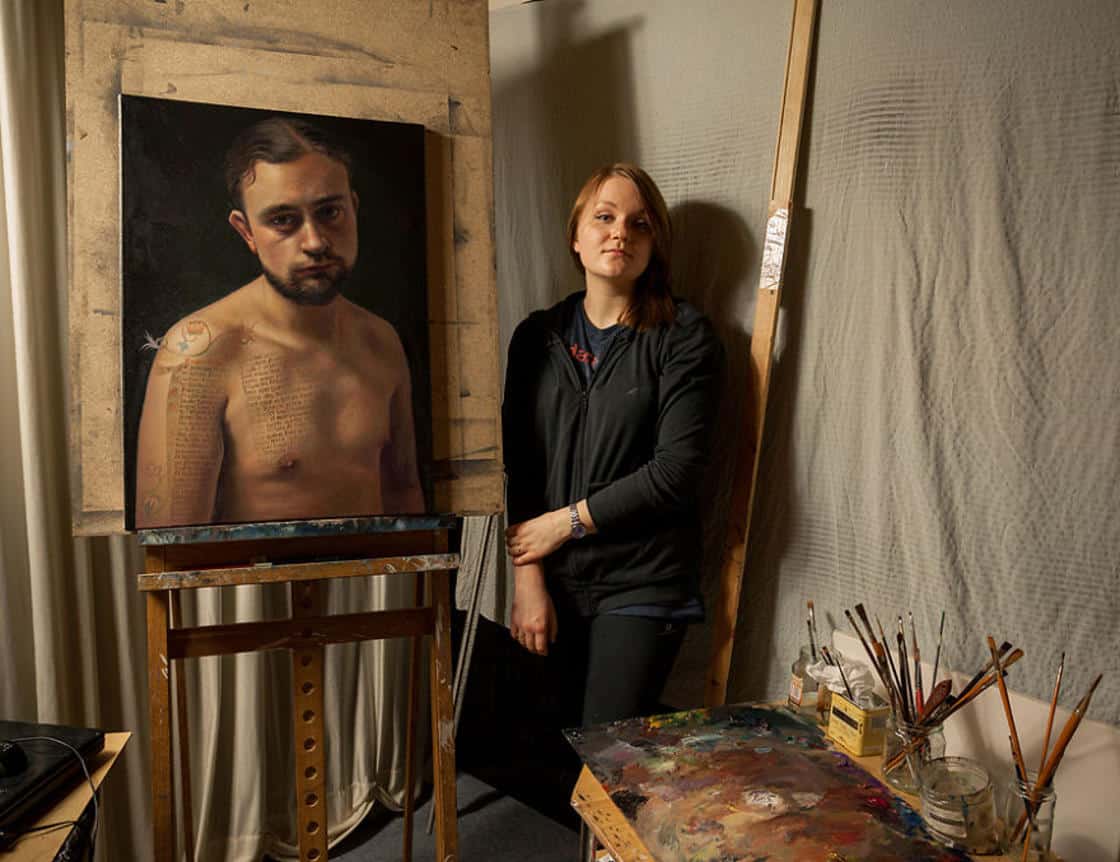
Agnieszka Nienartowicz is a Polish painter known for figurative oil paintings that often place tattooing, art history, and the human body in the same frame. Born in 1991 in Jelenia Góra, in Lower Silesia, she studied at the Academy of Fine Arts in Wrocław and later at the Academy of Fine Arts in Gdańsk, where she earned an MFA in 2016. She now lives and works in Zakopane, in southern Poland.
- Polish figurative painter working mainly in oil
- Born in 1991 in Jelenia Góra
- Studied painting in Wrocław and Gdańsk; MFA from Gdańsk in 2016
- Known for images that combine tattoo culture with classical painting references
- Lives and works in Zakopane
What kind of work does she make?
Nienartowicz paints carefully observed figures, usually in oil, with a finish that often feels polished and deliberate rather than loose or gestural. Her subjects tend to be women, shown frontally or in quiet poses, with skin rendered as a surface that can hold symbolism as well as anatomy. Tattoos appear frequently in her work, but not as decoration alone; they act like a second visual layer, carrying references to art history, myths, and images already familiar from museum culture.
This gives her paintings a double reading. At first glance they can look like contemporary portraits or studies of the body. Closer inspection reveals that the tattoo motifs can echo masterpieces such as Bosch or other canonical imagery, turning the body into a site where old visual culture is rewritten in a new medium.
Why do tattoos matter in her paintings?
Tattoos are central to the way Nienartowicz thinks about the painted figure. In her hands, they are not just markers of identity or fashion. They become a way to show how images move across time and between media: from panel or canvas to skin, from the museum to the living body. That shift changes the meaning of the original image, because the painted body is no longer passive. It carries the image, displays it, and alters it through flesh, pose, and context.
Her work also connects contemporary body culture with older traditions of portraiture and allegory. Instead of treating tattooing as separate from fine art, she places it inside a classical painting language. The result is a contemporary figurative practice that looks closely at what people choose to wear on their skin and why certain images continue to circulate.
Where did she train, and how has that shaped her style?
Nienartowicz studied painting at two Polish art academies: first in Wrocław between 2011 and 2013, then in Gdańsk, where she completed her MFA in 2016. At the Gdańsk Academy of Fine Arts she worked in the painting studio led by Professor Maciej Świeszewski and also studied drawing with Professor Maria Targońska. That combination of painting and drawing training matters in her finished work, which depends on precise contour, careful modelling, and control over surface.
Her education sits within a strong academic painting tradition, but her subject matter pushes beyond straightforward portraiture. The figures are often staged with a sense of stillness and clarity that reflects studio discipline, while the tattooed motifs add an unexpected conceptual twist. This balance between technical control and contemporary imagery is one reason her paintings are easy to recognise.
How is Agnieszka Nienartowicz recognised?
She has received scholarships, awards, and distinctions, which point to early professional recognition in Poland’s art education and exhibition system. Those credentials matter because they place her within a generation of academically trained painters who keep figurative practice alive while updating its subjects and symbols. Her work has attracted attention in writing about tattoo culture and reworked classical imagery, where her paintings are often discussed for the way they complicate the boundary between high art and body art.
She is based in Zakopane, a mountain town in the Tatra region, and that location may feel far from the urban centres usually associated with contemporary art. Still, her work travels well because its core concerns are legible across contexts: the body, image transmission, and the persistence of canonical visual forms. The paintings do not rely on local scene-setting; they rely on visual recognition and exact paint handling.
Frequently Asked Questions
Is Agnieszka Nienartowicz mainly a tattoo artist?
No. She is a painter, and tattooing appears in her work as subject matter and visual language rather than as her own professional medium. Her paintings use tattoo imagery to explore how bodies carry symbols and how classical art can be remade on skin.
What medium does she use?
Her best-known works are oil paintings. Oil suits her precise figures and layered surfaces, especially when she is rendering skin, fabric, and tattoo linework with a controlled finish. The medium also lets her build the subtle tonal shifts that give her figures their calm, almost icon-like presence.
Why is she linked to classical art?
She often quotes or reinterprets well-known images from the history of Western art, then places them on tattooed bodies. That move changes the original image by relocating it from the museum to the contemporary figure. It also turns the painted body into a carrier of memory, citation, and visual culture.