
The Maya civilization was a long-lived Mesoamerican civilization that developed across parts of present-day southern Mexico, Guatemala, Belize, Honduras, and El Salvador. It is best known for a fully developed writing system, complex calendar and astronomical knowledge, monumental stone architecture, and finely made sculpture, painted pottery, and carved stelae.
- It began to take shape in the Pre-Classic period, roughly 2000 BC to AD 250.
- Its best-known cities flourished during the Classic period, roughly AD 250 to 900.
- Maya writing is the most complete writing system known from the pre-Columbian Americas.
- Maya builders worked mainly in limestone, shaping temples, palaces, ball courts, and pyramids with stucco finishes and painted decoration.
- The civilization did not disappear at the end of the Classic period; Maya peoples and languages continue today.
Where did the Maya civilization come from?
The Maya civilization emerged gradually from earlier farming communities in the lowlands and highlands of Mesoamerica. By the Pre-Classic period, settlements were already building ceremonial platforms, trading across regions, and developing social hierarchies. Over centuries, these communities became city-states with rulers, nobles, scribes, artisans, and farmers tied together by tribute, warfare, alliance, and exchange.
There was no single Maya capital or empire. Instead, the civilization consisted of many independent polities such as Tikal, Palenque, Copán, Calakmul, and Caracol. Each city had its own dynasty, style, and political history, even while sharing religious ideas, artistic conventions, and a common elite culture.
What did Maya writing and learning look like?
Maya scribes used a logosyllabic script made of signs that could represent whole words or syllables. They wrote on stone monuments, ceramics, bark-paper books called codices, and plastered walls. The script recorded royal lineages, ritual events, wars, dedications, and calendrical data, giving modern scholars unusually rich evidence for a pre-Columbian civilization.
Maya scholars also developed advanced systems for tracking time and celestial movement. They used multiple calendars, including the 260-day ritual count and the 365-day solar year, and they recorded long spans of time with the Long Count. Mathematical notation included a concept of zero, written in a positional system that supported precise calculation. These tools were practical as well as ceremonial, shaping agriculture, ritual timing, and political legitimacy.
Why are Maya ruins so distinctive?
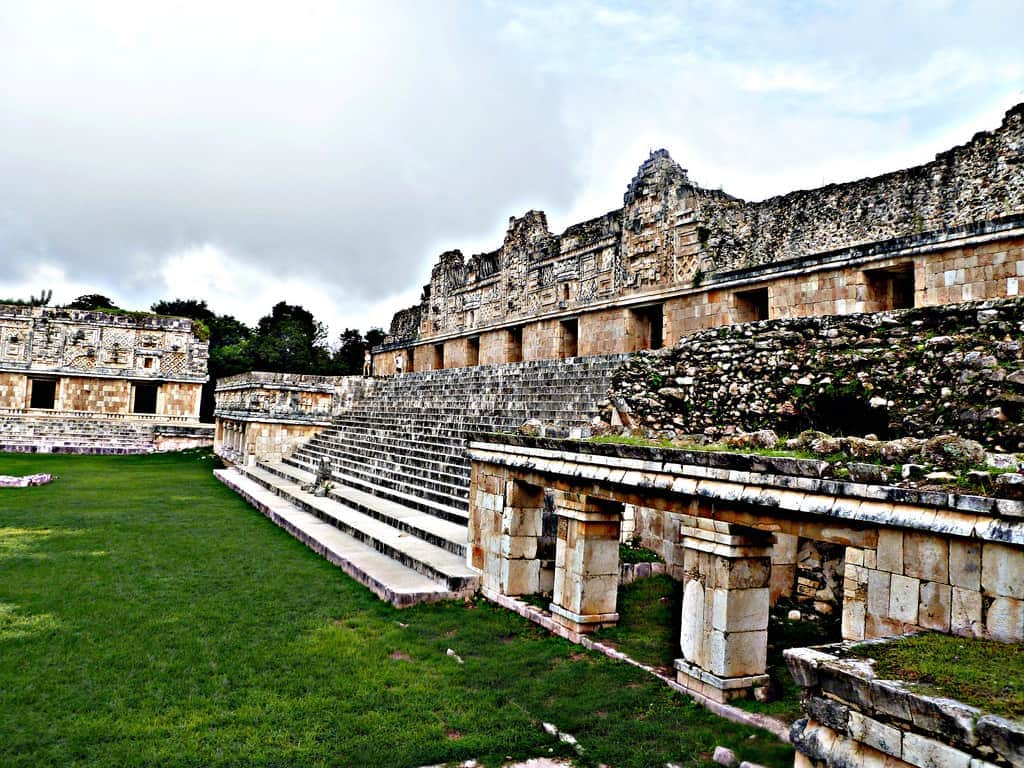
Maya architecture usually combines stone cores, cut limestone blocks, stucco surfaces, and steep stepped forms. Cities often centered on plazas framed by temples, palaces, administrative buildings, and ball courts. Buildings were oriented with careful attention to landscape, sightlines, and celestial events, so the built environment often worked as both civic stage and ritual instrument.
The visual language of Maya art is equally specific. Relief carving, painted ceramics, façade sculpture, and stucco decoration show rulers in elaborate headdresses, gods with hybrid features, and scenes of offering, dance, bloodletting, and captive display. Bright pigments once covered many surfaces, so the remains visible today can look stark compared with the original appearance. The best-known ruins, such as Tikal and Chichén Itzá, are only fragments of cities that were once densely occupied and carefully ornamented.
What happened to the Classic Maya cities?
Many southern lowland cities declined in the ninth and tenth centuries, after a period commonly called the Maya collapse. Population loss, political fragmentation, warfare, drought, environmental stress, and disrupted trade likely all played a part, though no single cause explains every region. Some centers were abandoned or reduced in size, while others shifted northward or into different forms of regional power.
The collapse was not the end of Maya life. Maya communities continued in the Post-Classic period, and many descendants still speak Maya languages and maintain cultural traditions today. Modern archaeology and epigraphy have also overturned older ideas that treated the civilization as a vanished mystery. What remains is a better view of the Maya as historical people whose cities rose, transformed, and persisted over millennia.
Frequently Asked Questions
Are the Maya and the Mayans the same thing?
“Maya” usually refers to the civilization, the peoples, or the languages, while “Mayan” is often used as an adjective in English. In casual use, “Mayan ruins” appears often, but many scholars prefer “Maya ruins” when referring to architecture and cities. The living peoples are not past tense; Maya communities still exist across the region.
What materials did Maya builders use?
Maya builders relied heavily on limestone, which was abundant in many regions and easy to cut when freshly quarried. They also used stucco made from lime plaster to coat walls, model sculpture, and create smooth surfaces for painting. In some areas they used volcanic stone, wood, and packed earth, but limestone and stucco defined much of the monumental style.
Why do Maya ruins look unfinished or bare?
Most surviving ruins are stripped of paint, roofing, timber, and stucco, all of which decayed or were removed over time. Original buildings were much more colorful and often had complex upper façades, roof combs, and sculpted details. What remains today is the structural core, which can make the architecture seem harsher and more monumental than it once was.