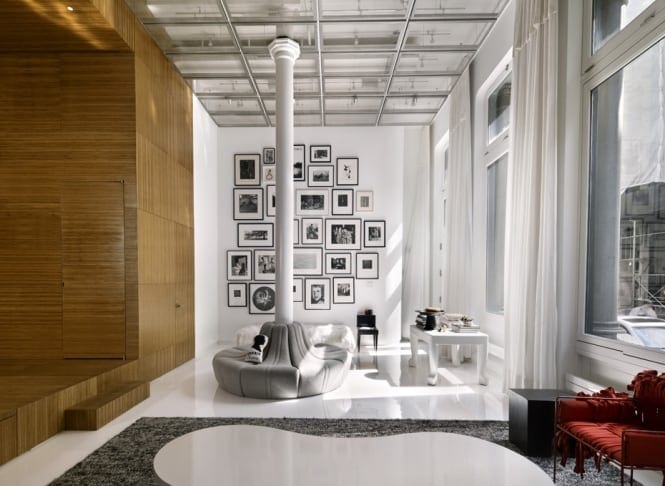

In the heart of TriBeCa, New York City, the White Street Loft stands as one of the finest examples of thoughtful urban residential design. Conceived by the acclaimed architecture and interior design firm WORKac, this multi-level loft apartment was the result of a meticulous four-year project — and the outcome is nothing short of extraordinary. Designed for a family of four, the space balances the competing demands of family life, work, and creative living within the constraints of a classic New York loft.
About WORKac
WORKac is a New York-based architecture and design firm founded by Amale Andraos and Dan Wood. Known for their ability to merge social purpose with innovative form, WORKac has earned international recognition for projects that challenge conventional notions of space and urban living. The White Street Loft exemplifies their signature approach: taking an existing structure and transforming it into something that feels entirely original — functional without being sterile, elegant without being cold.
The Layout: Organizing Life Across Three Levels
The White Street Loft occupies three floors and is organized into a series of distinct functional bands that flow naturally from public to private. Rather than using conventional room divisions, WORKac structured the space so that each zone transitions logically into the next, creating a sense of continuity while still offering the privacy a family needs.
Common Areas
The living room, dining area, and kitchen occupy the most accessible portion of the loft, positioned to take full advantage of natural light and street-level energy. These shared spaces are open and expansive, encouraging family gathering while maintaining enough breathing room for each area to feel purposeful. The kitchen, in particular, is designed as a social hub — visible from the living area and easy to move through, whether you’re hosting guests or managing the school-morning rush.
Private Quarters
Moving deeper into the loft, the private zones begin. Two children’s bedrooms are designed to be adaptable — compact but well-considered, with built-in storage and enough wall space to evolve as the children grow. The master bedroom is a calm, restrained retreat that deliberately contrasts with the more dynamic common areas. There is also a room for a live-in nanny, reflecting the practical realities of busy New York family life.
Design Philosophy: Classic New York Meets Rational Restraint
What makes the White Street Loft particularly interesting is how WORKac navigates between two opposing design impulses. On one hand, there is the classic New York loft aesthetic — raw materials, high ceilings, a sense of industrial history. On the other, WORKac brings a more rational, European sensibility that strips away ornament and lets proportion and function do the talking.
The result is a space that feels both timeless and distinctly contemporary. Neutral palettes are used throughout, allowing the architecture itself — the volumes, the transitions between levels, the play of light — to carry the visual weight. Carefully selected materials add warmth without cluttering the composition.
Designed for an Active Family
One of the most considered aspects of the White Street Loft is how thoroughly it has been designed around the rhythms of family life. A dedicated games room gives children a space to be loud and active without disrupting the rest of the household. A study area provides a quiet zone for homework and remote work. Even circulation through the loft — the way you move from one level to another, from common space to private — has been choreographed to reduce friction in daily life.
This is interior design that takes lived experience seriously. Not just beautiful photographs, but a home that genuinely works for the people inside it.
A Benchmark for Urban Family Living
The White Street Loft remains a compelling reference point for anyone thinking about how to make dense urban living work for families. It demonstrates that the constraints of a New York loft — the verticality, the inherited industrial bones, the pressure of limited square footage — can become assets rather than obstacles in the hands of a skilled design team.
For those interested in WORKac’s broader body of work, their projects consistently return to similar themes: how architecture can serve social life, how form can follow not just function but feeling, and how even the most pragmatic brief can become an opportunity for genuine invention.
More in
Interior Design
All Interior Design


More in
Architecture
All Architecture