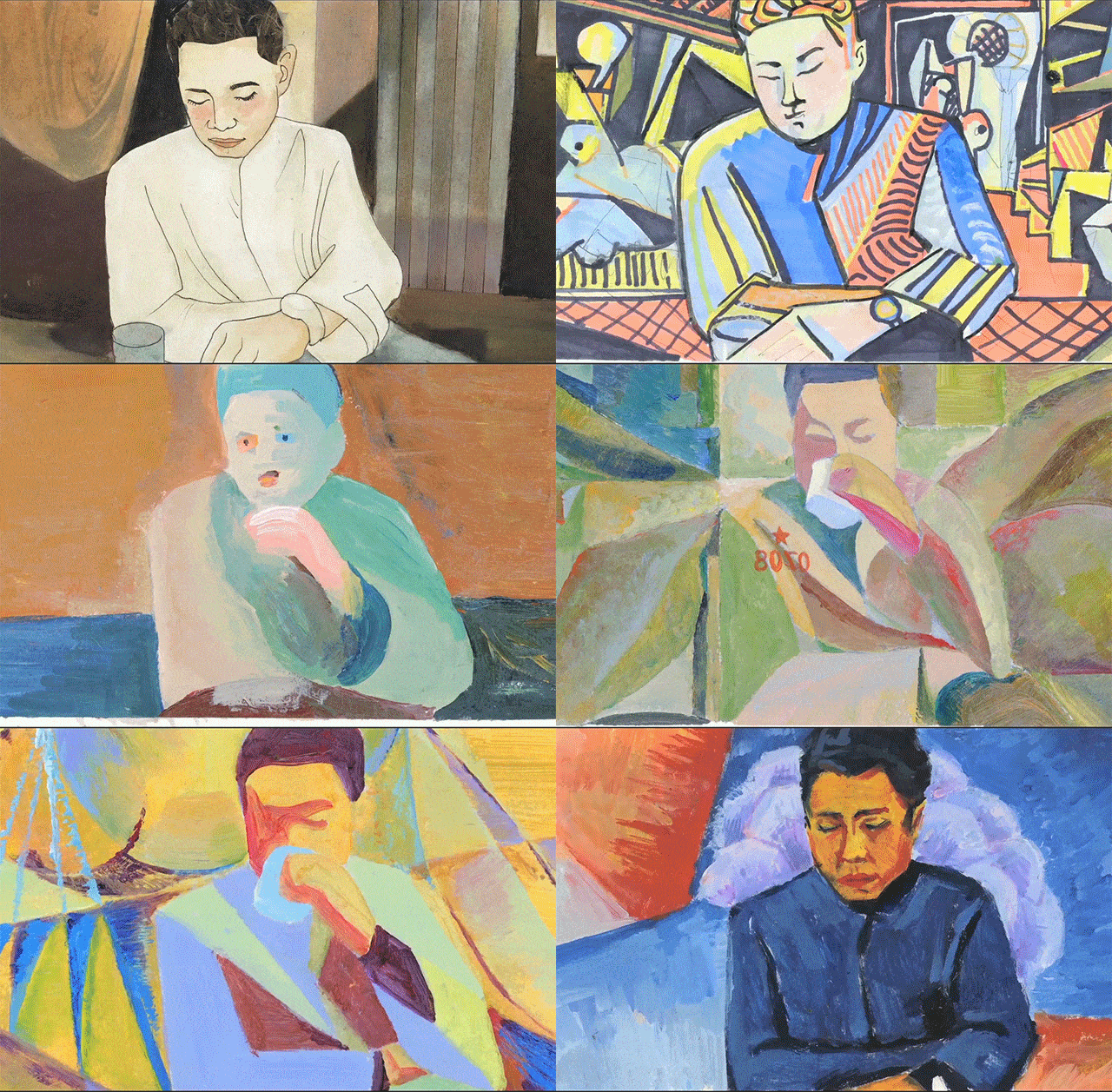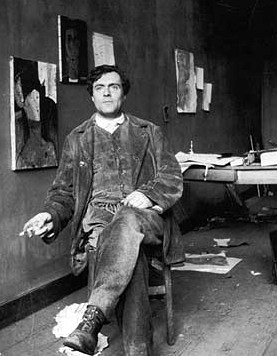
Amedeo Modigliani was an Italian painter and sculptor who built a short but distinctive career in Paris, where he became known for elongated figures, long necks, mask-like faces, and a spare modern style. He worked mainly in portraiture and nude studies, and his sculptures carried the same simplification of form, with smooth heads and carved features that recall African and ancient Mediterranean art.
- Italian-born artist who worked mostly in Paris from the early 1900s.
- Best known for portraits, nudes, and sculptures with stretched proportions.
- His style combines modernism with references to non-European and ancient art.
- He worked in both paint and stone, though sculpture became less central after 1914.
- He died young in 1920, which helped fix his reputation as a tragic modern artist.
How did Modigliani develop his style?
Modigliani arrived in Paris in 1906, a city crowded with experimental painters, sculptors, and writers. He met artists associated with Cubism, Expressionism, and the broader avant-garde, but he did not fully adopt any one movement. Instead, he turned toward a personal figurative language: bodies narrowed into vertical shapes, faces became oval and still, and eyes were often left blank or only lightly marked.
His education in Italy gave him a strong base in Renaissance drawing and portraiture, but Paris pushed him toward simplification. He studied African sculpture, archaic stone figures, and the carved masks then circulating in artistic circles. Those influences appear not as direct quotations but as a disciplined reduction of features into strong outlines and flattened planes.
What do Modigliani paintings and sculptures look like?
Modigliani’s paintings usually show a single sitter placed close to the surface, with little narrative setting behind them. The palette is restrained: earthy reds, dusty blues, creams, and browns appear often, with color used to support contour rather than to build complex light effects. His brushwork is controlled, and the image depends on line as much as on paint.
His sculpture, made mainly between 1909 and 1914, is even more stripped down. He carved or cut limestone heads with long noses, closed lips, and stylized eyes, often in a vertical rhythm that suggests ritual objects as much as portrait busts. Many of these works were made for a planned “Temple of Beauty,” an unrealized architectural project that would have linked sculpture, drawing, and space.
Why does Modigliani matter in modern art?
Modigliani matters because he produced a recognizably modern figure style without abandoning the human body. At a time when many artists were breaking form into fragments or moving toward abstraction, he kept portraiture central and made it newly expressive through proportion, pose, and contour. His work showed that modernism could be intimate, elegant, and psychologically charged rather than aggressively experimental.
He also became a key reference for later artists interested in the drawn line and the stylized figure. His portraits are not realistic likenesses in a strict sense, but they carry a strong sense of presence. That combination of restraint and intensity helped make his work widely reproduced and highly collectable after his death.
Why is Modigliani so often linked to tragedy?
Modigliani lived in poverty for much of his career, and his health was damaged by tuberculosis. He drank heavily, used narcotics, and struggled to find steady support, even while moving in important artistic circles in Montparnasse. He died in Paris in 1920 at the age of 35, and his partner Jeanne Hébuterne died soon after.
That early death shaped his reputation as much as the work itself. The story of the struggling artist in bohemian Paris has often been attached to his name, sometimes obscuring the technical discipline of his drawing and the careful structure of his compositions. His legacy rests on both the myth and the making: a concise body of work built from line, proportion, and reduction.
Frequently Asked Questions
Was Modigliani part of a specific art movement?
Modigliani is usually associated with modernism and the Paris avant-garde, but he does not fit neatly into Cubism, Fauvism, or Expressionism. He borrowed from several currents around him while keeping a distinct figurative approach. That independence is one reason his work still stands apart from the schools it came near.
Did Modigliani make more paintings or sculptures?
He is better known for paintings, especially portraits and nudes, but he also made an important group of sculptures. Sculpture occupied a concentrated period in his career and then gave way largely to drawing and painting. The carved heads remain central to understanding how he simplified the figure.
Why are Modigliani’s figures so elongated?
The elongation was a deliberate formal choice, not a simple distortion. It helped him create elegance, vertical emphasis, and a sense of distance from ordinary naturalism. The stretched forms also connect his work to both stylized ancient sources and the decorative modern line he developed in Paris.
Articles mentioning Amedeo Modigliani