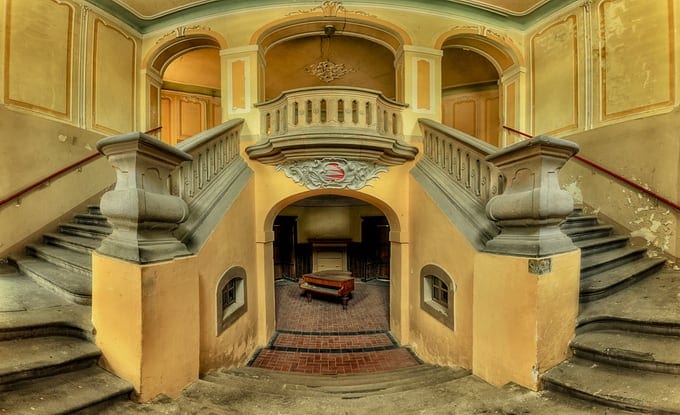
East Germany was the common English name for the German Democratic Republic, a socialist state that existed from 1949 to 1990 in the Soviet-occupied zone of postwar Germany. It covered the eastern part of the country after the Second World War, with Berlin divided between the two German states. As a place, it mattered not only for politics and war history but also for the buildings, objects, and visual systems produced under its state-run economy.
- Official name: German Democratic Republic, usually abbreviated GDR or DDR.
- Existed from 1949 until German reunification in 1990.
- Formed from the Soviet Occupation Zone after the Second World War.
- Known for socialist planning, heavy industry, prefabricated housing, and state-sponsored design.
- Its built environment ranged from monumental civic architecture to standardised apartment blocks and industrial interiors.
How East Germany came into being
After 1945, Germany was split into occupation zones controlled by the Allied powers. The Soviet zone became the basis of the German Democratic Republic when it was founded in 1949, in the early years of the Cold War. The new state aligned itself with the Soviet Union, while West Germany developed as a separate capitalist republic.
That division shaped daily life, industry, and culture. Border controls, state planning, and political censorship affected what could be built, printed, manufactured, and exported. East Germany was not just a map reference; it was a managed system in which architecture, furniture, posters, packaging, and public space all carried ideological weight.
What did East German design look like?
East German visual culture combined practicality with official symbolism. Early postwar architecture often used restrained classical references, but by the 1960s and 1970s socialist modernism dominated. This meant slab blocks, concrete housing estates, public institutions, and broad boulevards designed to express order and collective life. Materials such as prefabricated concrete panels, brick, and glazed tile were used at scale because they were efficient and repeatable.
Design work in East Germany was closely tied to state production. Graphic design, industrial design, ceramics, textiles, and furniture all had to fit planning targets and material shortages. The result was often austere, but not always crude: well-made lighting, glassware, domestic appliances, and signage could be sharply resolved and visually coherent, especially when designers worked within the limits of standardisation.
Why does East Germany matter in visual culture?
East Germany matters because it produced a distinct modernism under conditions very different from those in Western Europe or the United States. Its architecture and objects show how a state can shape aesthetics through supply chains, ideology, and regulation. For historians of design, it offers evidence of what happens when form follows not the market, but bureaucracy, planning, and political purpose.
It also matters because much of its built environment survived reunification. Housing estates, stairwells, factories, cultural centres, and civic buildings remain visible across the former East, sometimes altered, sometimes abandoned, sometimes carefully restored. Photographs of these places often emphasise textures that came from the period itself: poured concrete, linoleum, terrazzo stairs, painted steel rails, and worn woodwork.
What happened after reunification?
In 1990, East Germany dissolved and joined the Federal Republic of Germany. That political end did not erase the material traces of the state. Some buildings were demolished or gutted, especially where maintenance had been deferred, but others were adapted for new uses or preserved as examples of socialist modernism.
Today, East Germany survives as a historical and spatial reference rather than a country. The term still helps describe a particular social and design history: the landscapes of prefabricated housing, the state institutions that commissioned them, and the everyday interiors shaped by shortage, standardisation, and formal ambition.
Frequently Asked Questions
Was East Germany the same as the Soviet Union?
No. East Germany was a separate country, the German Democratic Republic, although it depended heavily on the Soviet Union politically and militarily. It was part of the Eastern Bloc, not a Soviet republic. Its government, currency, and institutions were its own, even if Soviet influence was strong.
Why is East Germany often associated with architecture?
Its government invested heavily in housing, civic buildings, and industrial infrastructure, all of which left a large physical record. The state used architecture to project modernity, equality, and collective identity. As a result, many of the most visible remains of East German culture are concrete estates, public interiors, and planned urban spaces.
Is the term “East Germany” still correct?
It is still widely used in English as a geographic and historical shorthand. The formal name during the state’s existence was the German Democratic Republic, or GDR/DDR. In historical writing, “East Germany” usually refers to that former state and the territory it governed before 1990.
At a glance
- Address
- East Germany
- Coordinates
- 52.516666, 13.4
Articles mentioning East Germany