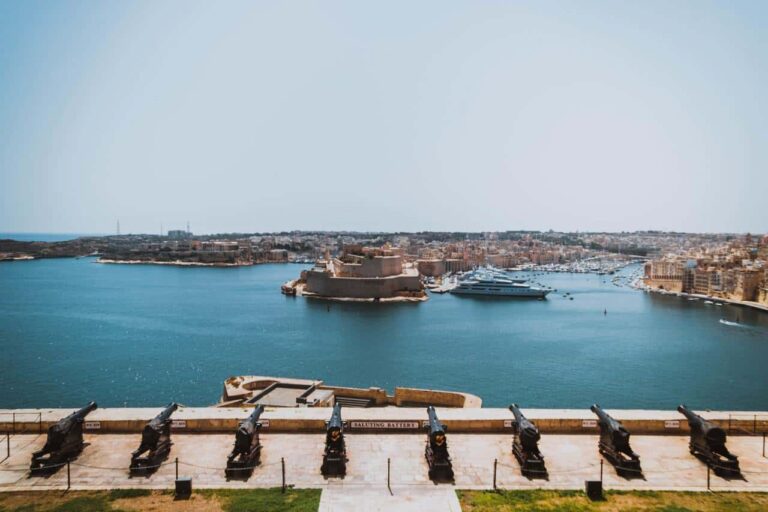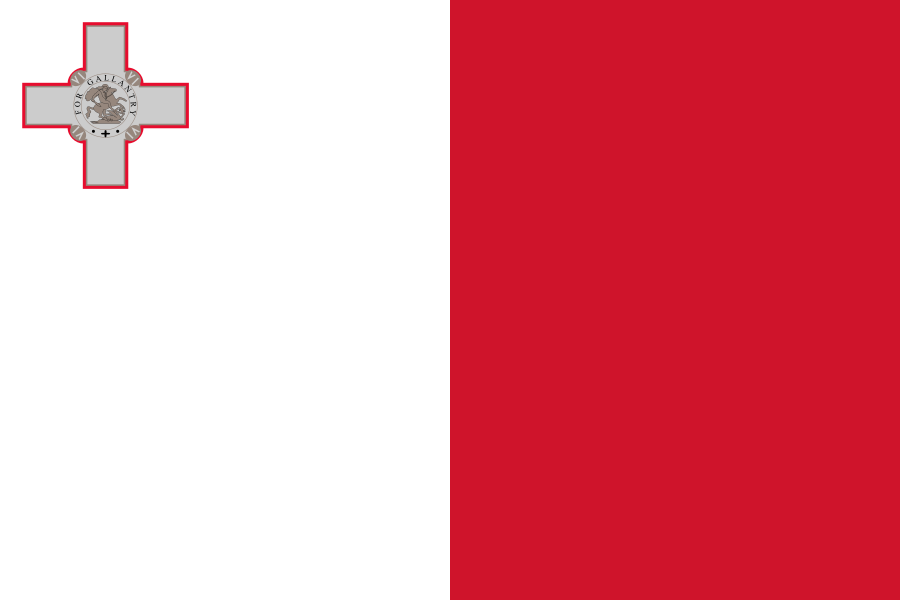
Malta is a small island country in the central Mediterranean, made up of an archipelago south of Sicily and north of Libya. Its compact size, dense population, and long history of seaborne trade and conquest have made it a place where architecture, craft, and public culture carry traces of many rulers and many uses. For design and visual culture, Malta matters because its built environment mixes limestone construction, baroque churches, military fortifications, contemporary cultural institutions, and a strong outdoor visual life shaped by bright light and limited land.
- Location: Central Mediterranean, south of Sicily
- Form: Archipelago and sovereign state
- Capital: Valletta
- Materials associated with the place: Globigerina limestone, plaster, stone carving
- Visual character: Dense urban fabric, fortifications, harbours, and strong sunlight
Why Malta looks the way it does
Malta’s visual character comes from geology, climate, and strategic location. Soft local limestone has been the main building material for centuries, so many streets, facades, churches, and defensive walls share a warm honey-coloured surface that catches the sun. The stone is easy to cut but weathers quickly, which has encouraged repeated repair, reworking, and close attention to maintenance. That gives Maltese towns a layered look: old masonry, patched surfaces, painted shutters, iron balconies, and signs of long use.
The island’s small size and limited land also shape its appearance. Settlements are compact, roads are narrow, and buildings often crowd together around harbours or hilltops. Valletta, built in the 16th century by the Knights of St John, is a particularly strong example of this density, with straight streets, bastions, and a grid plan adapted to defence and movement on foot. Across the islands, military architecture remains visible because Malta sat on major maritime routes and became heavily fortified over centuries.
How did Malta become so culturally layered?
Malta’s history passed through Phoenician, Roman, Arab, Norman, Spanish, and British rule, with the Knights of St John leaving the most visible architectural legacy. Each period introduced different building habits, religious forms, administrative systems, and decorative preferences, but none erased what came before. Instead, Malta accumulated styles: Arab-influenced street patterns, Baroque church interiors, British-era civic structures, and modern additions that sit beside older stonework.
That layering matters in visual culture because Malta often presents as both old and current at once. A street can contain a medieval core, a Baroque parish church, a 20th-century shopfront, and contemporary street art in the same frame. This is one reason Malta appears in discussions of identity, heritage, and public space. It offers a dense, legible example of how a small place can hold many historical registers without becoming static.
What does Maltese design and making involve?
Making in Malta often starts with stone. Local masons have long shaped limestone into ashlar walls, carved ornament, built corbelled balconies, and assembled elaborate church facades. The stone appears in domestic architecture as much as in monuments, which makes masonry part of everyday life rather than an elite craft alone. Metalwork, painted wood, ceramics, lace, and ship-related trades also belong to Maltese material culture, especially in older towns and coastal communities.
Contemporary Maltese design often works with the tension between preservation and adaptation. Historic buildings are frequently reused for galleries, hotels, studios, and cultural venues, so new interiors may be inserted behind old shells. That kind of reuse is common in a country where land is scarce and heritage is highly visible. It creates a design practice that must respect stone, scale, and regulation while still allowing experimentation.
Why does Malta appear so often in art, architecture, and travel?
Malta attracts attention because it condenses several visual themes into a small area: fortress landscapes, intense coastal light, religious ritual, and a tightly built urban scene. For photographers, it offers hard shadows, bright facades, and a strong relation between sea and city. For architects and designers, it poses practical questions about density, climate, conservation, and reuse. For artists, it offers a place where identity can be explored through history, migration, and the public image of a tiny state.
That is why Malta appears in contexts as different as sailing photography, pavilion design, street art, and hospitality projects. It is not only a destination; it is a setting with a recognizable material language. Limestone, sea walls, harbour infrastructure, and compact domestic architecture make Malta immediately readable, while its layered history prevents that reading from being simple.
Frequently Asked Questions
Is Malta a single island?
No. Malta is an archipelago, though the largest island is also called Malta. The republic also includes Gozo, Comino, and several smaller uninhabited islets. In everyday use, “Malta” often refers to the main island and the state at the same time.
What makes Maltese architecture distinctive?
Its main feature is the use of local limestone, which gives buildings a warm, uniform colour and makes carving easy. Fortifications, Baroque churches, and dense street patterns also stand out. The result is a built environment that feels compact, defensive, and highly tactile.
Why is Malta important in visual culture?
Malta combines strong historical layering with a very specific material palette, which gives artists and designers a rich setting to work with. Its light, stone, and dense urban form create striking images, while its history of occupation and exchange makes it useful for work about identity and memory. It is a small place with a large visual footprint.
At a glance
- Address
- Malta
- Coordinates
- 35.896667, 14.5
Articles mentioning Malta