
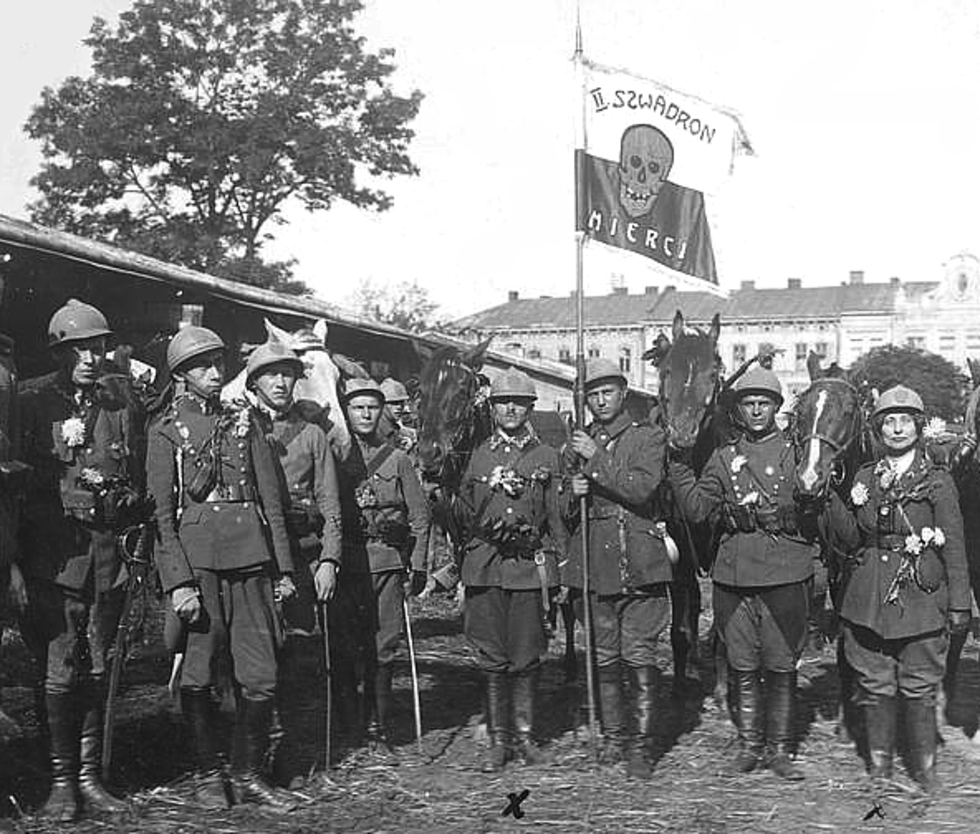
The Polish–Soviet War was a 1919–1921 conflict between the Second Polish Republic and Soviet Russia, with Soviet Ukraine and the Ukrainian People’s Republic also drawn into the struggle, over territory in today’s Ukraine and Belarus. It grew out of the collapse of empires after World War I and the fight to define borders in Eastern Europe, and at moments it threatened Polish statehood itself.
- It began in the aftermath of World War I, when old imperial borders had broken apart and new states were still forming.
- The war was fought across lands that are now part of Ukraine, Belarus, and eastern Poland.
- It ended with the Treaty of Riga in 1921, which fixed a border that lasted until the Second World War.
- The conflict helped shape interwar Polish politics, military identity, and ideas about the eastern borderlands.
Why did the war start?
The war emerged from competing claims over territory and sovereignty after the Russian Empire collapsed. Poland reappeared as an independent state in 1918, while Bolshevik leaders in Moscow aimed to extend revolutionary power westward. Both sides also dealt with local Ukrainian forces, including the Ukrainian People’s Republic, which sought its own statehood and often became an ally of convenience for Poland.
The front moved quickly because neither side had fully settled armies or fixed borders. Fighting was shaped by rail lines, cavalry raids, and control of major towns rather than by long, continuous trench systems. The conflict became as much about political legitimacy as about land.
How was it fought?
The war mixed regular armies, improvised formations, and rapid offensives. Polish forces under Józef Piłsudski pushed east in 1920 and briefly took Kyiv, while the Red Army counterattacked and advanced toward Warsaw. The Soviet leadership hoped a victory in Poland could open the road to revolution in Germany and the rest of Europe.
The most famous moment came in August 1920, during the Battle of Warsaw, often called the “Miracle on the Vistula” in Polish memory. Polish forces stopped the Soviet advance and drove it back. The fighting then settled into negotiations, ending with the Treaty of Riga in March 1921.
Why does it matter?
The war fixed the shape of the interwar Polish state and defined a disputed eastern frontier that remained politically loaded for decades. It also left a deep mark on Soviet and Polish historical memory. In Poland, it became a founding story of independence and military survival; in Soviet accounts, it could be framed as a failed advance of revolution rather than a settled national war.
For visual culture, the conflict matters because it generated posters, uniforms, press illustration, memorial imagery, and later heroic reconstructions that turned a fast-moving border war into a legible national narrative. Artists and designers working in the 1920s often drew on its symbols: cavalry, banners, railroad crossings, maps, and the sharply contrasting emblems of state and revolution.
What did it look like in practice?
On the ground, the war looked uneven and mobile. Troops moved by train and horse across large rural spaces, and towns changed hands repeatedly. Soldiers wore a mix of former imperial uniforms, new national kit, and field improvisations, which gave photographs and drawings a patched, transitional look.
In print, the war was translated into simplified images of advance and defense: red stars, Polish eagles, charging riders, and maps with arrows pressing toward Warsaw or Kyiv. Later commemorations often cleaned up this disorder, replacing mud and improvisation with clear national icons and decisive battle scenes.
Frequently Asked Questions
Was the Polish–Soviet War part of the Russian Civil War?
It overlapped with the Russian Civil War and grew out of the same collapse of imperial authority, but it was not simply a side conflict. Poland fought as an independent state with its own goals, and Soviet leaders treated it as a frontier war tied to the survival of the Bolshevik revolution. The conflict had its own diplomacy, campaigns, and peace settlement.
What ended the war?
The war ended with the Treaty of Riga, signed in March 1921. That agreement divided contested lands between Poland and Soviet Russia, with Poland gaining substantial territory to the east of the Curzon Line. The treaty brought formal peace, though it left lasting resentment on both sides.
Why is the Battle of Warsaw so well known?
The Battle of Warsaw mattered because it stopped the Soviet advance at a moment when Polish defeat seemed possible. Polish military planners used a counterattack to break the Red Army’s momentum, and the result became a major symbol of national survival. The battle later acquired a strong place in Polish memory and in state imagery.
Articles mentioning Polish–Soviet War
