
Scott Listfield is an American painter known for placing a lone astronaut in contemporary landscapes, turning a figure from the space age into a quiet observer of malls, highways, deserts, and abandoned industrial sites. His work combines oil painting, pop imagery, and a deadpan sense of surrealism to ask what progress, loneliness, and American consumer culture look like after the future has already arrived.
Stories from Scott Listfield
1 story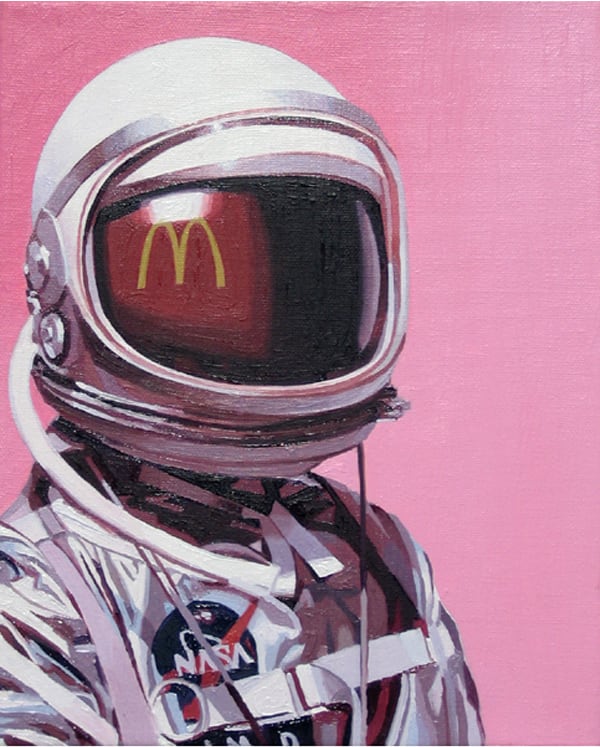
About Scott Listfield
- Known for: paintings of a solitary astronaut in everyday or damaged modern settings
- Medium: mostly oil on canvas, often with crisp, graphic surfaces
- Style: surreal, narrative, and rooted in postwar pop culture and landscape painting
- Recurring subject: the astronaut as a stand-in for the modern viewer, outsider, or displaced witness
- Why it matters: his work makes familiar infrastructure feel strange, cinematic, and slightly melancholy
Read the full overviewWhat does Scott Listfield paint?, Where did his approach come from?, Why the astronaut keeps coming back, What do the paintings look like in practice?
What does Scott Listfield paint?
Listfield paints scenes that look instantly legible and quietly impossible. A helmeted astronaut stands in a strip mall parking lot, on a beach, beside a billboard, or in front of a distant mountain range. The settings are usually recognisable American spaces: commercial corridors, suburban edges, desert highways, parking lots, and industrial ruins. The figure rarely acts; instead, the paintings use stillness to create tension.
This repeated character gives the work a clear visual grammar. The astronaut suggests exploration, ambition, and scientific optimism, but Listfield places that symbol into places shaped by commerce and consumption rather than discovery. The result is not science fiction in a literal sense. It is a painterly reflection on what modern life feels like when grand narratives about progress have become awkward, commercial, or exhausted.
Where did his approach come from?
Listfield’s imagery grows out of several overlapping traditions: surrealism, pop art, landscape painting, and the visual language of advertising and film. The astronaut is one of the most charged icons of the twentieth century, carrying memories of the Apollo era, Cold War competition, and the fantasy of human expansion. By removing the figure from space and dropping it into ordinary terrain, Listfield turns that icon into a flexible symbol of dislocation.
His paintings also borrow from the clarity of commercial illustration. Surfaces are often clean and controlled, with sharp light, simple compositions, and strong silhouettes. That polish matters. It lets the work sit halfway between a dream and an advertisement, which is part of what gives it its uneasy familiarity.
Why the astronaut keeps coming back
The astronaut functions as more than a costume. In Listfield’s paintings, it becomes a proxy for isolation, looking, and the problem of belonging. The helmet removes the face, so the figure reads as both anonymous and universal. It can suggest the artist, a tourist, a future explorer, or simply a person standing outside a scene they do not fully understand.
That repeat appearance also gives the paintings a serial quality. Listfield returns to the same basic structure while changing the landscape, the weather, the scale, or the cultural debris around the figure. This repetition creates a body of work that feels like a long-running visual thought experiment: what happens when a symbol of the future gets stranded in the present?
What do the paintings look like in practice?
Most of Listfield’s paintings are composed with a strong foreground and a broad, open setting. The astronaut is usually placed where a viewer would naturally stand, which makes the scene feel immediate. Colour tends to be controlled rather than explosive: dusty skies, asphalt greys, sunset oranges, neon signage, deep blues, and the pale glare of artificial light. Even when the image is humorous, the finish is disciplined.
He often uses familiar objects as anchors: cars, gas stations, big-box stores, road signs, diners, billboards, monolithic rock forms, or impossible horizons. These details matter because they root the surreal figure in actual built environments. The paintings are not abstract speculations; they are concrete depictions of places shaped by design, transport, retail, and infrastructure.
How has Scott Listfield’s work been received?
Listfield has found a wide audience because the images are easy to recognise and hard to exhaust. Viewers can read them quickly, but the paintings reward closer attention because their mood shifts between irony, nostalgia, and melancholy. That balance has made the work popular in both fine art and illustration-adjacent contexts, especially among audiences drawn to contemporary surrealism.
His influence is visible in the broader spread of astronaut imagery in contemporary painting and print culture. The appeal lies partly in the clarity of the icon, but also in Listfield’s specific use of it: not as heroic spectacle, but as a quiet way to frame alienation inside ordinary life.
Frequently Asked Questions
Is Scott Listfield considered a surrealist?
His work is often described as surreal, but it is not surrealism in the historical sense of the movement associated with André Breton. Listfield uses surrealism’s basic tactic of placing an unexpected figure in a familiar setting, yet his images are more contemporary and culturally specific. They draw as much from American roadside imagery and pop culture as from dream logic.
What materials does he use?
Listfield is best known for oil painting, especially on canvas. The paintings usually have smooth, carefully controlled surfaces that make the scenes feel clean and exact rather than loose or gestural. That finish supports the clarity of the compositions and the graphic strength of the astronaut figure.
Why an astronaut instead of another figure?
The astronaut carries a built-in history of ambition, technology, and the future. It is also visually simple: a sealed body, a reflective helmet, and a form that reads well against almost any landscape. Listfield uses that symbol to create contrast between high idealism and everyday, often banal surroundings.