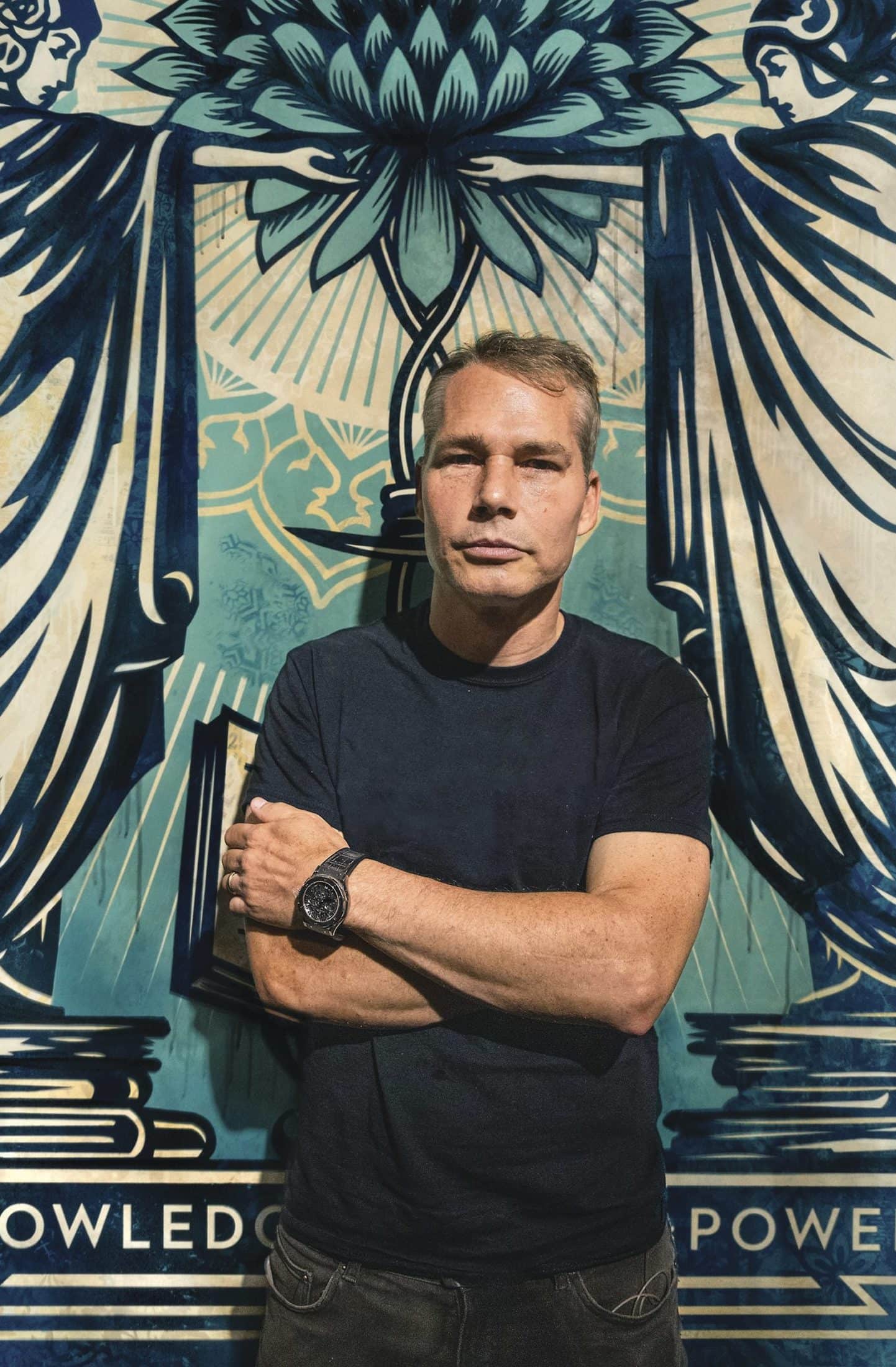
Shepard Fairey is an American graphic artist, muralist, and activist best known for the OBEY sticker campaign and the Obama “Hope” poster. Born in 1970, he came out of skateboarding and street graphics, where hand-pulled prints, stickers, wheat-pasted posters, and bold stenciled imagery shaped his visual language. His work sits at the point where design, propaganda, pop iconography, and public-space intervention meet.
- He started by making graphics for skateboards, shirts, and stickers, then moved into large-scale street campaigns.
- OBEY used repetition and placement in public space to make a simple image feel unavoidable.
- His style relies on flat color, high contrast, portraiture, and the look of old political posters.
- He has worked across posters, murals, album covers, packaging, and gallery installations.
- His practice helped define how contemporary street art can move between subculture, advertising, and institutional art.
How did Shepard Fairey become known?
Fairey first made a name for himself in the late 1980s and 1990s through skate culture. He began with stickers and T-shirt graphics, then expanded into paste-ups and public interventions that could be reproduced cheaply and spread quickly. That low-cost, repeatable approach mattered as much as the image itself: the work was designed to circulate.
The OBEY campaign became his best-known project. Its face-based graphics, blunt slogan, and repeated appearance on walls, signs, and stickers borrowed from the language of advertising and political propaganda while refusing a single fixed meaning. The project made Fairey a visible figure in street art long before he became widely known in museums and mainstream media.
What does Fairey’s work look like?
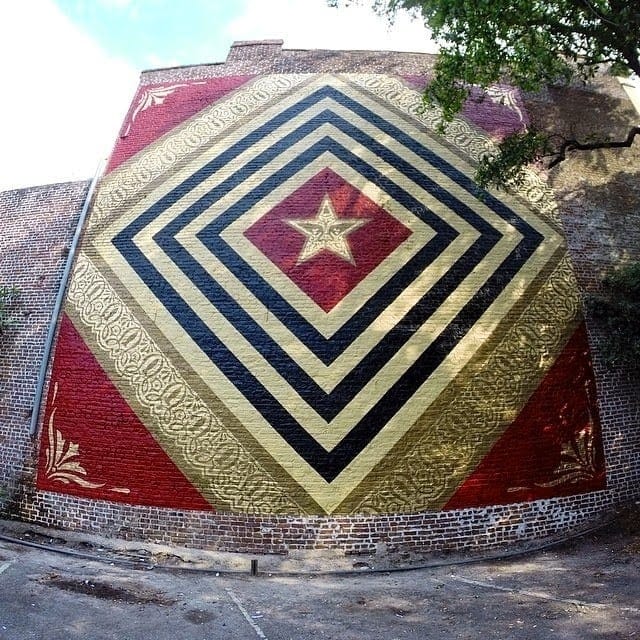
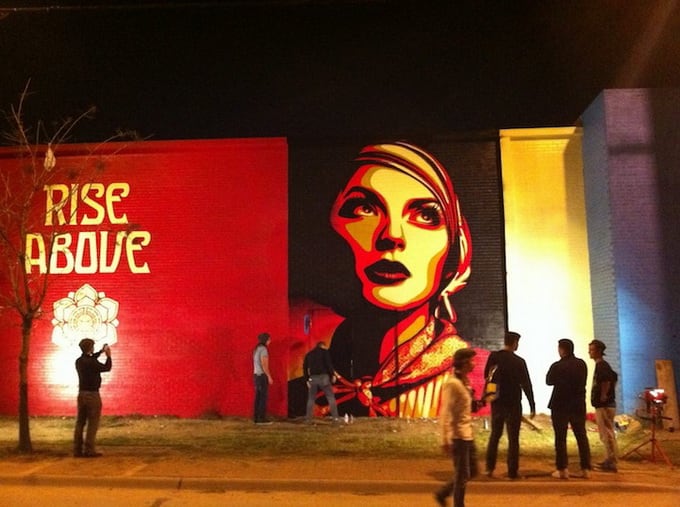
Fairey’s images usually use hard edges, limited color palettes, and a screen-printed or stencil-like finish. He often combines a central portrait with rays, stars, banners, laurel wreaths, or Soviet and mid-century design cues. The result feels immediately legible at a distance, which is one reason his murals and posters work so well in public space.
He also uses texture strategically. Weathered paper, halftone dots, rough ink coverage, and distressed surfaces give the work the look of something pasted into the city and worn by time, even when it is newly produced. That balance between graphic polish and urban abrasion is central to his style.
Why does the OBEY campaign matter?
OBEY is one of the defining examples of post-1980s street art as a system of repeated images rather than a single object. Fairey used a simple visual formula to create recognition through saturation. The campaign showed how an artwork could behave like a brand while also criticizing branding, authority, and visual manipulation.
That tension still shapes discussion of his work. Supporters see a sharp, accessible visual culture that brought design, politics, and public art together. Critics point to its reliance on appropriation and its later proximity to commercial art and merchandise. Both views are part of its significance: OBEY helped establish the terms on which contemporary street art would be judged.
How does he work across murals, posters, and commercial design?
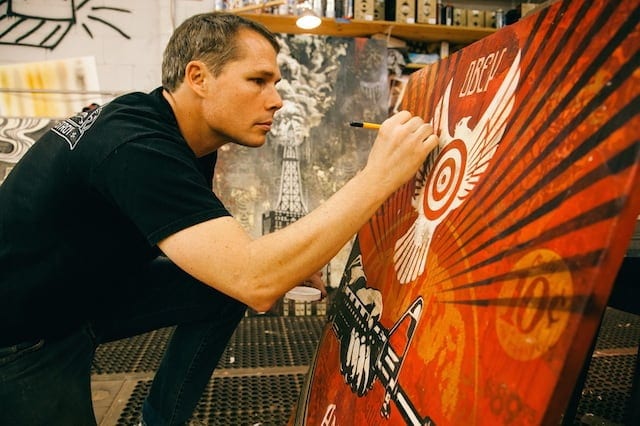
Fairey has moved easily between walls, print, and product. He has produced large murals in cities around the world, often using assistants, projections, grids, stencils, and layered spray and brush work to scale up a composed illustration. He also creates posters and editions that preserve the clarity of the original graphic idea while allowing for variation in paper, ink, and print run.
That same visual system adapts well to album covers, political campaigns, and nonprofit projects. The work can carry a message quickly because it is built from simplified symbols and forceful composition. The downside is that the language can become instantly recognizable to the point of formula, which is part of both his success and his criticism.
Frequently Asked Questions
Is Shepard Fairey a street artist or a graphic designer?
He is both, and the overlap is the point. His street practice gave him visibility and his design training gave him control over composition, typography, and reproduction. Many of his best-known works depend on the methods of both fields at once.
What materials and techniques are associated with his work?
His practice commonly uses screen printing, stenciling, wheat-paste posters, vinyl stickers, spray paint, and acrylic paint. In murals, these methods are often combined with drawn underpainting or projected layouts so the final image can be scaled up cleanly. The result is a graphic surface with visible layers of making.
Why is his art so recognizable?
Fairey relies on a small set of formal tools: strong symmetry, limited color, bold outlines, and propaganda-like framing. He repeats them across many images, so the work becomes legible almost instantly. That consistency is part of how his images travel so easily from wall to poster to merchandise.
Articles mentioning Shepard Fairey