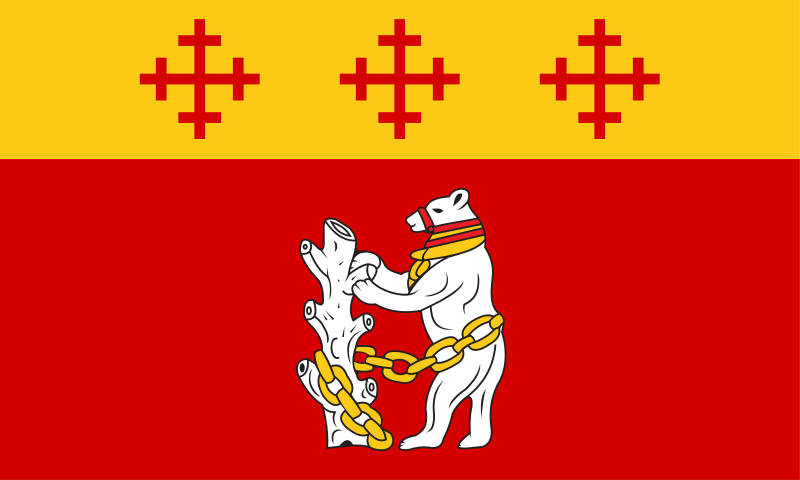
Warwickshire is a landlocked county in central England, now part of the West Midlands region and known for towns such as Warwick, Stratford-upon-Avon, Rugby, Nuneaton and Bedworth. Its landscape combines historic market towns, river valleys and commuter suburbs, while its cultural reputation rests heavily on its literary associations with William Shakespeare and George Eliot.
| Type | Non-metropolitan county |
|---|---|
| Region | West Midlands, England |
| County town | Warwick |
| Largest town | Nuneaton |
| Districts | North Warwickshire, Nuneaton and Bedworth, Rugby, Warwick, Stratford-on-Avon |
| Common abbreviations | Warks, Warwicks |
What is Warwickshire?
Warwickshire is an administrative and historic county rather than a single urban centre. It includes a mix of older county towns, industrial towns, and places shaped by the growth of nearby cities such as Birmingham and Coventry. That mix gives the county a practical identity: part rural Midlands, part satellite belt, part heritage landscape.
The county’s boundaries have changed over time, especially in the 20th century, when local government reorganisation altered how its towns were administered. Even so, the name Warwickshire still carries strong historical weight, particularly in literature, education and tourism. Stratford-on-Avon, in particular, anchors the county in the public imagination because of Shakespeare.
Why does Warwickshire matter?
Warwickshire matters because it is one of the English counties most closely associated with the cultural history of the language itself. Shakespeare was born in Stratford-upon-Avon, and George Eliot, the pen name of Mary Ann Evans, was born in Nuneaton. Those associations have made the county a reference point for English literary heritage, school curricula and heritage branding.
The county also matters as a working administrative unit. Its districts handle planning, housing, transport and local services, and its towns connect rural settlements to larger regional economies. Rugby gives the county a place in the history of sport through the game that bears its name, while Warwick and Kenilworth contribute castle-centred historic architecture that draws visitors and shapes the county’s visual character.
What does Warwickshire look like in practice?
On the ground, Warwickshire is not uniform. The southern part includes Stratford-on-Avon and Warwick, where timber-framed streets, stone churches and visitor economies shape daily life. The north of the county includes more densely populated and industrially influenced areas, especially around Nuneaton and Bedworth, with rail links and housing tied to the wider West Midlands conurbation.
In visual terms, the county often appears in two registers: heritage and ordinary life. Heritage sites, theatres, castles and preserved streets are highly visible, but so are logistics parks, housing estates, schools and farming land. That combination is part of what makes Warwickshire legible as a place: old buildings and working landscapes share the same county name.
How is Warwickshire used in design, media and place branding?
Warwickshire appears frequently in logos, tourism campaigns, heritage organisations and local products because the name signals Englishness, age and regional credibility. In publishing and media, it often functions as a location shorthand for Shakespeare country, rural Midlands settings, or middle England more broadly. That shorthand can flatten the county’s variety, but it is effective because the name already carries a dense set of associations.
For designers and writers, Warwickshire is also a useful example of how place names work as visual and cultural markers. The county’s identity can suggest black-and-white timber framing, stone manor houses, school crests, parish maps and tourism leaflets, but it also covers contemporary civic design and ordinary signage. Its visual language is therefore less a single style than a layered mix of historic symbolism and present-day administration.
Frequently Asked Questions
Is Warwickshire the same as Warwick?
No. Warwick is a town and the county town of Warwickshire, while Warwickshire is the wider county. The names are related because the county takes its name from Warwick, but the county also includes many other towns and districts.
Why is Stratford-upon-Avon so strongly linked to Warwickshire?
Stratford-upon-Avon is one of the county’s best-known towns because it is the birthplace of William Shakespeare. That connection has made it a major heritage destination and a defining part of how Warwickshire is presented in books, tourism and public culture. It has also made the county central to national ideas about literary history.
What is the county’s significance beyond heritage?
Warwickshire remains important as a local government area and as part of the wider economy of central England. Its towns support manufacturing, logistics, education, retail and commuting patterns, especially in the north of the county. The heritage image is real, but it sits alongside ordinary civic and economic life.
At a glance
- Address
- United Kingdom
- Coordinates
- 52.333332, -1.583333
Articles mentioning Warwickshire