
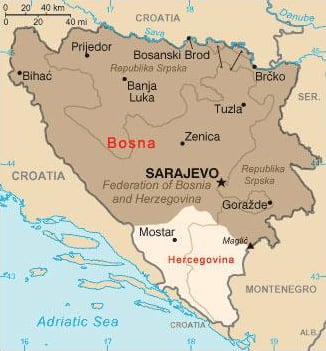
Bosnia is the larger northern region of Bosnia and Herzegovina, the country in the western Balkans that it shares with Herzegovina in the south. The name also appears as a shorthand for the whole state, especially in historical, political, and cultural writing. As a place name, Bosnia matters because it names the core of a country whose modern identity formed from older regional, imperial, and state traditions.
- Bosnia covers most of the land area of Bosnia and Herzegovina, while Herzegovina makes up the southern part.
- The term can mean either the region alone or, informally, the whole country.
- Its political history runs from medieval polities through Ottoman and Austro-Hungarian rule to the modern state.
- In practice, the name often signals a specific geographic and cultural setting rather than a strict administrative unit.
What does Bosnia refer to?
Bosnia is a historical region in the western Balkans, centred on the northern and central parts of the country now called Bosnia and Herzegovina. It has no separate contemporary government of its own, but it remains a powerful geographic name in maps, journalism, history, and everyday speech. The term is often used loosely to mean the whole country, though that usage is imprecise.
The region’s identity is tied to its landscape and settlement pattern: river valleys, mountain basins, inland cities, and a long relationship with surrounding imperial centres. Sarajevo, the capital of the state, lies in Bosnia, which helps explain why the region is so often treated as the country’s default reference point in foreign reporting and cultural coverage.
Where did the name come from?
The name Bosnia appears in medieval sources and is associated with the historical polity that developed in the central Balkans. Over centuries, that name survived changes in rule and administration, including Ottoman and Habsburg periods, and became embedded in modern national geography. Herzegovina, by contrast, arose later as a regional name and is now paired with Bosnia in the country’s official title.
Because the two names are linked but not identical in scale or origin, Bosnia carries both a narrow and a broad sense. In formal usage, it means the region; in informal usage, it can stand in for Bosnia and Herzegovina as a whole. That dual meaning can create ambiguity, especially in international writing.
How is Bosnia used in practice?
In contemporary usage, Bosnia appears in cultural, political, and travel contexts where writers need to identify the northern part of the country or speak about the state informally. A photographer might work “in Bosnia” while moving between Sarajevo, Mostar, and the surrounding countryside; technically, Mostar is in Herzegovina, so the phrase may be shorthand rather than a precise regional label. This kind of shorthand is common in reporting and casual speech.
The region also matters in architecture, craft, and visual culture because it frames how local materials, weather, and building traditions are described. Bosnia includes mountain and continental inland conditions that affect stone use, timber framing, roof forms, and domestic construction. When a design or photographic project names Bosnia, it often signals not only location but also a specific social and material setting.
Why does the distinction matter?
Calling Bosnia by its own name, rather than collapsing it into the whole country, respects the geography and history of Bosnia and Herzegovina. It also avoids confusion when a project or article concerns only the northern and central region, or when a place in Herzegovina is being discussed. In editorial and academic writing, that distinction matters because place names carry political and cultural weight.
For readers encountering the term in an article about architecture, art, or photography, Bosnia usually indicates a setting shaped by post-Ottoman urban fabric, socialist-era building, wartime damage, and contemporary reconstruction. Those layers affect what is seen in the street and what is built into objects and buildings. The region is therefore not just a label on a map; it is part of the material context of the work.
Frequently Asked Questions
Is Bosnia the same as Bosnia and Herzegovina?
No. Bosnia is one of the two main historical regions within Bosnia and Herzegovina, alongside Herzegovina. In casual speech, people sometimes use Bosnia to mean the entire country, but that is a shorthand rather than a precise geographic term.
Is Sarajevo in Bosnia or Herzegovina?
Sarajevo is in Bosnia. It is the capital of Bosnia and Herzegovina and sits in the northern and central regional area associated with Bosnia. That is one reason the region often becomes the default reference when the country is discussed abroad.
Why do writers sometimes use Bosnia to mean the whole country?
Because Bosnia is the more widely recognized of the two regional names and because it has long functioned as a political and cultural shorthand. The usage persists in journalism and conversation even when it is not technically exact. In careful writing, Bosnia and Herzegovina is the full state name, while Bosnia refers only to the region.