
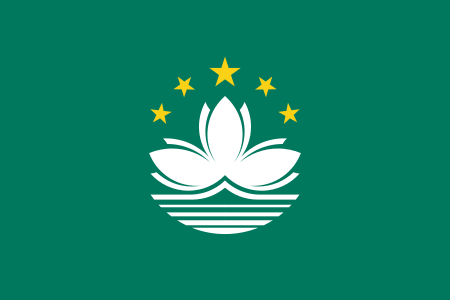
Macau is a special administrative region of China on the western edge of the Pearl River Delta, known for its dense urban fabric, Portuguese colonial past, and economy built around gaming, tourism, retail, and light manufacturing. It sits across the water from Hong Kong, borders Guangdong to the north, and combines Chinese and European legal, architectural, and culinary traditions in a small territory that has been shaped by trade and port life for centuries.
- A compact city-region where Chinese and Portuguese histories meet in streets, façades, and public space.
- One of the world’s best-known gambling destinations, with casino complexes that have transformed its skyline.
- A former colonial port whose urban core preserves churches, civic buildings, tiled pavements, and shophouses.
- A place where luxury hospitality, spectacle architecture, and mass tourism are central to the built environment.
- Still retains industrial and craft traces, even as service industries dominate the economy.
Why Macau became a distinctive place
Macau’s modern identity begins with maritime trade. Portuguese settlement in the 16th century turned the peninsula into a contact zone between Europe, China, and wider Asian trading networks. Unlike many colonial ports, Macau remained under Portuguese administration until 1999, when sovereignty returned to China and the territory became a special administrative region. That long overlap of Chinese and Portuguese rule left visible marks on street names, churches, administrative buildings, food, and the layout of the old city.
The territory is small, and that has always mattered. Land scarcity pushed development upward and outward, creating a compressed urban form where temples, casinos, housing blocks, and hotels sit close together. The result is a place where history is not separated from commerce: a baroque church can stand near a gaming hall, and a narrow lane can open onto a large resort complex. That contrast is central to Macau’s character.
What does Macau look like in practice?
The most recognisable image of Macau today is the casino resort. Since gaming was liberalised in the early 2000s, large operators have built towers, entertainment halls, shopping arcades, and conference facilities that dominate reclaimed land and reshape the skyline. Architects and developers treat the territory as a site for spectacle: mirrored facades, vast atriums, themed interiors, and hotel towers are designed to attract visitors from mainland China and beyond.
At the same time, the historic centre remains one of the most legible colonial streetscapes in East Asia. Portuguese-style paving, stuccoed facades, tiled panels, and compact public squares give districts such as the old peninsula a different rhythm from the Cotai Strip’s scale and brightness. Macau is therefore not one city image but two in tension: a heritage port city and a resort economy built on reinvention.
Why does Macau matter to design and visual culture?
Macau matters because it shows how architecture follows political status and economic policy. The territory’s rapid transformation after the growth of casino licensing produced some of the most ambitious hospitality projects in the region, including buildings by major international firms. These projects are not just large hotels; they are urban machines for circulation, branding, and entertainment, where design controls movement, framing, and atmosphere.
Macau also matters as a case study in preservation under pressure. Its historic centre has been recognised for its cultural value, yet that heritage exists beside relentless commercial development. Designers working there must negotiate scale, tourism, and local identity at once. The result is a city where the old and new are not neatly separated, and where every facade, paving pattern, and interior route carries a layer of economic and historical meaning.
How Macau is represented in art, photography, and architecture
Artists and photographers often treat Macau as a place of sharp contrasts: abandoned amusement parks, flashy casino architecture, quiet side streets, and the residual traces of older civic life. That tension makes it useful for work about urban spectacle, postindustrial leisure, and the afterlife of tourism infrastructure. It is a place where surfaces matter, whether those surfaces are gold-clad hotel interiors or weathered colonial tiles.
Architecture publications often return to Macau for the same reason. The territory concentrates questions about density, luxury, and identity into a small geographic area. A project there is rarely just a building; it becomes part of a larger argument about how a city should look when its economy depends on visitors, and how much of a historic place can be repurposed without being flattened into theme and image.
Frequently Asked Questions
Is Macau the same as Macao?
Yes. Macau and Macao are two spellings of the same place, with “Macau” common in English and “Macao” often used in Portuguese contexts and in some official names. Both refer to the same special administrative region on China’s southern coast.
Why is Macau associated with casinos?
Macau became strongly associated with casinos after gaming expanded into a major regulated industry in the early 2000s. That change attracted international operators, large-scale investment, and vast resort construction. Gambling now shapes the territory’s economy, skyline, and visitor traffic.
What survives of older Macau?
Older Macau survives most clearly in its historic peninsula, where churches, temples, civic buildings, and narrow streets still reflect its Portuguese and Chinese past. These areas show a different scale from the newer resort districts, with more emphasis on everyday urban texture than on spectacle. Preservation remains important because development pressure is intense.
At a glance
- Address
- canton of Blanquefort, France
- Coordinates
- 22.166666, 113.55
Articles mentioning Macau


