
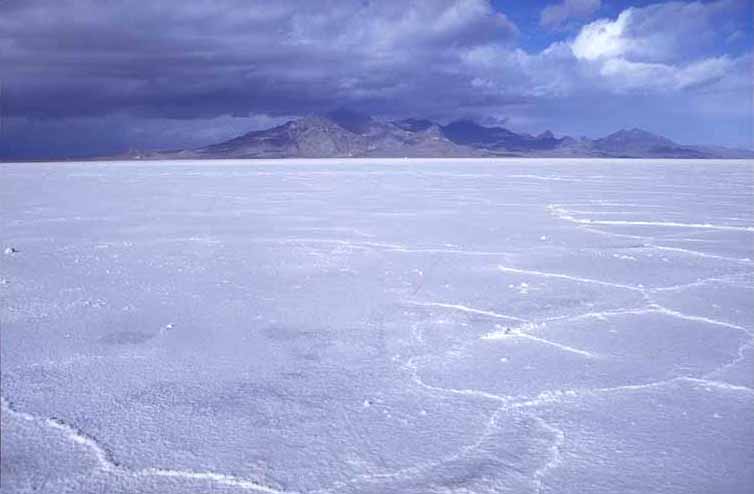
Bonneville Salt Flats is a vast salt pan in Tooele County, Utah, formed from the dried remains of ancient Lake Bonneville and best known as a testing ground for land speed records. Its hard, flat surface makes it one of the few places in North America where cars and motorcycles can run at very high speed in a controlled straight line. The site is public land managed by the Bureau of Land Management, and the racing strip used for speed attempts is commonly called Bonneville Speedway.
- A natural salt pan left by a prehistoric lake.
- One of the most important venues in land speed racing.
- Used for two major annual speed events.
- Its surface depends on seasonal water, evaporation, and careful management.
- Appears often in photography and automotive design because of its empty horizon and reflective ground.
Why does the Bonneville Salt Flats matter?
The Bonneville Salt Flats matters because it turned geology into a performance surface. The crust is broad, level, and extremely hard, which gives racers a long straight runway for testing aerodynamics, traction, and engine power. For designers and engineers, the flats are not just a backdrop; they are part of the machine’s operating environment. Speed records set there became symbols of industrial ambition, and the site helped define the visual language of streamliners, hot rods, and experimental vehicles.
The flats also carry cultural weight beyond racing. Their white expanse has drawn photographers, filmmakers, and artists who use the site’s minimal surface and distant horizon to isolate form. In that sense, Bonneville is both infrastructure and landscape: a working place for motorsport and a highly legible image of modern speed.
How did the flats form?
Bonneville is a remnant of Pleistocene Lake Bonneville, a much larger inland sea that once covered a huge part of western Utah. As the climate changed, the lake receded and left behind layers of evaporite minerals, especially salt. Repeated cycles of flooding and drying built the dense crust seen today. The result is a surface that looks fragile but can support vehicles when conditions are right.
The flats are not static. Rain, groundwater, mineral migration, and human use all affect the surface. In some years, the salt crust thins or becomes uneven, which changes where and how racing can happen. That makes Bonneville a place shaped by both deep time and immediate maintenance.
What happens there in practice?
Most of the site’s fame comes from land speed racing. Competitors bring purpose-built vehicles to the flats to run on measured courses, usually in pursuit of records or class bests. The surface encourages long-wheelbase streamliners, enclosed bodywork, and careful attention to drag reduction, cooling, and stability. A car that works on asphalt may behave very differently on salt, where traction is limited and small changes in surface condition matter.
Two major annual events are held there, drawing racers, crews, and technical specialists. The best-known are the Bonneville Speed Week and the World of Speed, though the exact schedule can shift with conditions and event management. These gatherings depend on a shared protocol of timing, safety, vehicle classification, and class rules, so the flats function as a highly organized test track rather than an open expanse of improvisation.
What does Bonneville look like in photographs and design culture?
Bonneville has a distinctive visual identity: a pale, nearly featureless plane under a huge sky. On a bright day, the salt can read as white, silver, or even mirror-like when a thin film of water sits on the surface. That simplicity is part of its appeal. It gives vehicles, figures, and shadows a stark outline, which is why the site appears so often in automotive photography.
Designers and image makers also value Bonneville because it strips away context. A streamlined car or motorcycle reads as an object of pure function there, separated from street clutter and urban signage. That clarity has helped make the flats a recurring symbol of mechanical progress, especially in stories about hydrogen vehicles, streamliners, and record-setting prototypes.
Frequently Asked Questions
Are the Bonneville Salt Flats the same as Bonneville Speedway?
No. The Bonneville Salt Flats are the broader natural site, while Bonneville Speedway refers to the racing course laid out on part of that surface. The speedway is the zone used for timed runs and organized events. The distinction matters because not every part of the flats is set up for racing.
Why is the surface so important for land speed records?
Land speed attempts need a long, flat, predictable track, and Bonneville provides that better than most natural sites. The salt crust reduces bumps and gives vehicles a rare chance to build speed in a straight line over distance. Even so, the surface condition changes from year to year, which affects traction and setup.
Is Bonneville just for racing?
No. Racing is the best-known use, but the site also functions as a landscape, a photographic location, and a managed public land area. Its open horizon and reflective ground attract artists and documentarians who are not there for speed runs. The same qualities that make it useful for racing also make it visually distinctive.
At a glance
- Address
- Tooele County, United States
- Coordinates
- 40.79972, -113.8
Articles mentioning Bonneville Salt Flats


