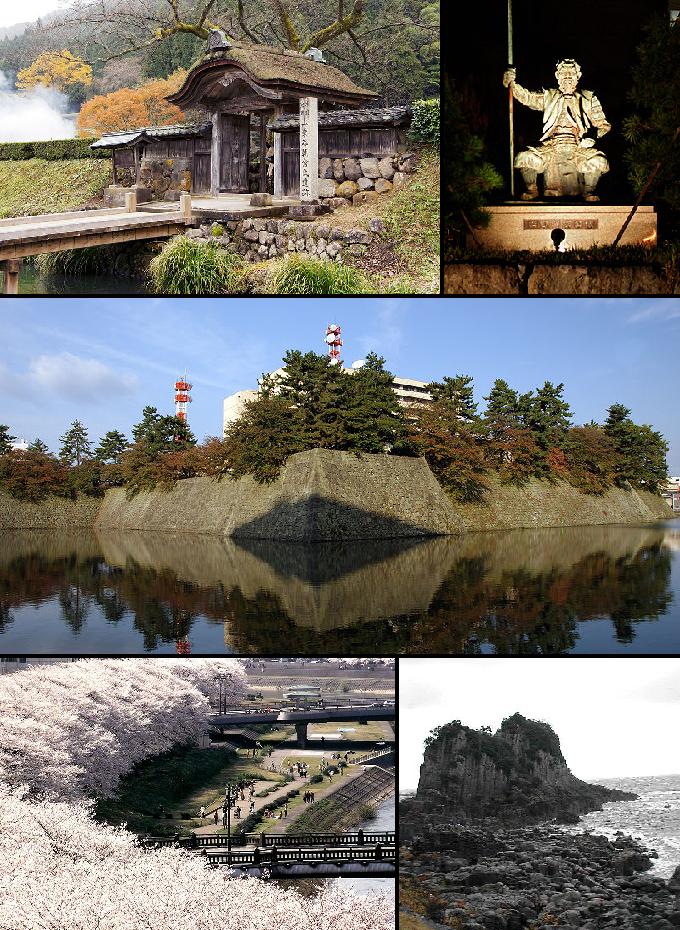
Fukui is a city on Japan’s Sea of Japan coast and the capital of Fukui Prefecture. It sits in the north-central part of the prefecture and functions as its administrative, commercial, and transport centre.
| Essential fact | Detail |
|---|---|
| Place type | City and prefectural capital |
| Country | Japan |
| Region | Hokuriku, on the Sea of Japan coast |
| Role | Government seat, local services hub, and regional market city |
| Known for | Association with coastal climate, mountain access, and a quieter urban scale than Japan’s largest cities |
Where is Fukui, and what is it like?
Fukui lies in a coastal basin between the Sea of Japan and the mountains of central Honshu. That geography matters: the city has access to port routes and marine weather, but it is also shaped by inland rivers, winter snow, and the enclosed feeling common to cities set between sea and hills.
As a prefectural capital, Fukui contains the offices, schools, and services that organise daily life across the region. It is not a global megacity or a major tourist magnet on the scale of Kyoto or Osaka. Its scale is more practical than theatrical, which is often what makes it legible in photographs: streets, riverbanks, rail lines, municipal buildings, and ordinary commercial frontage rather than monumental landmarks.
How did Fukui become important?
The city developed as a regional centre in a historically strategic part of Japan, where transport corridors met a usable coastal plain. Like many Japanese prefectural capitals, its present importance comes less from a single famous monument than from long administrative continuity. The city became the prefecture’s seat and accumulated the institutions that come with that role.
Modern Fukui also reflects the pressures of rebuilding and planning in a country shaped by war damage, earthquakes, and postwar urban change. Much of what is seen today is the result of infrastructure, zoning, and steady redevelopment rather than preserved old-town density. That makes the city useful for photographers interested in surface, repetition, and the ordinary geometry of contemporary Japanese urban life.
What does Fukui look like in practice?
Fukui’s visual character comes from its mix of civic architecture, residential districts, transport infrastructure, and weather. The city is not defined by one single skyline. Instead, it presents a series of modest urban scenes: low to mid-rise blocks, broad roads, river edges, rail crossings, utility poles, and seasonal shifts in light and snow.
For a visual culture reader, that matters because such a place supports work that treats the city as texture rather than spectacle. A photographer can make a convincing portrait of Fukui through surfaces and intervals: concrete, glass, asphalt, signage, bridges, and the soft compression of the built environment against the mountains. In that sense, Fukui is not just a location on a map. It is a setting where the everyday structure of a Japanese regional city becomes visible.
Why does Fukui matter in visual culture?
Fukui matters because many important images come from places that are neither famous nor oversized. Regional capitals often show how a country organizes itself outside its showcase cities, and they offer a clearer view of housing, transit, municipal order, and weathering materials. These are all useful subjects for photography, film, and design research.
When a place like Fukui appears in an article, it usually signals attention to atmosphere, civic space, or the specific conditions of a medium-sized Japanese city. That can include storefront rhythms, empty streets, winter light, and the way local architecture sits inside a landscape shaped by sea and mountain. The city’s value lies in that steadiness: it is a place where the ordinary is easy to see.
Frequently Asked Questions
Is Fukui a city or a prefecture?
Fukui in this entry refers to the city, not the prefecture. It is the capital of Fukui Prefecture, which means the prefectural government is based there. The city shares its name with the prefecture, which often causes confusion.
What region of Japan is Fukui in?
Fukui is in the Hokuriku area on the Sea of Japan side of Honshu. It sits in the north-central part of Fukui Prefecture, between the coast and the inland mountain system. That location gives it a colder, snowier climate than many Japanese coastal cities farther south.
Why might a photographer be interested in Fukui?
Fukui offers the visual conditions of a mid-sized regional city: layered streets, municipal buildings, transport infrastructure, and a landscape shaped by weather. Those elements support photography that focuses on structure, routine, and atmosphere rather than landmarks. The city’s restraint can make small details feel more legible.
At a glance
- Address
- Fukui Prefecture, Japan
- Coordinates
- 36.064056, 136.219583
Articles mentioning Fukui, Fukui