
The Mojave Desert is a high, arid desert region in the southwestern United States, stretching across southeastern California and into southern Nevada, northwestern Arizona, and a small part of southwestern Utah. It takes its name from the Mohave people, whose homeland overlaps the region.
Stories from Mojave Desert
4 stories


About Mojave Desert
- It is the driest of the North American deserts, with rainfall so low that plant and animal life cluster around washes, springs, and mountain edges.
- The landscape is shaped by basin-and-range geology: long mountain chains, broad valleys, dry lake beds, and scattered volcanic fields.
- Joshua trees are the desert’s most familiar plant, though creosote bush, yucca, cacti, and salt-tolerant scrub define much of the ground cover.
- The Mojave sits at a crossroads of ecology, Native history, military testing, mining, tourism, and land art.
Read the full overviewWhat kind of desert is the Mojave?, How is the landscape formed?, Why does the Mojave matter in art and design?, What does the Mojave look like on the ground?
What kind of desert is the Mojave?
The Mojave is a cold desert as much as a hot one. Summer temperatures can be severe, but winter nights fall sharply, and higher elevations can receive occasional snow. That temperature swing matters: it shapes the soils, the water cycle, and the kind of vegetation that can survive there. Life in the Mojave depends on brief windows of moisture, often arriving as winter rain or isolated summer storms.
Its boundaries are often defined by the range of the Joshua tree, a plant that depends on the desert’s specific climate band. Within that band, the land changes quickly. Dry basins flatten into open pans; alluvial fans spread from mountain fronts; and rocky hills break into sparse, pale ridges. The region’s visual identity comes from that sharp contrast between emptiness and abrupt structure.
How is the landscape formed?
The Mojave is part of the Basin and Range province, where the Earth’s crust has been stretched into a sequence of raised ranges and lowered valleys. This tectonic pattern gives the desert its open horizontals and broken mountain silhouettes. Wind and flash flooding then rework the surfaces, cutting arroyos, moving gravel, and leaving fans of sediment where slopes meet the valley floor.
Salt flats, playas, and dry lake beds mark places where water once collected and evaporated. Volcanic cones and lava flows appear in some parts of the desert, adding black rock and rough texture to an otherwise light-toned terrain. For artists, photographers, and architects, the Mojave offers strong spatial cues: distance, glare, shadow, and minimal color.
Why does the Mojave matter in art and design?
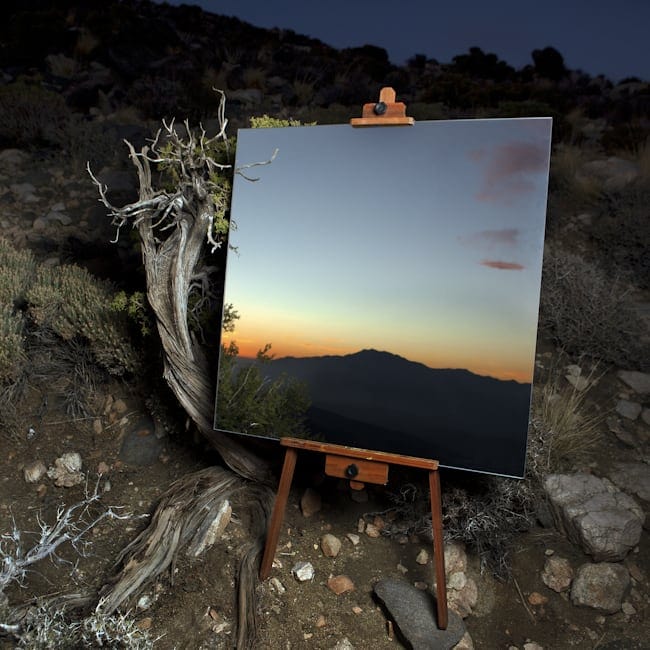
The Mojave has long served as a stage for visual culture because it reduces the scene to essentials. Clear skies, exposed ground, and extreme light make surfaces legible in a way that urban or forested places rarely do. That is one reason the desert attracts photographers, filmmakers, installation artists, and land artists working with scale, reflection, and the horizon line.
It also matters as a site of modern infrastructure and extraction. Mining, rail routes, military test ranges, solar arrays, and highways have all used the desert’s apparent emptiness for large-scale projects. That history complicates any romantic view of the place: the Mojave is not untouched, but heavily worked, mapped, and contested.
What does the Mojave look like on the ground?
On foot, the Mojave often reads as a sequence of textures rather than a single vista. Gravel plains crunch underfoot. Shrubs grow in spaced-out clumps. Salt crust can turn to slick mud after rain, then harden into pale, brittle skins. In shaded drainage lines, the desert may carry more color and density, with mesquite, willow, or seasonal wildflowers appearing where water lingers.
In practical terms, this is a place of extremes and thin margins. Shade matters, as does distance to water and the timing of travel. The same harshness that defines the Mojave also gives it a precise visual order: a landscape where geology, weather, and light are always visible at once.
Frequently Asked Questions
Is the Mojave Desert the same as Death Valley?
No. Death Valley is a basin within the greater Mojave Desert, though it is one of the region’s most famous and extreme environments. The Mojave includes many other landscapes besides Death Valley, from the Joshua Tree region to the high desert around the Nevada border.
Why are Joshua trees linked to the Mojave?
Joshua trees grow in a relatively narrow climate zone that matches much of the Mojave’s elevation, temperature, and rainfall pattern. Their distribution has become a practical marker for the desert itself. Because they are so distinctive in form, they also shape how the region is imagined in photography and design.
Is the Mojave only a natural landscape?
No. The Mojave is also a cultural and industrial landscape with long Indigenous histories and extensive modern use. Military testing, road building, mining, and renewable energy projects have all altered its surfaces and uses. That mix of ecology and development is part of what makes the region important.