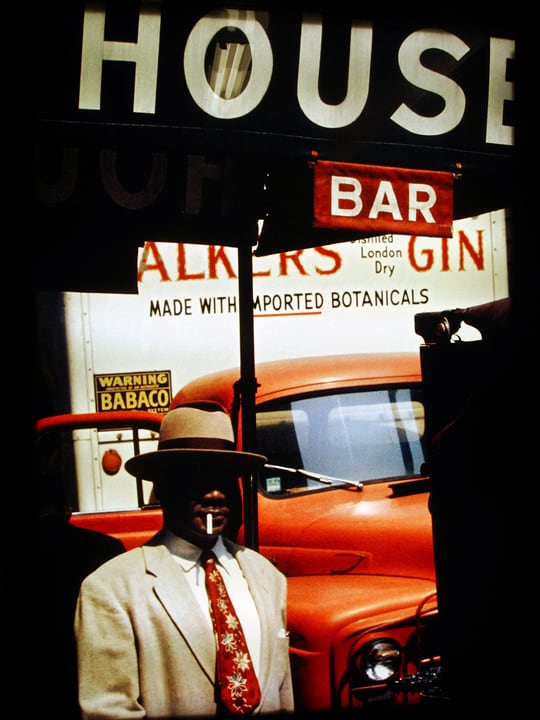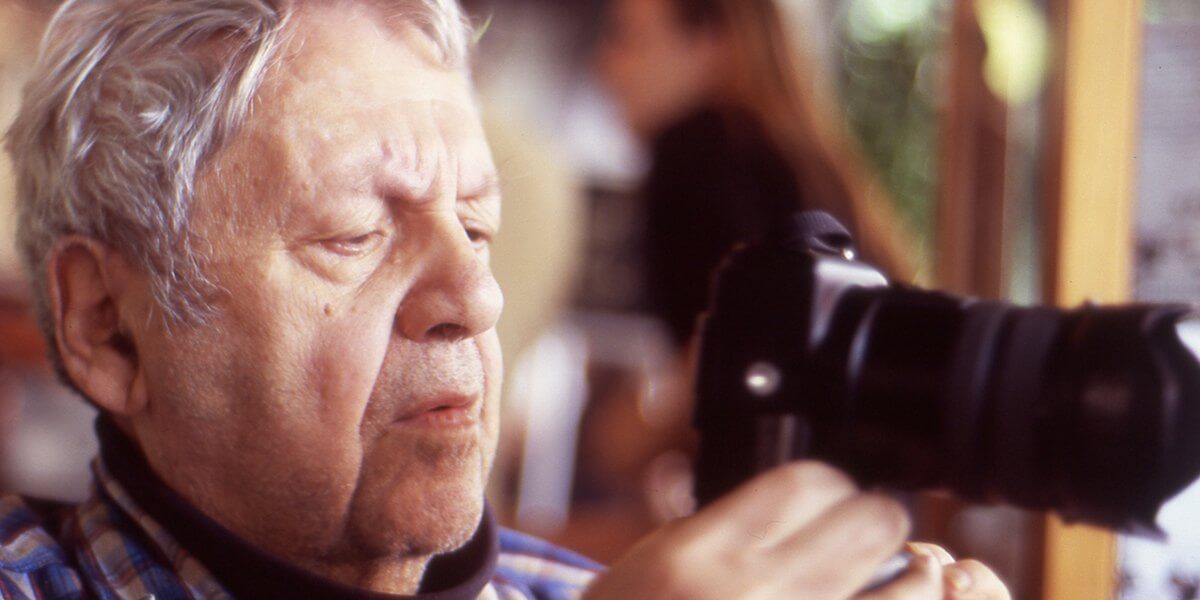
Saul Leiter was an American photographer and painter known for turning the ordinary street into a composition of color, reflection, and partial concealment. His photographs from 1940s and 1950s New York helped shape what later came to be called the New York School, even though his work looked less like reportage than like quietly observed painting.
- Leiter worked across photography and painting, and his images carry a painter’s attention to color, edge, and surface.
- He often photographed through windows, steam, rain, and other obstructions, letting glass and weather break up the scene.
- His New York pictures use close cropping, muted color, and shallow depth of field to make familiar streets feel abstract.
- He became influential later, after decades of relative obscurity, when color street photography gained wider recognition.
What made Saul Leiter’s photographs different?
Leiter’s street photographs do not try to explain the city in a documentary way. They often isolate fragments: a red coat behind a steamed window, a taxi cut off by a frame, a face partly hidden by umbrellas or reflections. That approach gives his work a feeling of seeing by chance, but the results are carefully composed. The eye moves across layers of glass, shadow, and color before settling on a subject.
This use of obstruction was central to his style. Rather than eliminating barriers between camera and subject, he used them as visual material. Rain on windows, condensation, shopfront glass, and reflective surfaces became part of the picture. The technique made daily urban life feel private, fragile, and painterly.
Why is he linked to the New York School?
The New York School was not a formal academy. It was a loose circle of photographers active in mid-century New York who valued personal vision over neutral description. Leiter belonged to that wider current, but his work stood apart because he used color earlier and more fully than many of his peers. At a time when serious photography was still often associated with black and white, he treated color as structure, not decoration.
His images also share the New York School’s interest in improvisation and urban chance. He photographed people on the street, in shops, at bus stops, and in taxis, but he did not aim for the clean legibility of photojournalism. Instead, he looked for visual accidents: a hat brim slicing a face, a smear of red against gray snow, a window frame dividing a scene into abstract parts.
How did painting shape his photography?
Leiter trained and worked as a painter, and that background matters. His photographs often feel built from blocks of tone rather than from clear narrative. He paid close attention to the relation between warm and cool colors, and to the way a small area of bright pigment or fabric can organize an entire frame. That sensibility comes from painting as much as from photography.
The influence runs both ways. His paintings and photographs share a taste for reduction, atmosphere, and incomplete information. In both media, he avoids the obvious center of the image and lets edges carry meaning. This is one reason his work still feels modern: it does not depend on a single decisive subject, but on arrangement, surface, and looking.
What does his work look like in practice?
A typical Saul Leiter photograph from mid-century New York might show a figure crossing a street behind a pane of wet glass, or a taxi seen through fogged-up light. Colors are often restrained but precise: a flash of crimson, the dull gold of a coat, the green of a sign, the soft white of winter light. He frequently uses tight framing, so parts of bodies and objects enter and exit the image abruptly.
The effect is intimate without being sentimental. The city appears crowded, but never fully exposed. Leiter’s pictures suggest that the most interesting parts of urban life happen at the edge of visibility, where reflection, weather, and movement interfere with clarity. That is why his photographs are often discussed not only as street scenes, but as studies in seeing itself.
Frequently Asked Questions
Was Saul Leiter mainly a color photographer?
He is now best known for color photography, especially his early street work in New York. That reputation was slow to develop, because color photography was less respected in fine art circles for many years. He also made black-and-white photographs and worked extensively as a painter.
What subjects did Saul Leiter photograph most often?
He photographed everyday city life: pedestrians, taxis, storefronts, café windows, snow, rain, and commuters. He often focused on small, passing moments rather than major events. The ordinary subject matter is part of why the pictures feel so immediate.
Why does Saul Leiter matter today?
He showed that color, cropping, and obstruction could carry the same seriousness as documentary clarity. Later generations of photographers drew on his way of making the city feel layered and subjective. His work also helped widen the idea of what street photography could look like.
Articles mentioning Saul Leiter