
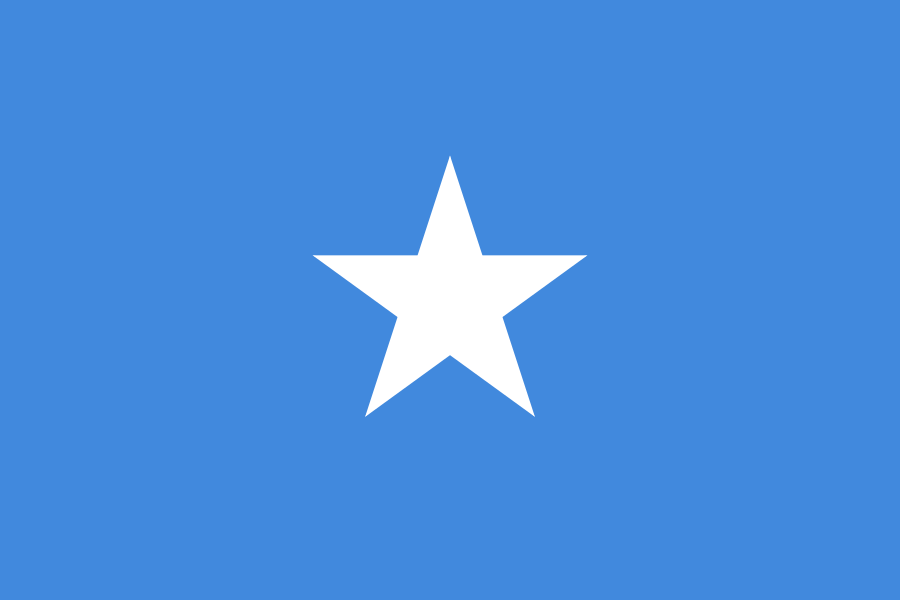
Somalia is a country in the Horn of Africa, on the eastern edge of the African continent, with a long coastline on the Gulf of Aden and the Indian Ocean. It is a place of dry plains, plateaus, and highlands, shaped by hot weather, seasonal monsoon winds, and irregular rainfall. Somalia matters not only as a state but as a maritime and cultural crossroads linking East Africa, the Arabian Peninsula, and the wider Indian Ocean world.
- Capital: Mogadishu
- Region: Horn of Africa, eastern Africa
- Coastline: the longest on mainland Africa
- Languages: Somali and Arabic are official languages; Italian and English also appear in some settings
- Main terrain: plateaus, plains, and highlands
Where is Somalia, and what is it like?
Somalia occupies a strategic position on the Horn of Africa, bordered by Ethiopia, Djibouti, and Kenya, with water on two sides. Its coastline runs for more than 3,000 kilometres, giving the country a major presence on maritime routes that have long connected African, Arab, and Asian ports. The landscape is mostly arid to semi-arid, with sparse vegetation in many areas and more productive zones in the north and along river corridors in the south.
Climate shapes daily life and settlement patterns. Much of Somalia is hot throughout the year, with rainfall that arrives irregularly and can vary sharply from one area to another. Seasonal winds, including the monsoons, affect sea travel, fishing, and trade, which helps explain why ports and coastal towns have been important for centuries.
Why has Somalia mattered historically?
Somalia has long sat inside trading networks that moved frankincense, myrrh, livestock, hides, and later imported textiles, metal goods, and ceramics. Coastal cities and emporia along the Somali shore traded with Arabia, Persia, India, and the Swahili coast, while inland pastoral communities maintained routes tied to camels, water points, and seasonal grazing. This made Somalia both a maritime and a pastoral society, with life organised around movement, exchange, and adaptation to climate.
Islam spread early through the region and became deeply embedded in Somali urban culture, scholarship, and law. The country’s modern history includes colonial partition between Britain, Italy, and France in adjacent territories, independence in 1960, and the later creation of the Somali Republic. Since the collapse of the central government in 1991, Somalia has experienced prolonged conflict and political fragmentation, alongside periods of rebuilding, federal governance, and regional autonomy.
What does Somali culture look like in practice?
Somali culture is often expressed through language, poetry, oral memory, textile use, and architecture adapted to climate and mobility. Poetry occupies an unusually important place in public life, serving political, social, and aesthetic functions. Dress commonly includes loose garments suited to heat, and in many settings fabrics and draped cloth play a central role in everyday appearance.
Craft traditions reflect both nomadic and urban life. Portable shelters, woven mats, leatherwork, metal ornaments, and carved wood appear in different regions, while coastal towns show influences from the Red Sea and Indian Ocean world in building forms and decorative details. In modern cities, Somali visual culture also includes photography, calligraphy, commercial graphics, and fashion that mix local materials with global styles.
How is Somalia seen today?
For many outside observers, Somalia is often reduced to conflict and instability, but that picture misses the country’s deep historical continuity and regional importance. Somalia remains a place of ports, pastoralism, religious learning, and extensive diaspora connections. These links have shaped commerce, family life, and cultural production far beyond the country’s borders, especially in East Africa, the Gulf states, Europe, and North America.
Its long coastline continues to matter for fishing, shipping, and security, while the environment remains fragile because of drought, shifting rainfall, and pressure on land and water. Somalia’s present is therefore best understood as a combination of repair and endurance: a state still being rebuilt, and a society whose cultural forms were never confined by the borders drawn in the 20th century.
Frequently Asked Questions
Is Somalia a desert country?
Not entirely. Much of Somalia is arid or semi-arid, but the country also includes highlands, river valleys, and coastal zones with different conditions. Rainfall is limited and uneven, so vegetation and farming depend heavily on location and season.
Why is Somalia important in trade history?
Somalia’s coastline put it on long-distance maritime routes across the Indian Ocean and the Red Sea. Ports and coastal settlements traded with Arabia, India, and East Africa, moving goods such as frankincense, myrrh, livestock, and imported manufactured items. That trade gave Somali cities cultural diversity and commercial reach.
What languages are spoken in Somalia?
Somali is the main language and one of the official languages, alongside Arabic. English and Italian also appear in education, government, and business in some contexts, especially where colonial history or international ties remain influential. Language use varies by region, generation, and institution.
At a glance
- Address
- Somalia
- Coordinates
- 2.033333, 45.35
Articles mentioning Somalia


