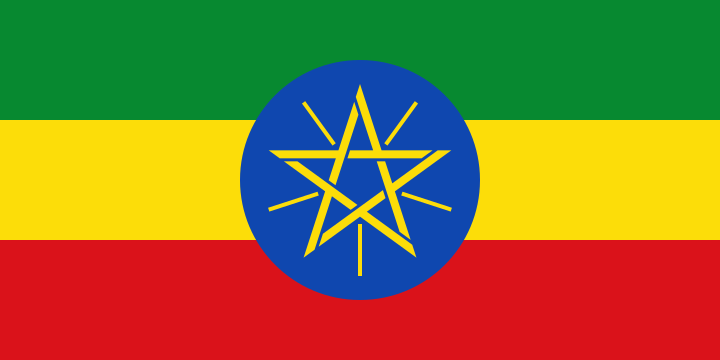
Ethiopia is a country in the Horn of Africa and one of the most historically and culturally distinctive places on the continent. It is a federal state with a large population, a landscape that ranges from highland plateaus to lowland deserts, and a visual culture shaped by long urban traditions, Orthodox Christianity, Islamic scholarship, and many regional communities with their own making practices.
| Essential fact | Details |
|---|---|
| Type | Country |
| Region | Horn of Africa |
| Capital | Addis Ababa |
| Government | Federal democratic republic |
| Languages | Many languages are spoken; Amharic is the federal working language |
| Known for | Ancient Christian heritage, coffee culture, textile traditions, metalwork, beadwork, and diverse regional design practices |
Where Ethiopia sits in Africa
Ethiopia is landlocked, which has shaped its trade routes, politics, and material culture for centuries. Its neighbors include Eritrea, Djibouti, Somalia, Kenya, Sudan, and South Sudan, placing it at a crossroads between the Red Sea, the Nile basin, and East African inland networks. That position helped make it an early center of state formation and long-distance exchange.
The country’s terrain matters to its identity. Highland areas support dense settlement, farming, and historic cities, while lowland regions sustain pastoralist and semi-nomadic lifeways. This geographic variation is visible in architecture, clothing, domestic objects, and the materials people use, from woven grasses and leather to metal and recycled plastic.
Why Ethiopia matters in visual culture
Ethiopia has an exceptionally long artistic record. The churches of Lalibela, the illuminated manuscripts of the Ethiopian Orthodox tradition, and the carved, painted, and gilded objects associated with liturgical life show a sustained craft culture that is not separate from religion but built into it. Crosses, processional objects, book arts, and church textiles remain central to how Ethiopian visual identity is recognized.
Outside sacred settings, Ethiopia is equally important for living craft traditions. Weaving, basketry, pottery, leatherwork, and metal jewellery vary by region and community, and many of these practices are still part of everyday life rather than museum heritage. Contemporary designers and photographers often turn to Ethiopia because it combines deep historical continuity with strong local distinctiveness in dress, adornment, and domestic making.
What does Ethiopian making look like in practice?
Ethiopian textiles are among the country’s best-known visual forms. Cotton cloth, often handwoven on narrow looms, appears in wraps, dresses, shawls, and ceremonial garments. The white cotton shemma, sometimes decorated with colored woven borders, is a familiar example, but textile traditions differ widely across communities and regions. Clothing often signals religion, occasion, status, and place, not just style.
Material culture also includes basketry, clay vessels, carved wood, and recycled-object design. In recent years, artists and community makers have turned scrap metal, plastic, and discarded packaging into jewellery, signage, and decorative forms. That shift does not replace older craft systems; it sits alongside them, showing how Ethiopian visual culture continues to adapt while keeping strong ties to handwork and local identity.
How Ethiopia appears in contemporary photography and design
Photographers often use Ethiopia to explore the relationship between dress, ritual, landscape, and identity. Portrait projects set in Ethiopia tend to focus on textiles, body adornment, painted surfaces, and the way garments carry social meaning. The country’s visual richness makes it a frequent subject for documentary work, but good work resists flattening it into costume or exotic spectacle.
Designers and artists also draw on Ethiopian materials and communities to think about reuse, sustainability, and authorship. When a project involves local makers, the most important details are usually the practical ones: what is woven, hammered, stitched, or assembled; which materials are sourced locally; and how older forms are being adapted rather than simply copied. Ethiopia matters because it offers examples of design that are deeply rooted in place.
Frequently Asked Questions
Is Ethiopia one of the oldest countries in Africa?
Ethiopia is widely associated with deep historical continuity, including early state formation and a long written and religious tradition. It is often described as one of Africa’s oldest independent polities because it was never fully colonized in the same way as many other African states. That history gives it unusual symbolic weight in African and global cultural history.
What crafts is Ethiopia best known for?
Ethiopia is especially known for handwoven textiles, religious metalwork, basketry, leather goods, and pottery. Ethiopian Orthodox crosses, church cloths, manuscript arts, and ceremonial garments are among the most recognizable forms. Many of these crafts remain tied to daily use or religious practice rather than being made only for tourism.
Why do photographers and designers keep returning to Ethiopia?
Ethiopia offers a strong mix of visual continuity and regional variety. Its clothing, body adornment, landscapes, and craft traditions give photographers and designers a rich set of forms to document, interpret, or learn from. The most responsible work treats those forms as living practices shaped by specific communities, not as generic “African” imagery.
At a glance
- Address
- Ethiopia
- Coordinates
- 9.03, 38.74
Articles mentioning Ethiopia