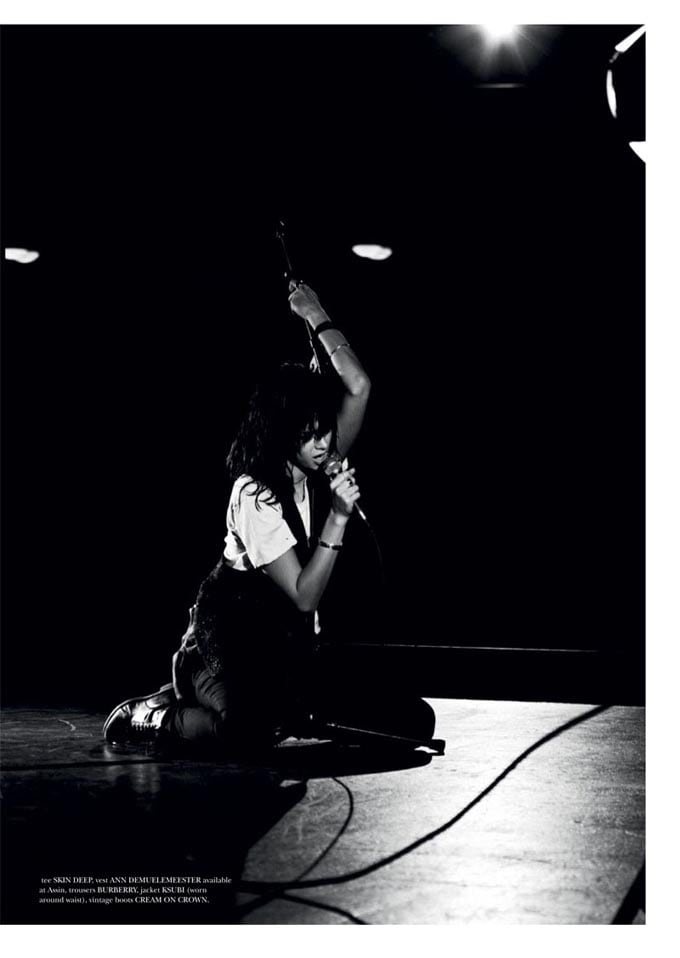
Patti Smith is an American singer, poet, and visual artist whose work fused rock music with spoken word, literary reference, and the raw performance style of 1970s New York punk. She emerged as a defining figure of that scene with her 1975 debut album Horses, and she became widely known for turning songs into vehicles for poetry, autobiography, and political intensity.
- She helped shape the sound and look of New York punk in the mid-1970s.
- Horses mixed garage rock, free verse, and improvisation instead of polished pop structure.
- Her best-known song, “Because the Night,” was co-written with Bruce Springsteen and became a mainstream hit in 1978.
- She also worked as a poet and visual artist, making her practice broader than music alone.
- Her image and writing continue to influence fashion, photography, zines, and editorial culture.
Where did Patti Smith come from?
Smith was born in Chicago in 1946 and raised partly in New Jersey. Before she became a recording artist, she wrote poetry, studied artists and writers, and moved in downtown New York circles where music, performance, and art overlapped. That background matters because her work never separated lyrics from literature or stage presence from visual style.
Her early performances took place in small clubs, galleries, and loft spaces rather than in conventional concert halls. She often performed with minimal framing: a band, a microphone, a loose dress shirt, a jacket, and a delivery that could move from singing to recitation to near-shouting. That stripped-down approach helped define the look of punk before the genre was standardized by labels and magazines.
What made Horses important?
Horses mattered because it rejected the idea that a rock record had to sound smooth or commercially efficient. The album opens with a famous declaration, then moves through songs that use repetition, extended phrasing, and literary allusion. Smith’s voice sits between chant and song, while the guitar work and rhythm section keep the arrangements lean and tense.
Photographer Robert Mapplethorpe’s cover portrait also became central to the album’s legacy. The image presents Smith in a white shirt, jacket slung over one shoulder, looking direct and unguarded. It is a strong example of how her art worked across media: the music, the writing, and the image all reinforce the same sense of independence and ambiguity.
How did she shape punk culture?
Smith influenced punk by expanding what punk could contain. Her work borrowed from Arthur Rimbaud, William Blake, and beat poetry as readily as from garage rock and early rock and roll. That combination gave later musicians permission to treat lyrics as literature and performance as something closer to declaration than entertainment.
She also offered a model of style that was not built around glamour in the usual sense. Her stage clothes, posture, and photographs suggested thrift, speed, and a deliberate refusal of polish. In editorial and fashion contexts, that image has remained useful because it reads as both spontaneous and constructed: a person making a look out of ordinary clothes, not costume fantasy.
What does Patti Smith look like in practice?
In practice, “Patti Smith” often means a particular kind of cultural borrowing: rock songs shaped by poetry, black-and-white photography that emphasizes intensity over perfection, and writing that treats everyday life as material for art. Her performances commonly use repetition, spoken interludes, and abrupt shifts in volume. On the page, her prose and poetry carry the same forward motion.
For designers, photographers, and magazine makers, her influence appears in homages that use plain clothing, severe composition, and a lived-in New York sensibility. A tribute to Smith usually avoids excess and relies instead on posture, type, grainy imagery, and directness. The result is less an imitation of a person than a translation of an attitude into visual form.
Frequently Asked Questions
Why is Patti Smith called the “Godmother of Punk”?
That nickname reflects her role in helping define the artistic language of punk before the genre hardened into a set of clichés. She brought poetry, art-world experimentation, and unvarnished performance into rock at a moment when those worlds still felt separate. The phrase is shorthand, but it points to a real influence on later punk musicians and visual culture.
Is Patti Smith mainly a musician or a poet?
She is both, and her work depends on the overlap. Her songs often read like poems with music attached, while her poetry keeps the momentum and cadence of spoken performance. Treating her as only one or the other misses the way her career was built across disciplines.
Why does she appear so often in fashion and art magazines?
Smith offers a strong visual shorthand for authenticity, rebellion, and downtown culture. Her clothing is simple, her photographs are usually direct, and her image carries the history of New York’s art and punk scenes. Editors return to that look because it is easy to reference, but hard to flatten into a cliché when handled well.
Articles mentioning Patti Smith