
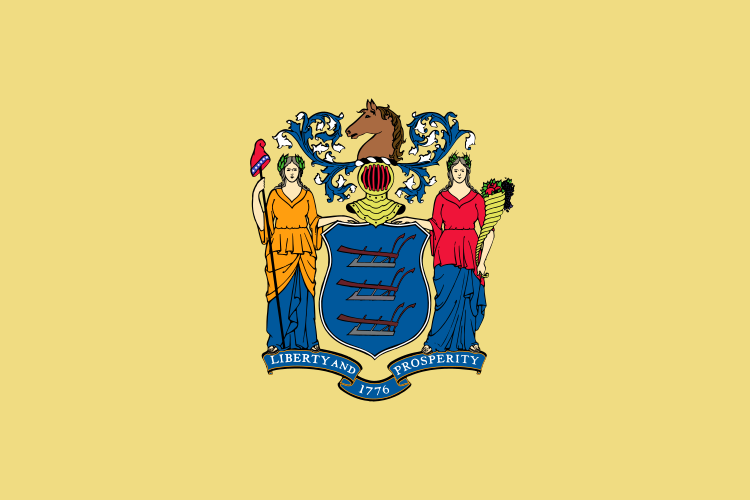
New Jersey is a U.S. state on the Northeast corridor, wedged between New York City and Philadelphia and edged by the Atlantic Ocean. Its small size and dense population have made it a place of ports, suburbs, industry, warehousing, transit routes, and highly varied built environments, from shore towns and pine barrens to commuter towns and freight landscapes. For visual culture, it matters because so much production, distribution, and movement passes through it.
- One of the smallest U.S. states by area, but one of the most densely populated.
- Shaped by two major metropolitan regions: New York City to the northeast and Philadelphia to the southwest.
- Known for a mix of coastline, marsh, forest, suburbs, industrial corridors, and transport infrastructure.
- Frequently appears in design and lifestyle work as a site of manufacturing, logistics, and commuter culture.
- Its landscape often reads as layered rather than singular: shoreline, highway, rail, warehouse, and neighborhood sit close together.
What makes New Jersey distinct?
New Jersey’s defining trait is concentration. People, roads, rail lines, ports, and buildings cluster tightly across a relatively small area, so the state often feels less like a single visual type than a compressed version of the eastern seaboard. It contains high-rise waterfronts, old industrial cities, colonial-era towns, planned suburbs, farmland, and protected ecological zones such as the Pine Barrens.
That density shapes daily life and visual culture. Materials arrive quickly, goods move fast, and architecture often has to serve multiple pressures at once: land is expensive, circulation matters, and buildings are frequently adapted rather than isolated on large plots. The result is a landscape where the practical and the improvised sit side by side.
Why does New Jersey matter in design and culture?
New Jersey matters because it sits in the working space between major cultural centers. It supports the movement of people and goods into New York City and Philadelphia, and that infrastructure has long influenced what gets built there. Warehouses, terminals, offices, shopping centers, distribution parks, and commuter rail stations all leave a strong mark on the state’s visual identity.
The state also has a long industrial history. Manufacturing, chemical production, shipping, and printing helped shape its economy and its architecture, especially in older urban areas along the Hudson, Passaic, and Delaware rivers. In contemporary work, New Jersey often appears as a place where design has to accommodate speed, storage, access, and scale rather than spectacle alone.
What does New Jersey look like on the ground?
It can look like many different places within a short drive. Near the Hudson River, the state presents dense apartment blocks, ferry terminals, and skyline views across from Manhattan. In the center and south, there are low-rise suburbs, strip malls, campuses, and industrial estates. Along the coast, boardwalk towns and beach houses create a more seasonal, recreational image.
Materials and forms are often ordinary but telling: brick rowhouses, concrete retaining walls, salt-weathered timber, asphalt lots, chain-link fencing, glass office parks, and the steel systems that support bridges and rail. This is part of the state’s appeal for photographers and designers. It offers a compressed study of American infrastructure and habitation rather than a single postcard scene.
How does its geography shape everyday life?
New Jersey’s geography encourages movement across borders. Many residents commute into neighboring cities, while others work in logistics, healthcare, education, and manufacturing within the state itself. The road network, toll bridges, tunnels, and rail lines are not just background; they structure how neighborhoods develop and how businesses locate themselves.
The Atlantic coast also gives the state a second identity. Shore communities depend on tourism, seasonal trade, and weather patterns, which produces a different visual language from inland New Jersey. That contrast between transit-heavy interior zones and leisure-oriented coastlines is one reason the state resists easy summary.
Frequently Asked Questions
Is New Jersey only a suburb of New York City?
No. Parts of the state function as suburbs or commuter territories for New York City and Philadelphia, but New Jersey also has its own cities, industries, campuses, coastlines, and rural landscapes. Newark, Jersey City, Paterson, Camden, Trenton, and Atlantic City each have distinct urban histories and forms. The state is better understood as a dense network of overlapping regions than as a single suburb.
Why do designers and artists pay attention to New Jersey?
Because it concentrates many forms of American infrastructure in one place. Ports, freight yards, highways, older industrial buildings, and layered suburban development create a rich field of surfaces, signs, and spatial problems. Artists and designers often use that complexity to examine labor, mobility, reuse, and the aesthetics of ordinary built space.
What kind of landscapes is New Jersey known for?
New Jersey is known for variety: beaches, barrier islands, wetlands, forests, farmland, suburbs, and industrial corridors all sit within the state’s borders. The Pine Barrens are one of its most recognizable natural landscapes, while the Hudson waterfront and the Atlantic shoreline are two of its best-known urban and recreational edges. That range is a major part of the state’s identity.
At a glance
- Address
- United States
- Coordinates
- 40, -74.5
Articles mentioning New Jersey


