

Tim Storrier keeps sending one man into the empty desert. He wears a pale suit and a hat, and he carries almost everything he owns. Paint boxes, rolled canvases, a palette and a water bag hang from his body. The figure has followed the artist since he first won the tim storrier archibald prize.
The wanderer is Storrier, more or less. The Australian painter has been walking him across plains under huge skies since at least 2011. Most of what the paintings say about the artist is in the load he carries.
A self-portrait without a face
The wanderer made Storrier’s name a second time. In 2012 he won the Archibald Prize, Australia‘s best-known portrait award, with The histrionic wayfarer (after Bosch). The Art Gallery of New South Wales lists him as that year’s winner.
The painting is a faceless self-portrait, with a sitter who has no face. Storrier took the idea from The Wayfarer, a work by Hieronymus Bosch from around 1510. Bosch’s traveler may be choosing a road, or he may be a prodigal son coming home.
Storrier replaced Bosch’s pack with a painter’s kit and added a dog. He argued that clothes and equipment can identify a person as well as a face can. That idea carried the tim storrier archibald prize entry. A small sketch of his real face sits on a scrap of paper that blows away in the wind.
A life-size bronze of the wayfarer now stands on the campus of Bond University in Queensland. The same figure has walked through the paintings ever since.
Before the tim storrier archibald prize
The year before the win, Storrier’s Archibald entry was Moon boy (self-portrait as a young man). It showed an empty suit standing in a bare landscape. The Archibald entries show he had already begun testing how much a painting can say without a face.
Storrier’s landscapes share a dreamlike edge with Australian artist’s otherworldly sci-fi landscapes with nostalgia, a useful comparison for anyone drawn to his strange, empty skies.
Titles that give the joke away
Read his titles and a running joke appears. A dauber is an old word for a poor painter, someone who slaps paint on without care. Speed Dauber shows the wanderer in a hurry.
The Splotcher, which appears in the early 2020s, goes further. This faceless painter wears a pointed red dunce cap and pushes ahead with a brush held out in front of him. Many viewers read him as a stand-in for Storrier, the tim storrier archibald prize winner.
Storrier returns again and again to the word impedimenta. It is Latin for baggage, especially the heavy kind an army hauls behind it. His hero is a clumsy painter buried under his own gear, walking toward a destination he never reaches.
Storrier’s own notes place the wanderer in older company. He cites Atlas holding up the sky, Sisyphus and his boulder, and the swagman tramping the Australian bush. He does not present the figure as grand. In his notes he writes, “I may be painting pre Modernist pictures, maybe, I hope so.”
Where the wanderer goes missing
In many of the paintings, the man never appears at all. His belongings remain, set down in the desert as if he stepped out of frame and might return in a minute.
When the wanderer vanishes and only his belongings remain, the question of what a picture withholds becomes central, much like in Philadelphia gallery’s unreadable art on perception, which explores meaning viewers cannot easily pin down.

In The Ulster Lounge, a green tufted sofa sits alone on a flat plain. A sky fills most of the canvas. No one is coming to sit on it.


In Equine Impedimenta (Tully’s Baggage), a horse stands almost buried under a pile of bundles. The luggage made it into the picture. The painter does not.

The Arcadian Repose, painted in 2015 and 2016, is the largest work in this group at three meters across. The baggage has been dropped and now lies everywhere. Papers, tools, a chair and scraps of paper lift off across the sand. A later work, Notes from the Arcadian Repose, is a strip three meters long that adds an old television test pattern to the debris.

Some of the work moves away from the desert altogether. The Celestial Bowl, a small painting from 2023, shows a dish holding a sky full of stars. It is one of the few still lifes in his output, and it has no wanderer in it.


Fire came first
The wanderer arrived after fire. Storrier built his early reputation on burning lines. In remote parts of the outback, he strung rope or wire between two posts, set it alight and painted the glowing line against the evening sky.
He photographed those scenes as well, and the photographs stand as works in their own right. Burning ropes and logs remain a hallmark of his work. They also drift into the newer paintings, often beside floating fragments of scorched paper.

Storrier was born in Sydney in 1949. He won the Sulman Prize in 1968, at age 19, and won it again in 1984. He received an Order of Australia (AM) in 1994.

Records disagree on where he lives. A 2012 gallery record gives Bathurst as his base. His current gallery biography places him in Bowral, New South Wales, in the Southern Highlands. He was 77 in 2026, and a 2025 Brisbane show added pelicans to his cast of recurring characters.

Collections include the Metropolitan Museum of Art in New York, the National Gallery of Australia and the Art Gallery of New South Wales. Philip Bacon Galleries in Brisbane and Australian Galleries in Sydney represent him. Limited edition prints and small bronzes are sold through his own site.
The sources for this profile are Storrier’s gallery records, the Art Gallery of New South Wales and Inspiration Grid. Together they show a painter who uses a faceless traveler to question what identity means. The wanderer keeps walking because the question has no finish line.

Source: mossandfog.com
Frequently asked questions
What prize did Tim Storrier win in 2012 with his wayfarer painting?
Tim Storrier won the Archibald Prize in 2012 with The histrionic wayfarer (after Bosch). The article describes it as Australia’s best-known portrait award.
Why is Tim Storrier’s Archibald Prize-winning self-portrait faceless?
Storrier argued that clothes and equipment can identify a person as well as a face can. That idea is the basis of the faceless self-portrait, which shows a sitter with no face.
What older artwork inspired Tim Storrier’s wayfarer figure?
Storrier based the figure on The Wayfarer, a work by Hieronymus Bosch from around 1510. He replaced Bosch’s pack with a painter’s kit and added a dog.
More in
Art
All Art


More like this

Solstice and Equinox
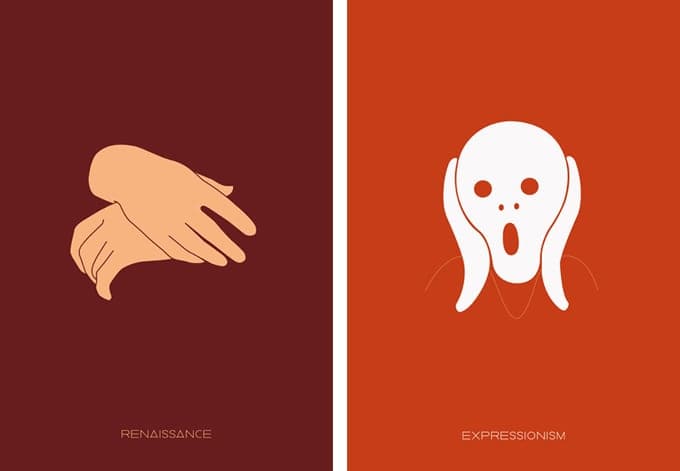
Minimalistic Posters Of Major Art Movements

Astonishing Paper Sculptures of Jean-François Glabik

Language Beyond Speech: At The Polish Pavilion, Sound And Movement Construct Narrative

Dustin Yellin's Enigmatic Glass Sculptures Fuse History and Fantasy in Brooklyn Studio
